Google Releases Gemini 4 Carbon: Significant Leap in Cybersecurity Capabilities

Google releases Gemini 4 Carbon, highlighting gains in coding, agentic, and cybersecurity capabilities.
Google has officially launched its frontier model Gemini 4 Carbon, claiming significant improvements in coding, agentic tasks, and cybersecurity. It ranks first on the Artificial Analysis Intelligence Index (v5.0), with Claude Opus 5.5 and GPT-6 Astra close behind, indicating a narrowing gap among leading models. The article argues that pairing cybersecurity with coding and agentic tasks reflects security becoming a main track for frontier models, and that autonomous agent execution is naturally coupled with security scenarios. However, the announcement did not disclose specific scores, the size of the lead, pricing, or availability timeline, making migration decisions difficult for enterprises. The author advises developers and security teams to watch for follow-up technical details and third-party evaluations rather than judging solely by rankings.
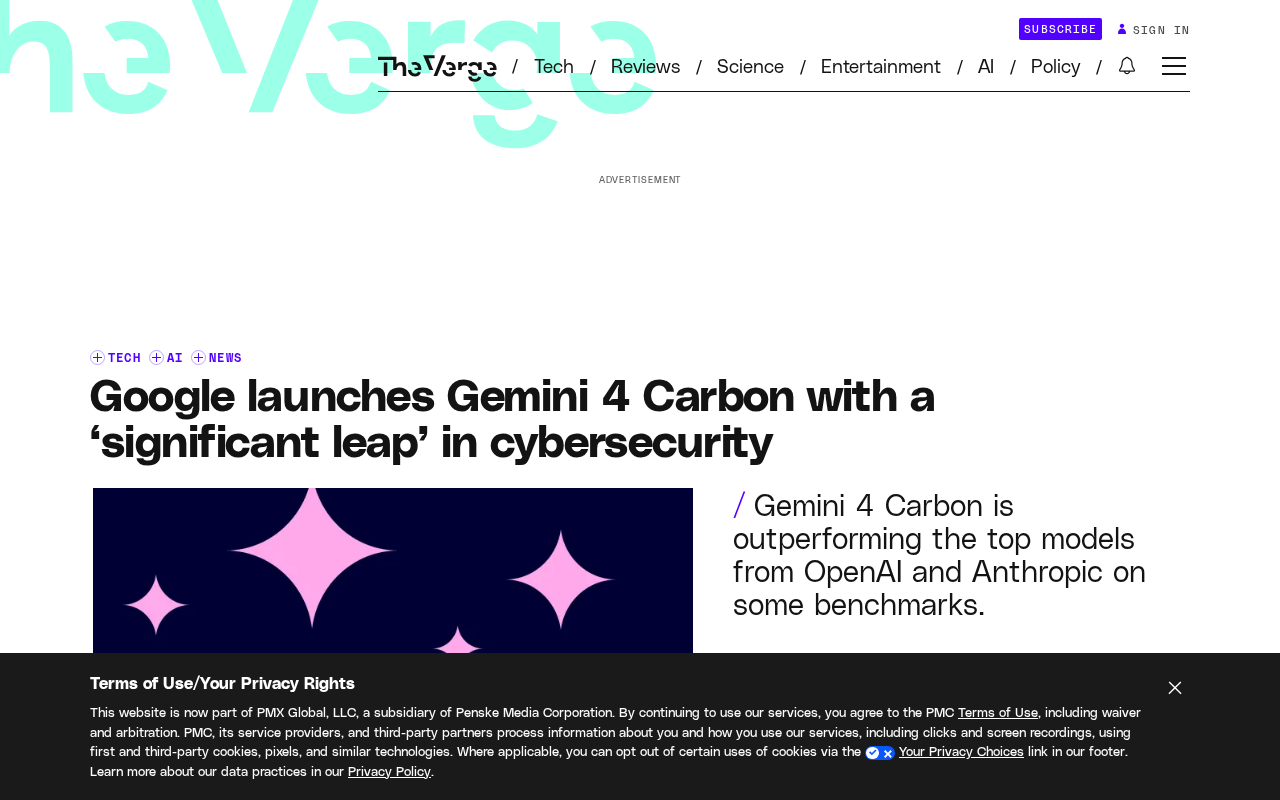
Google has officially launched its latest frontier model, Gemini 4 Carbon, which the company says delivers "significant improvements" in coding, agentic tasks, and cybersecurity. The release signals that competition among frontier models is shifting from general capabilities toward harder-edged dimensions such as security and automated execution.
1. Topping the Benchmark, but the Margin Remains an Open Question
According to Google's announcement, Gemini 4 Carbon ranks first on the Artificial Analysis Intelligence Index (v5.0) benchmark, with Claude Opus 5.5 and GPT-6 Astra close behind. This ranking is an important market signal for Google—in the back-and-forth race among frontier models, the top spot often directly influences developer choices and enterprise procurement decisions.
However, the original information did not disclose specific scores or the size of the lead. For readers focused on differences in model capability, a simple ranking order only shows "who is ahead," not "by how much." When evaluating whether a model is worth migrating to, this is a key information gap that requires additional verification.
Artificial Analysis Intelligence Index is a composite evaluation index maintained by the independent analysis firm Artificial Analysis. It aggregates scores from multiple public benchmarks (covering dimensions such as reasoning, coding, math, and instruction following) into a single weighted score, and updates weights and question sets with version iterations (such as v5.0 mentioned in the article). Because it does not rely on a single vendor's self-assessment, it is often used by developers as a reference for cross-model comparison. However, the aggregate index itself has limitations: weight choices can amplify or mask differences in specific capabilities, and benchmark questions may already be covered by model training data. Therefore, a high ranking does not equate to better performance in real business scenarios, and judgment still needs to be combined with third-party evaluations for specific tasks.
2. Why Cybersecurity Became a Keyword in This Release
In its announcement, Google placed cybersecurity alongside coding and agentic tasks as a core improvement area for Carbon. This wording deserves unpacking: security capability is shifting from an "add-on" to a "main track" in frontier model evaluations, because models are increasingly used in scenarios such as code auditing, vulnerability analysis, and automated defense.
The Intersection of Agentic Capabilities and Security Scenarios
There is a natural coupling between agentic tasks and cybersecurity. A model capable of autonomously executing multi-step operations may be used in security scenarios for automated threat detection, but it may also introduce new attack surfaces. Google emphasizing both in the same release suggests that Carbon's capability improvements are not isolated technical metrics but overall optimization for real deployment scenarios.
Agent capability generally refers to a model's ability, once given a goal, to autonomously plan steps, invoke external tools (such as code execution environments, browsers, and APIs), and adjust its strategy based on intermediate results to complete multi-step tasks. Related evaluations often focus on task completion rate, tool-call accuracy, and the stability of long-chain reasoning. In the context of cybersecurity, the autonomous execution characteristics of agents mean they can be used for automated vulnerability scanning, log analysis, and incident response, but may also be abused to probe and exploit attack surfaces. Therefore, when vendors emphasize improvements in agentic capabilities, they usually need to explain permission boundaries, sandbox mechanisms, and abuse protection strategies at the same time. This is also an important dimension for assessing whether such models are suitable for production deployment.
Continued Investment in Coding Capabilities
Coding capability is another area highlighted. For frontier models, code generation quality directly determines their usability in developer toolchains and indirectly affects performance on security auditing tasks. Google mentioning it alongside security aligns with the overall landscape in which model vendors are competing around the developer ecosystem.
Code generation quality is typically measured in the industry through benchmarks such as SWE-bench (fixing issues in real repositories) and HumanEval (function-level generation), supplemented by human preference evaluations. For security auditing tasks, models not only need to write runnable code but also understand cross-file call relationships and identify potential injection points and insecure dependencies, which places higher demands on context window length and static analysis capabilities. This is also why coding capability and security capability are often promoted together by vendors: both share the underlying ability to understand code semantics, and improvements in coding capability can often transfer to tasks such as vulnerability identification. However, the transfer effect still needs to be verified through targeted evaluations.
3. Information Gaps and What to Watch
The information in this announcement is relatively limited. The original text mentions that Carbon has "improved" over its predecessor, but the specific magnitude of improvement, the boundaries of applicable scenarios, and the evaluation methods for security capabilities are not elaborated. In addition, the announcement does not mention the model's pricing, release method, or availability timeline—precisely the practical factors enterprise users care about most.
From a competitive landscape perspective, Claude Opus 5.5 and GPT-6 Astra follow closely on the leaderboard, indicating that the gap between leading models continues to narrow. Whether Gemini 4 Carbon can translate its benchmark ranking into actual user growth depends on more detailed technical disclosures and genuine third-party evaluations.
For developers and security teams, the reasonable approach at this stage is to follow official follow-up evaluation details and access methods rather than making migration decisions based solely on rankings.
One-line Summary
Google releases Gemini 4 Carbon, highlighting improvements in coding, agentic, and cybersecurity capabilities.
Paragraph Summary
Google has officially launched its frontier model Gemini 4 Carbon, which the company says delivers significant improvements in coding, agentic tasks, and cybersecurity. The model ranks first on the Artificial Analysis Intelligence Index (v5.0), with Claude Opus 5.5 and GPT-6 Astra close behind, showing that the gap between leading models continues to narrow. The article argues that placing cybersecurity alongside coding and agentic tasks reflects security capability shifting from an add-on to a main track for frontier models, and that there is a natural coupling between autonomous agent execution and security scenarios. However, the announcement did not disclose specific scores, the size of the lead, pricing, or availability timeline, making it difficult for enterprise users to make migration decisions based on it. The author recommends that developers and security teams focus on subsequent technical details and third-party evaluations rather than judging solely by rankings.
Related articles

Why Does Self-Play AI Always Get Crushed by Cheap Units? An RTS Developer's Account of the Dilemma
An independent developer trained an RTS commander AI with pure self-play, only to find it dominated historical versions but was crushed by human players using cheap tier-1 units. This article analyzes the causes of self-play strategy collapse, explores solutions such as exploiters, diversity rewards, and reward design, and introduces the open Bot Kit and AI league plan.
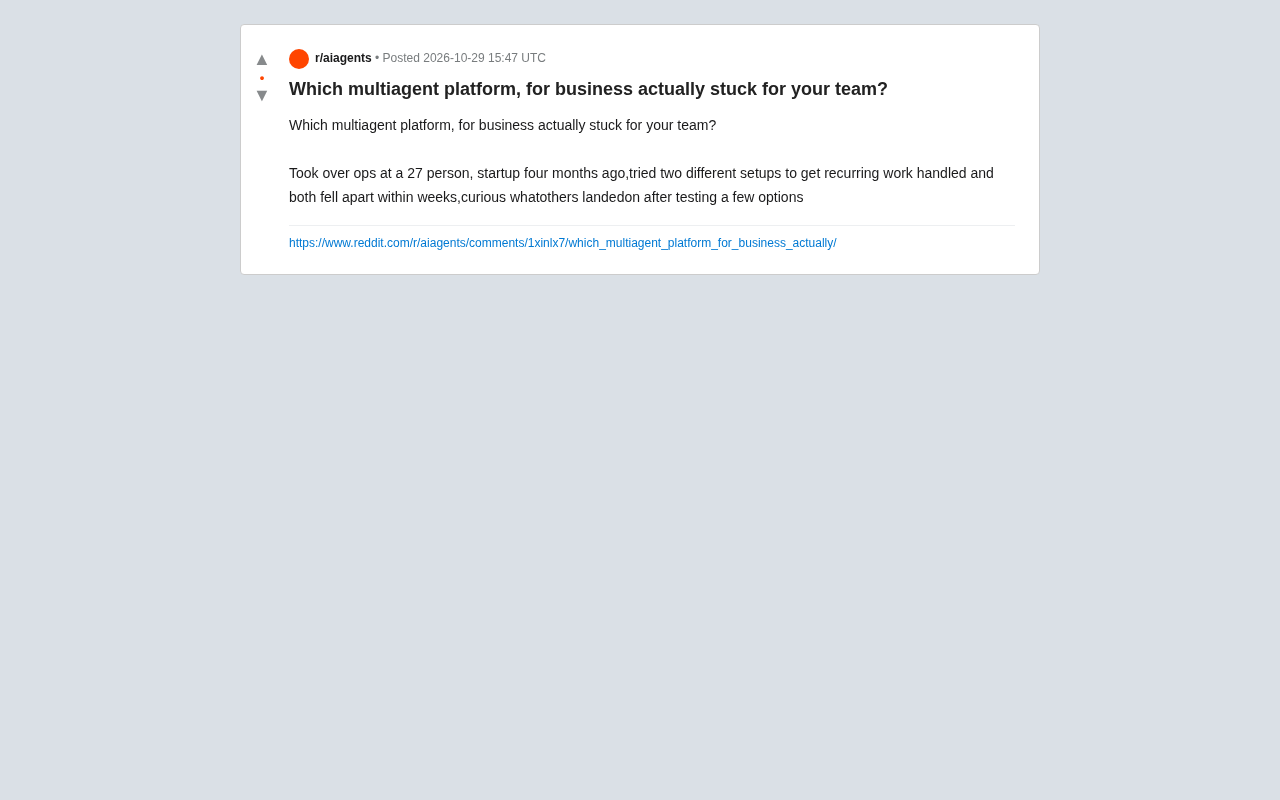
Which Multi-Agent Platform Wins? A Small Team's Battle Scars and Selection Considerations
A 27-person startup's ops lead tried two multi-agent platforms in four months and both failed. This article analyzes why small-team deployments break down, and offers selection guidance on integration depth, observability, and progressive rollout.

Thrive Holdings Takes ADT Private in $7.6 Billion Deal
Thrive Holdings acquires ADT for $7.6 billion in an all-cash take-private deal expected to close in Q1 2027. Analysis of the deal structure, ADT's asset value, and impact on the smart home security industry.