Google Releases Gemini Omni 1.2 Flash: 15-Second Videos and Conversational Editing
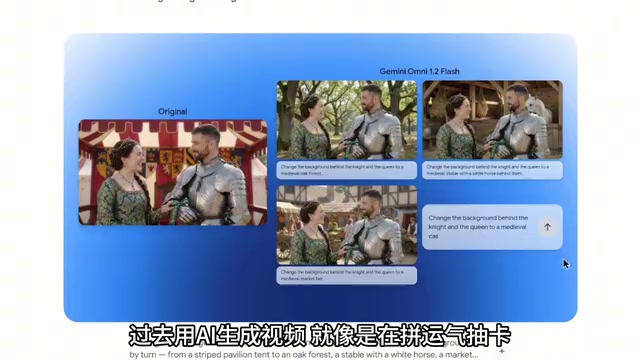
Google releases Gemini Omni 1.2 Flash, focusing on controllability, multi-turn editing, and low-cost mass production.
Google launches the multimodal video generation model Gemini Omni 1.2 Flash, shifting away from cinematic spectacle to focus on controllability, editing efficiency, and cost. Native video duration increases from 10 to 15 seconds with 1-second precision control from 3 to 15 seconds. The core capability is multi-turn conversational editing, allowing users to replace local elements like sky or clothing while preserving camera movement and subject structure. Multimodal references accept character photos, product detail images, 3-second videos, and audio, maintaining face, texture, and brand color consistency during 360-degree rotations—directly addressing e-commerce and advertising pain points. Cost-wise, it supports low-resolution drafts with on-demand high-resolution rendering, cuts API prices by 30% to about $0.07 per second at 720P, and integrates SynthID invisible watermarks. The article positions it as an efficient, mass-producible pipeline tool, with complex physics and high-dynamic scenes still being iterated.
Google has officially launched its multimodal video generation model, Gemini Omni 1.2 Flash. Unlike the industry's single-minded pursuit of cinematic visual spectacle, this update focuses squarely on the most vexing challenges in putting AI video into practice: controllability, editing efficiency, and cost.
Technical Specs: Dual Gains in Duration and Controllability
The previous generation, Omni 1.1, had a native video duration cap of 10 seconds. Omni 1.2 Flash extends the native single-clip duration to 15 seconds and supports precise control from 3 to 15 seconds in 1-second increments. This means creators can express a complete knowledge point in a single generation without having to stitch clips together frequently.
The more core update lies in multi-turn conversational editing. In the past, generating video with AI was more like drawing from a gacha: a slight change to the prompt could completely alter faces or scenes. With Omni 1.2 Flash, users can fine-tune as if conversing with an editor: after generating a video, simply input "change the sky in the background to a sunset glow" or "put the protagonist in a white shirt," and the model will replace local elements while preserving the original camera movement and subject structure. Traditional one-shot full regeneration thus becomes progressive fine-tuning.
The technical prerequisite for multi-turn conversational editing is the model's "addressable" structured understanding of video content: it needs to separate and represent elements such as characters, background, lighting, and camera motion in latent space, and in subsequent turns rewrite only the specified regions while keeping the rest consistent. Such capability typically relies on "reference frame locking" and cross-turn latent variable caching, so that each edit is based on the previous generation result rather than recalculating from scratch from the prompt. In contrast, early text-to-video models mostly used one-shot diffusion sampling, where any change to the prompt would alter the evolution path of random noise, making local fine-tuning difficult. The difficulty of local editing also lies in spatiotemporal consistency: replaced elements must maintain deformation continuity and shadow matching in subsequent frames, otherwise flickering and jumps will occur.
Multimodal References and Consistency Control
The new version enhances multimodal reference instruction capability, allowing simultaneous input of character photos, product detail images, dynamic video clips up to 3 seconds, and even audio prompts. In actual tests, the model can maintain character faces, clothing textures, and even text and brand standard colors on product packaging without deformation or garbled text during 360-degree camera rotations.
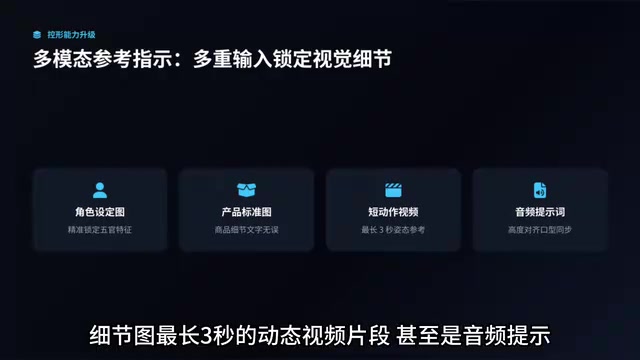
This capability directly addresses pain points in e-commerce and brand advertising scenarios. In the past, when AI generated product videos, blurry or altered logos were almost a common problem; with multi-image references and consistency control, the usability of virtual clothing try-on and 360-degree product displays has improved significantly.
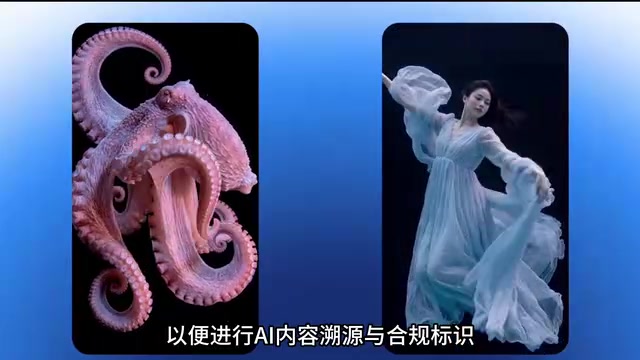
SynthID is an invisible watermarking scheme proposed by Google DeepMind. It embeds statistical features directly into the pixels or audio waveforms of generated content, which are imperceptible to the human eye but can be detected by a dedicated detector to determine whether content was generated by the corresponding model, and it has a certain robustness against common cropping, compression, and scaling. Unlike adding visible logos or metadata labels, invisible watermarks may still be detected after content is screenshotted, transcoded, and redistributed, making it one of the main technical means for AI content provenance and platform compliance. It should be noted that watermark detection requires the model provider to open detection interfaces, and cross-platform mutual recognition is still in progress, which also means that a single vendor's watermark cannot solve the problem of provenance across the entire internet.
Cost Strategy: Draft and Render Separation
Changes on the cost side are equally noteworthy. Users can quickly iterate drafts at 360P or 720P, adjust details through conversation until satisfied, and then render to 1080P or 4K with one click. API call pricing has also been reduced by 30%, with 720P dropping to about $0.07 per second. This "cheap drafts + on-demand high-quality rendering" workflow significantly lowers the overall cost of industrial-scale batch video generation.
In addition, the new version optimizes generation alignment, improves lip-sync performance, and continues to integrate SynthID invisible watermarks in all output videos for AI content provenance and compliance labeling.
The cost of generative video is mainly determined by the number of inference steps in diffusion sampling and the output resolution. The pixel count of video grows quadratically with resolution: a single 1080P frame has about 2.25 times the pixels of 720P, and 4K is about 9 times that of 720P. Multiplied by the number of frames and denoising steps, compute costs escalate rapidly. Therefore, the layered workflow of "low-resolution drafts + high-resolution final renders" yields significant engineering benefits: concentrating repeated trial-and-error iterations at the cheap tier and consuming expensive rendering only once the plan is finalized. Per-second API pricing also encourages teams to spend budget on final delivery clips rather than intermediate experimental clips.
Application Scenarios and Industry Positioning
In actual creation, short video matrices and explainer videos are direct beneficiaries. A 15-second continuous shot is just right to convey a knowledge point or a product's core selling point. Combined with conversational editing, marketing teams can generate advertising variants in different languages and styles for the same set of videos at extremely low cost.
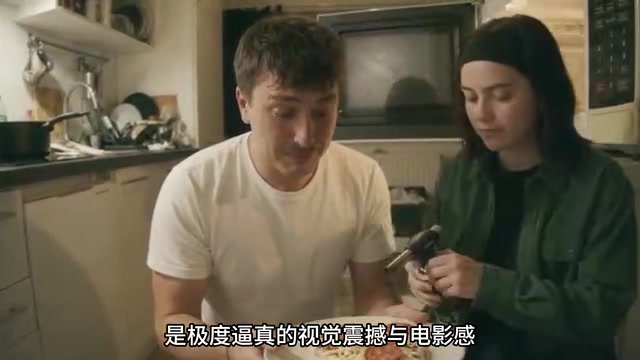
From an industry standpoint, if some large models emphasize extremely realistic visual spectacle and cinematic feel, Gemini Omni 1.2 Flash positions itself more like an efficient, practical, mass-producible pipeline tool, solid in generation speed, call cost, multi-turn controllability, and engineering deployment.
Objectively, there is still room for improvement. Official documentation shows that rendering performance is still being iterated for scenarios involving high-intensity complex physics simulations and highly dynamic sports competitions. At the same time, it mainly addresses native clip generation and editing; post-production subtitle attachment and multi-platform aspect ratio cropping still require existing video post-production software. For teams hoping to incorporate AI video into their production workflows, this pragmatic positioning is actually more appealing.
Background Notes
Lip-sync and audio-driven video typically rely on phoneme-level alignment: the system first transcribes speech into a phoneme sequence and extracts temporal features, then aligns facial parameters such as mouth opening and jaw movement with phoneme boundaries frame by frame, and finally constrains the reconstruction of the mouth region during video generation. Compared with pure visual generation, such tasks have extremely low tolerance for temporal precision; a deviation of tens of milliseconds can create an obvious "dubbed" feel. This also explains why support for audio reference input is particularly critical for explainer and digital human broadcast videos—it moves the consistency between sound and picture from manual post-production alignment forward to the generation stage.
Related articles
 Tech Frontiers
MuJoCo: An Analysis of DeepMind's Open-Source General-Purpose Physics Simulator
An in-depth analysis of Google DeepMind's open-source physics simulator MuJoCo: high-performance C++ kernel, MJCF modeling format, contact solving principles, MJX GPU acceleration, and robot reinforcement learning use cases.
 Tech Frontiers
Claude API Quick Start: The Official Quickstarts Project Collection
Anthropic's official claude-quickstarts project collection helps developers quickly build deployable apps with the Claude API. Nearly 20k stars, Python-based, great for beginners and prototyping.
 Tech Frontiers
AI Agents Connecting Directly to APIs: Which Calls Can Be Safely Allowed?
AI agents can call any API, but the real challenge is deciding which calls can be safely allowed. This article analyzes allowance decisions from three dimensions—intent matching, least privilege, and controllable impact—and argues that the control layer should sit outside the agent, combined with audit traceability to build a trustworthy API call governance mechanism.