Google Takes AI Search Ads Global as Core Advertising Growth Slows
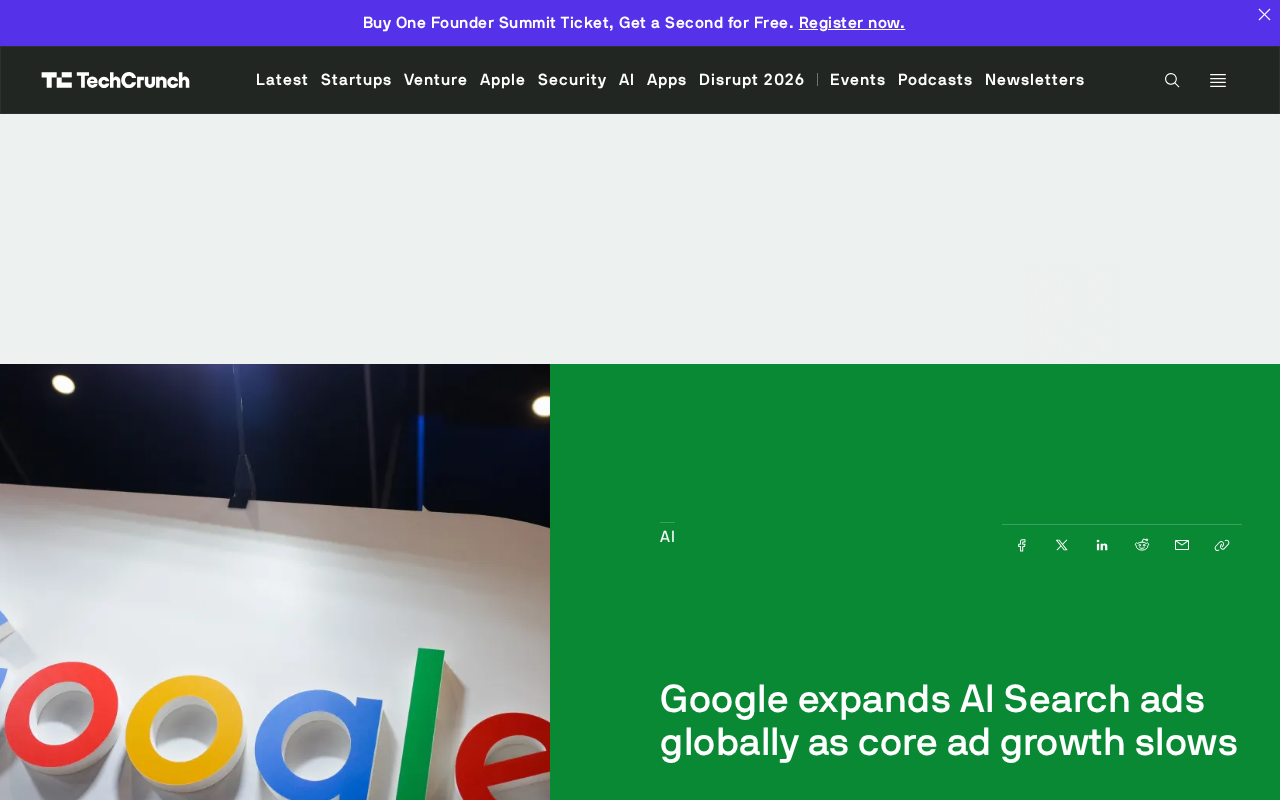
Google takes AI search ads global to counter slowing growth in core search advertising.
Alphabet's Q3 revenue grew 25% to $127.6B, but traditional search ad growth is slowing. Google is expanding AI search ads globally, embedding ads into generative answers rather than fixed search positions. This is both defense against budget outflows and offense in the evolution of information access. The real challenge: balancing monetization with user trust in AI search results.
Google is moving AI search ads from the experimental stage to the global market. The move was announced alongside parent company Alphabet's Q3 earnings: overall revenue grew 25% year-over-year to $127.6 billion. Behind the strong headline number, the growth momentum of search advertising—Google's traditional cash cow—is weakening, and AI search ads are being pushed to the forefront to find new growth.
Overall growth masks the slowdown in core advertising
Alphabet's Q3 revenue grew 25% year-over-year to $127.6 billion—a rate that would be considered strong for a tech company of any size. But breaking down the structure, the forces driving growth have already shifted. Traditional search advertising is Google's most stable revenue source, and its slowing growth means the twenty-year-old model of "stuffing ads into the search results page" is approaching the flattening part of its efficiency curve.
High overall revenue growth on one side and a decelerating core advertising business on the other—this contrast itself is the direct motivation behind Google's push to globalize AI search ads. The company needs a new advertising vehicle to absorb advertisers' budgets, and AI search is where traffic and user attention are currently migrating.
AI search ads move from limited trials to global rollout
Previously, AI search ads were tested only on a limited scale. Now Google has announced their expansion to the global market. The significance of this step isn't just a change in coverage—it's a change in how ad formats are bound to the search experience.
In traditional search, ads are arranged separately from organic results, with relatively fixed positions and formats. In the AI search scenario, answers are generated by models, and ads need to be embedded into the generative answer flow. This requires Google to redesign how ads are presented, and requires advertisers to rethink their bidding strategies—beyond keyword bidding, the relevance of content to AI answers becomes more important.
The global rollout suggests Google has some confidence in the test results for this format—at least the basic commercial viability loop has been proven. But advertising ecosystems vary greatly across global markets, and regulatory environments, advertiser structures, and user acceptance in different regions will all affect how well it lands.
Technical prerequisites for generative search and ad embedding
Traditional search ads rely on keyword matching and bid ranking, with ad slots and organic results separated on the page. AI search (such as Google's AI Overviews) generates answers directly through large language models, changing the page structure from "ten blue links" to a synthesized response. This means ads can no longer simply occupy fixed positions but must be embedded into the generation process—perhaps as sponsored modules beside the answer, or through the model deciding when to show commercial content for specific queries. Technically, this requires the system to complete ad relevance judgment, display timing decisions, and compliance review while generating the answer, making latency and accuracy more complex than traditional bidding. For advertisers, the placement logic also shifts from "buying keywords" to "getting content cited or associated by the model," and metrics need to be redefined.
Strategic trade-offs under growth pressure
Taking AI search ads global is essentially a dual play of defense and offense. On the defensive side, core search advertising growth is slowing—if advertisers aren't given new placement scenarios, budgets may flow to other platforms. On the offensive side, AI search represents the long-term evolution of how users access information, and the earlier the advertising infrastructure is built, the better positioned Google will be in the new format.
This trade-off also carries risks. Embedding ads into AI-generated answers, if handled poorly, could undermine user trust in AI search results. Google needs to find a balance between monetization and experience—and that balance point may differ in every market.
The impact of AI Overviews on search traffic and ad inventory
AI Overviews are summary-style answers generated by models at the top of Google's search results, often giving users information without needing to click through to links. This format improves the search experience but compresses the exposure space for traditional organic results and ads—one of the reasons outsiders worry about slowing search ad growth. Google's response is to bring ads directly into the AI answer scenario, so that monetization follows the migration of user attention. Understanding this makes it clear that the globalization of AI search ads is not just geographic expansion but a response to the redistribution of ad inventory caused by changes in search page structure.
Editorial view
The signal from Alphabet's earnings is relatively clear: high overall revenue growth cannot mask the growth pressure on the core advertising business, and the globalization of AI search ads is Google's move to actively seek a second growth curve. The real question isn't how many countries the ads cover, but whether the ad format in the AI search scenario can be accepted by both users and advertisers. If users become resistant to AI search results because of ads, the long-term value of this business will be diminished. What Google needs to prove next is that AI search ads can be both profitable and non-destructive to trust.
One-line Summary
Google takes AI search ads global to counter slowing growth in core search advertising.
Paragraph Summary
Alphabet's Q3 revenue grew 25% year-over-year to $127.6 billion, but traditional search advertising growth is slowing and growth momentum is shifting. Google announced the expansion of AI search ads from limited testing to the global market, embedding ads into the generative answer flow rather than arranging them in fixed positions as in traditional search. This is both defense—preventing ad budgets from flowing to other platforms—and offense—positioning early in the evolution of how users access information. The article points out that the real challenge is balancing monetization with user trust: if ads damage users' trust in AI search results, long-term value will be diminished. How many countries are covered isn't the point; whether the ad format can be accepted by both users and advertisers is key.
Related articles

Gemini 4 Carbon Hands-On: The Strongest AI Model? Compared with Claude Opus 5.5
Google's Gemini 4 Carbon tops the Artificial Analysis leaderboard with 71% on CW Bench and leads Vending Bench. Hands-on comparison with Claude Opus 5.5: stunning front-end design but slightly behind in web development, with a clear price advantage.

Gemini 4 Carbon Tops Global Rankings as AI Productivity and Open-Source Ecosystems Surge
Google DeepMind's Gemini 4 Carbon tops global benchmarks, built for complex agents and system security. ByteDance launches Doubao Work integrated with Feishu, Anthropic's AI autonomously breaches 5 system-level attack chains, and ModelBest and Fudan open-source on-device multimodal and image generation models.

Overseas Creator Breaks Down N8n AI Agent Business Playbook: From Tooling to Monetization
An overseas creator breaks down the N8n AI agent business playbook: comparing Zapier, Make, and N8n, detailing four monetizable automation categories—lead capture, WhatsApp follow-up, booking, and content pipelines—plus agency pricing and a sales playbook.