GPT 6.2 Leak Rumors: Doubts About the Leaker's Credibility

Reddit rumors claim GPT 6.2 is confirmed, but the evidence is weak and it's unverified community speculation.
Recently, a Reddit post claimed that leakers on platform X confirmed the existence of GPT 6.2 and cited their prediction of "Gemini 4 Carbon" as credibility backing. The article points out that this is a typical second-hand leak: a Reddit user relays anonymous claims with no official documents, code snippets, or reliable identity information. "Gemini 4 Carbon" itself has not been officially confirmed and cannot serve as valid evidence. The article further lists reliable signals of AI model leaks (job postings, open-source commits, early API documentation, etc.), noting that this rumor has none of them. The version number "6.2" also does not match OpenAI's past naming habits. The conclusion is that such rumors reflect community anticipation rather than technical intelligence, and developers should rely on official changelogs and API documentation.
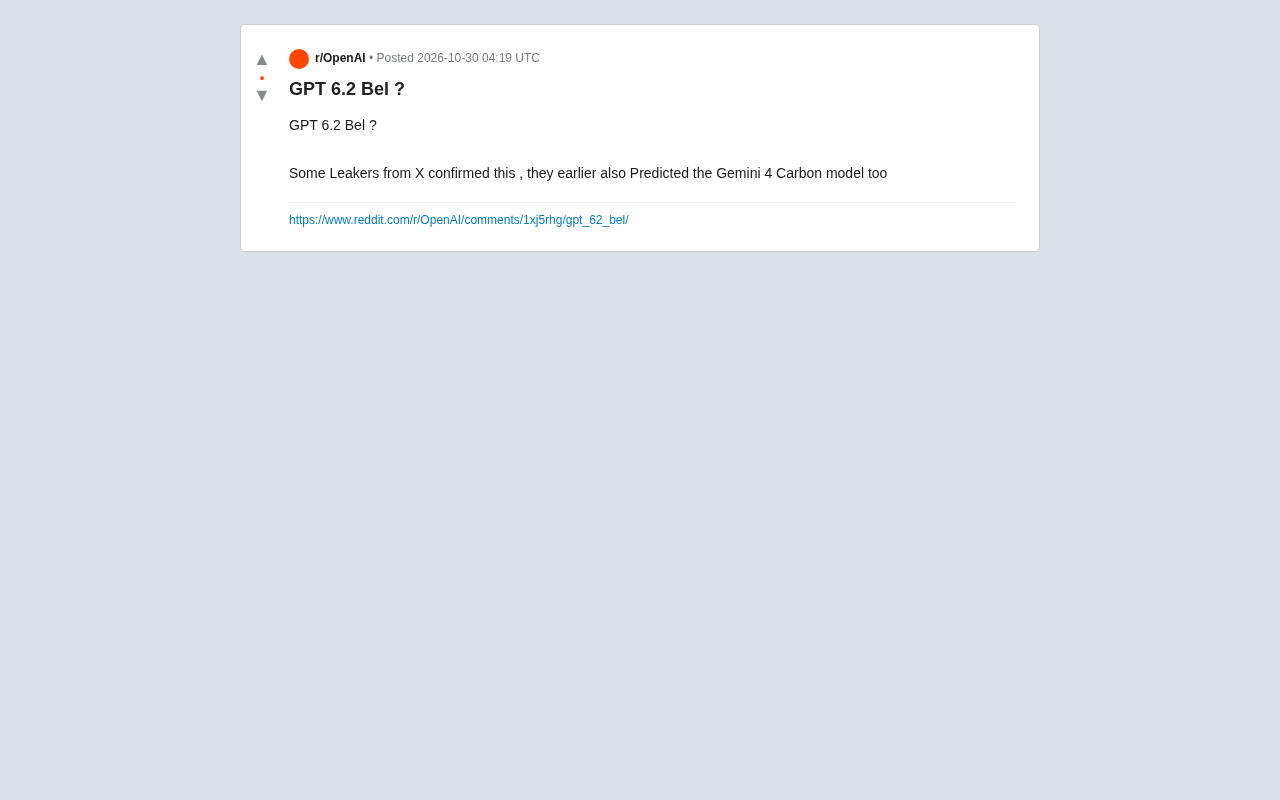
Recently, a short post titled "GPT 6.2 Bel ?" has been circulating in the Reddit community, claiming that some leakers on platform X have confirmed the existence of GPT 6.2, and mentioning that these leakers had previously predicted the "Gemini 4 Carbon" model. The screenshot attached to the post only shows the original Reddit page and provides no further technical details or evidence.
Rumored Content and Source Analysis
According to the Reddit post, leakers on platform X claim that GPT 6.2 has been confirmed, but the post itself does not provide any official documents, code snippets, or clear identities of insiders. You might not have noticed that these leakers are said to have accurately predicted the "Gemini 4 Carbon" model—a claim that likewise lacks any verifiable public record.
From the information propagation chain, this is a typical "second-hand leak": a Reddit user relays the claims of anonymous accounts on platform X, and those X accounts provide no original evidence. Such rumors are not uncommon in the AI community, especially during periods when major model vendors are iterating intensively, when the community is highly sensitive to version numbers.
Gemini 4 Carbon is the rumored codename/version name for Google's next-generation Gemini model, but as of now, Google has never confirmed this naming in any blog, developer conference, or API documentation. Google's Gemini series has used suffixes such as Ultra, Pro, Flash, and Nano to distinguish capability tiers, and "Carbon" is not part of any existing public naming system. Therefore, using it as a reference point for the leaker's credibility carries the risk of circular reasoning: using one unconfirmed event to support another unconfirmed event. When evaluating AI rumors, it is advisable to trace whether the leaker has a verifiable track record (such as leaked model cards, API endpoints, or official timelines), rather than relying on word-of-mouth "prediction records" in the community.
Leaker Credibility Assessment
The only argument in the post supporting credibility is "they also correctly predicted Gemini 4 Carbon before." But this argument has two problems: first, Gemini 4 Carbon itself is not a publicly confirmed official name, and its authenticity is equally questionable; second, even if a prediction happened to hit the mark once, that is not enough to prove the systematic reliability of subsequent leaks.
In the field of AI model leaks, common reliable signals include: technical keywords in official job postings, accidental commits in open-source repositories, early availability of cloud provider API documentation, and so on. This rumor relies entirely on the verbal assertions of anonymous social accounts, and the strength of evidence is low.
In the context of AI model leaks, "reliable signals" usually refer to traces that can be independently verified. For example: new model architecture keywords appearing in job postings, accidental commits appearing in GitHub repositories or Hugging Face organization pages, API documentation or pricing pages from cloud vendors (such as Azure, AWS Bedrock) listing new model IDs ahead of time, and model cards or system cards being briefly made public. These signals are credible because they are generated by the vendors themselves or by partner systems, rather than being verbal assertions by anonymous accounts. In contrast, anonymous leakers on platform X often publish vague information under the name of "inside information," then delete or modify posts afterward, lacking auditability. This rumor does not have any of the above types of signals at all, so its evidence strength is at the lowest level.
Reference Significance for Developers
For developers who follow model iteration, the practical value of such rumors is limited. The version number "6.2" itself is also worth scrutinizing—OpenAI's previous version naming did not strictly follow a linear increment pattern of "major version.minor version," and community speculation about version numbers is often based on subjective assumption rather than official roadmaps.
A more pragmatic approach is to follow official channel changelogs, API change records, and model card documentation. Before official information is released, any claims about specific version numbers, parameter scales, or capability improvements should be regarded as unconfirmed community speculation.
OpenAI's version naming habits: OpenAI has not strictly followed a linear increment pattern of "major version.minor version." Its public model names include GPT-3.5, GPT-4, GPT-4o, GPT-4.1, GPT-5, and so on, where "o" stands for omni, and suffixes such as ".1" also do not increment at a fixed pace. Precise version numbers like "GPT 6.2" appearing in the community are more the product of speculators applying software version number habits, and do not match OpenAI's actual release naming logic. If developers want to track model iteration, they should follow OpenAI's official blog, API changelog, and the retirement and recommended timelines on model pages, rather than making technical choices based on version number rumors.
Conclusion
This Reddit post reflects the AI community's anticipation for a new generation of models, rather than reliable technical intelligence. The leaker's background is vague, the evidence chain is missing, and the cited "successful prediction" itself cannot be verified. Readers are advised to remain cautious and wait for official information.
One-line Summary
Reddit rumors claim GPT 6.2 has been confirmed, but the evidence chain is weak and it is unconfirmed community speculation.
Paragraph Summary
Recently, a post has been circulating in the Reddit community claiming that leakers on platform X have confirmed the existence of GPT 6.2, and citing their previous prediction of "Gemini 4 Carbon" as credibility backing. The article's analysis points out that this rumor is a typical second-hand leak: a Reddit user relays the claims of anonymous accounts, with no official documents, code snippets, or reliable identity information. Moreover, "Gemini 4 Carbon" itself has not been officially confirmed and cannot constitute valid supporting evidence. The article further lists reliable signals of AI model leaks (job postings, open-source commits, early API documentation, etc.), and points out that this rumor has none of them. The version number "6.2" also does not match OpenAI's past naming habits. The conclusion is that such rumors reflect community anticipation rather than technical intelligence, and developers should rely on official changelogs and API documentation.
Related articles
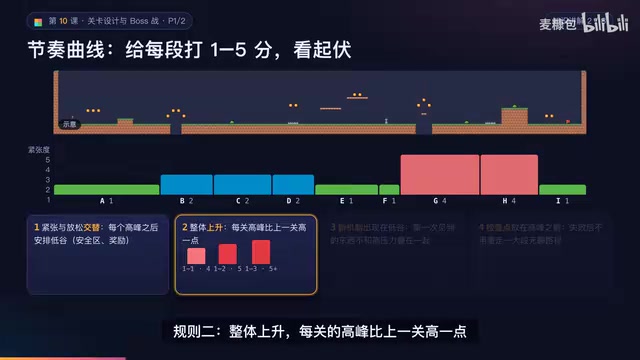
AI Game Development in Practice: Designing Levels with the Four-Step Method and Pacing Curves
AI game development lesson 10: design levels with the four-step method (teach, practice, combine, test) and a 1-5 pacing curve, plus sightline guidance and safety zones—implement Animatable Body 2D moving platforms and generate ASCII sketches for 1-2 Underground Cavern and 1-3 Guard Hall.

AI Game Development in Practice: Two-Phase Boss State Machines and Death Heatmap Tuning
AI game development lesson 10: implement a two-phase Boss with a state machine, guarantee fairness with color signals and a 0.4-second warning floor, locate difficulty cliffs with a death heatmap, and apply lightest-to-heaviest fixes one at a time, with an acceptance checklist and common pitfalls.
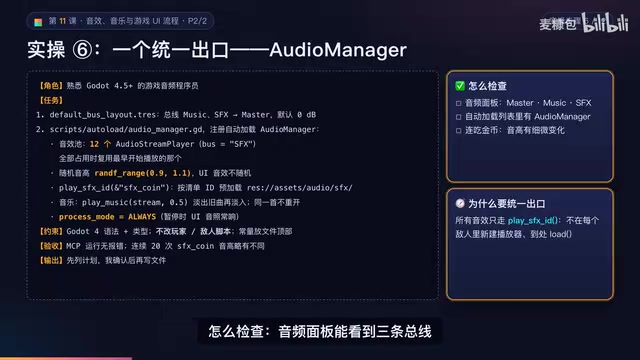
AI Game Development in Practice: Audio Buses and Building the Full UI Flow
AI game dev lesson 11 part 2: Godot's audio trio, audio buses and dB conversion, AudioManager's player pool and random pitch, autoload boundaries, the full UI flow from title to clear, fault-tolerant JSON saves, and pixel font anti-aliasing and integer-size rules.