GPT-6 Cyber Limited Release, Gemini Video Editing Upgrade, METR Reports Anthropic R&D Acceleration
OpenAI releases GPT-6 Cyber, Google launches conversational video editing, METR warns of AI acceleration.
This briefing covers multiple frontier AI developments. OpenAI released the cybersecurity-specific model GPT-6 Cyber, scoring 48.5% on Exploit Gym, producing 948 Linux kernel exploits in 10 days and finding 81 unknown Firefox vulnerabilities, released in a limited way via Daybreak Red. Google rolled out Gemini Omni 1.2 Flash to all Google AI subscribers, supporting multi-turn video editing, up to 4K, with costs reduced 30%. Most notably, METR says Anthropic's capability growth rate is about 1.9x previous, with unreleased internal Model 4 exceeding 50% on all 15 tests. Kimi launched a hosted agent cloud service, Cursor can build and deploy apps from descriptions, and open-source security governance shows two paths: tiering and regulation.
OpenAI has taken a rather unusual step in cybersecurity: releasing a specialized model, GPT-6 Cyber, made available to select customers through the Daybreak Red channel, with plans to gradually expand access. Meanwhile, Google is bringing video generation and editing capabilities to all AI subscribers, and Anthropic's internal models are showing alarming signs of acceleration in METR's evaluations. This issue's briefing is extremely information-dense; below are a few threads worth expanding on.
OpenAI: Security-Specific Models and the Scale of Image Generation
GPT-6 Cyber is positioned not as a general-purpose assistant but as a specialized tool for security research. Official figures show it scored 48.5% on Exploit Gym, up from 32.1% for the previous generation; the model produced 948 Linux kernel privilege-escalation exploits in 10 days and discovered 81 previously unknown high-severity Firefox vulnerabilities. Security teams at Mozilla, Cisco, and others have begun using it.
The significance of these numbers is that vulnerability discovery is shifting from highly labor-intensive manual work to a process that can be scaled by models. But the "limited release" itself also shows that OpenAI remains cautious about the proliferation of such capabilities—the line between offensive and defensive often depends solely on who the user is.
Another figure mentioned in passing is equally noteworthy: ChatGPT and the API now generate more than 4 billion images per week, up from 3 billion eight months ago. Image generation has gone from a demo-like feature to an infrastructure-level workload.
Exploit Gym is one of the benchmarks for evaluating the exploit capabilities of large models. It typically requires writing working exploit code against known vulnerabilities in a controlled environment and scores on dimensions such as success rate and stability. A higher score means the model is better able to independently complete the entire chain from vulnerability analysis to constructing an exploit. This metric is sensitive because it simultaneously measures defensive value (helping vendors discover and patch vulnerabilities in advance) and offensive risk (lowering the barrier to launching attacks), which is one of the direct reasons GPT-6 Cyber chose a limited release rather than a public one.
Google: Video Editing Enters the Era of Multi-Turn Dialogue
Google has begun rolling out Gemini Omni 1.2 Flash to all Google AI subscribers. In the Gemini app, users can modify video footage through multi-turn dialogue, with improved stability; Ultra subscribers can create and edit videos up to 15 seconds long. The model has been integrated into platforms such as AI Studio and the Gemini API, supports up to 4K resolution, and costs 30% less.
Making video editing a conversational interaction essentially translates "timeline operations" into "intent descriptions." For users unfamiliar with editing software, this path has a much lower barrier to entry; but for professional scenarios requiring precise frame-level control, whether multi-turn dialogue can replace traditional tools remains to be seen.
Google also showed a new application interface for Anti-Gravity, with key upgrades to the browser, development environment, and voice interaction. The voice mode based on Gemini Live and the cloud-based Agent have also been gradually rolled out.
"Flash" in Gemini Omni 1.2 Flash is the name of the lightweight tier in Google's model product line, focused on low latency and low cost, typically trading some complex reasoning capability for faster responses and lower call prices; "Omni" indicates native support for multimodal input and output. The "30% cost reduction" mentioned in the article generally refers to a drop in API call prices for the same task, not a decline in model capability. For tasks like video editing that require repeated trial and error and multiple rounds of modification, a lower per-call cost directly determines whether users are willing to use conversational editing frequently.
METR Evaluation: Capability Growth Rate Reaches About 1.9x Previous
This is the item that deserves the most serious attention in this issue. METR's evaluation states that Anthropic's model capability growth rate has reached about 1.9 times the previous level, possibly touching the threshold for R&D acceleration. The evaluation included an unreleased internal model, Model 4, which exceeded 50% on all 15 tests and surpassed 90% on several.
Employees self-reported a coding efficiency gain of about 12x, but METR classified this survey evidence as "very loose" and said it had submitted a report of about one hundred pages to Anthropic, with the public version redacting a large amount of key evidence. This handling is itself worth pondering: the evaluation organization compromised between transparency and commercial confidentiality, and readers should retain a degree of caution about the conclusions.
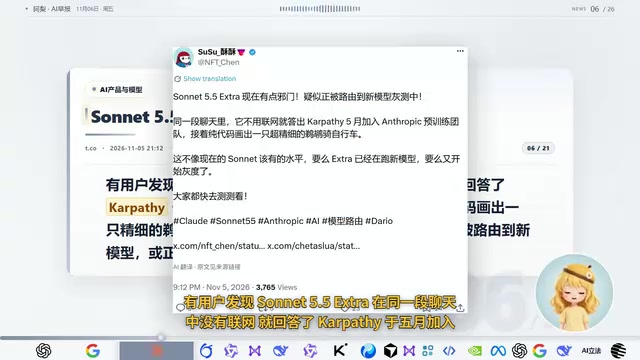
There is also a community observation: a user found that Sonet 5.5 Extra answered questions about Karpathy (who joined Anthropic's pretraining team in May) in the same chat without internet access, and also drew a detailed pelican riding a bicycle using pure code. The user speculated based on this that Extra may have been routed to the new model or may be undergoing a gray-scale test. This is speculation from a single source and should not be treated as conclusive.
METR (Model Evaluation & Threat Research) is a nonprofit evaluation organization that has long used "task duration" as a metric to measure how long a model can independently perform human work, and focuses on whether there are signs of self-acceleration in model capabilities. The so-called "threshold for R&D acceleration" refers to the point at which, when AI significantly improves the efficiency of AI research itself, the capability growth curve may shift from linear to steeply rising, thereby outpacing conventional governance and evaluation rhythms. Such conclusions rely heavily on internal model data and undisclosed evidence, so the report's reproducibility, sample selection, and degree of redaction all directly affect its credibility.
Open Source and Toolchain: Progress in Small Models and Local Execution
Ant Group's Lingbo released the METR model Ling 3.2 Flash, with a total parameter count of 560 billion and 25 billion parameters activated per run, strengthening complex visual 3D understanding and interaction capabilities. In the release evaluation, its document understanding and ZeroBench test scores were both higher than Opus 5's Max mode.
Bose's research team, Nanbeige, released the open-weight model Nanbeige 4.3 to 33B, scoring 20 on the Artificial Analysis intelligence index evaluation, on par with the X-Hot mode of Kun 3.8 27B, with each having its own focus: Nanbeige has stronger terminal-use capabilities but weaker knowledge capabilities. Agent Scope launched the open-weight decision model Piccolo, offering three sizes of 27 billion, 9 billion, and 4 billion parameters, which evaluates candidate options in context and returns structured decisions; in the demo, it was used to control a character in Zenless Zone Zero for actual combat.
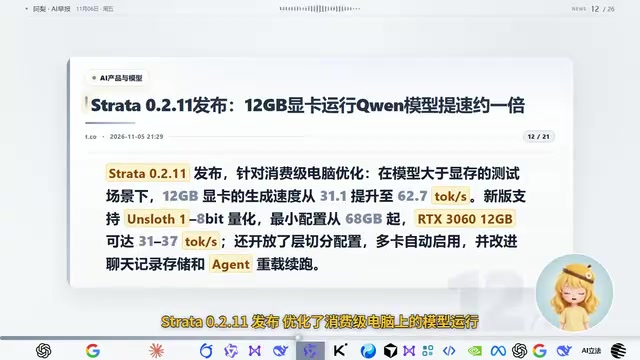
The Strata 0.2.11 update is more friendly to consumer hardware users: in a test scenario where the model is larger than VRAM, generation speed on a 12GB graphics card increased from 31.1 tokens per second to 62.7. The new version also supports Anslows quantization, open layer-splitting configuration, automatic multi-GPU enabling, chat history storage, and Agent reload and resume.
Activated parameters vs. total parameters is key to understanding MoE (Mixture of Experts) architecture models: the total parameter count determines the model's capacity ceiling, while the parameters actually activated in each forward pass determine inference cost and speed. The 560 billion total parameters and 25 billion activated per run mentioned in the article mean the model is very large in size but its per-inference overhead is close to that of a medium-sized model, which is why it can balance capability and deployment cost. Similarly, "open weights" means the model parameters can be downloaded and run locally, but it does not necessarily come with training data and a full open-source license, so users should pay attention to the specific licensing terms before use.
Product Updates: From Hosted Agents to Proactive Assistants
Kimi launched a hosted agent, turning the runtime environment into a cloud service so that enterprises and developers do not need to build frameworks or maintain underlying infrastructure themselves; the service supports long-running tasks and multi-agent collaboration, can connect to company systems or be embedded in applications, controls data access through isolated sandboxes, permission management, and pre-inference interception, comes with more than 140 skills and over 30 plugins, and initially offers 8 financial scenario templates.
Cursor can now build online applications from descriptions and share them via links—say what tool you want, and Cursor will write the application, configure the database, and complete deployment, running deterministic and agentic security checks before deployment. Perplexity's proactive agent TeamMates is being rolled out to Max subscribers on the web version, runs in an isolated environment, can perform computer tasks, and can use skills, memory, and tools; a mobile app will also be launched.

Other noteworthy items include: DeviReview 2.0 released, with prices cut by up to one-fifth of the original and speed increased to 1.5 times the original; Underdog released the open-weight text-to-speech model Woof, with a download size of 31.7MB, which can run completely offline in the browser via WebGPU; the NVIDIA research team released VFlash, a visual planning model for physical AI, which uses the fixed-length nature of prediction results for parallel decoding, increasing inference speed by up to 5.7 times and reducing error by 61%, and can run accelerated on Jetson, Digix Spark, and H100.
Security and Policy: Open-Source Guardrails and Campus AI
OpenAI launched a private security processing solution that can review relevant API requests without retaining prompts and responses; records are kept in the user's own environment and checked by automated security agents, and OpenAI staff cannot access the content.
Google clarified its policy for K12 schools: schools using the Google Workspace suite can keep Search, but must actively choose whether to enable AI products. Earlier, The New York Times reported that schools refusing AI would have Search shut down, sparking backlash from educators and parents.

The security issues of open-source models were also addressed directly by two executives. DeepSeekAd research engineer Gao Xi said the company is exploring model tiering, addressing risks through capability layering and access control; Qianwen lead Liu Daheng believes that open-source models cannot be recalled and guardrails are easily stripped, so Qianwen will rely more on regulations, industry norms, and infrastructure coordination for governance. Both approaches point to the same reality: the governance of open-source models cannot rely on the models alone.
At the policy level, U.S. Democratic Representative Ansari proposed on the first day of taking office a pause on advanced AI R&D and a permanent ban on superintelligence. Previously, Sanders and Cathar had proposed related legislation to establish a federal Department of Artificial Intelligence to review frontier models, with individuals violating the rules facing up to 20 years in prison and companies potentially being forcibly dissolved—currently still at the proposal stage. Separately, CNBC cited people familiar with the matter as reporting that Moonshot is in talks with European cloud service providers to rent a cluster of more than 8,000 NVIDIA Blackwell chips, mainly for inference but possibly also for training, and has offered to pay 30% to 50% more in advance than non-Chinese customers to hedge against future restriction risks; no deal has been confirmed.
In a single day, from specialized security models to conversational video editing, from quantitative evidence of R&D acceleration to diverging paths in open-source governance, the volume of information has approached the upper limit of what a single briefing can carry. What is truly worth tracking is not the releases themselves, but the form in which these capabilities reach ordinary developers in a few months.
One-line Summary
OpenAI releases the security-specific model GPT-6 Cyber, Google launches conversational video editing, and METR warns of signs of AI capability acceleration.
Paragraph Summary
This issue's briefing covers multiple frontier AI developments. OpenAI released the cybersecurity-specific model GPT-6 Cyber, which scored 48.5% on Exploit Gym, produced 948 Linux kernel privilege-escalation exploits in 10 days, and discovered 81 previously unknown high-severity Firefox vulnerabilities; it is being released in a limited way through the Daybreak Red channel. Google rolled out Gemini Omni 1.2 Flash to all Google AI subscribers, supporting multi-turn dialogue for video modification, up to 4K, with costs reduced by 30%. Most noteworthy is METR's evaluation stating that Anthropic's model capability growth rate has reached about 1.9 times the previous level, with the unreleased internal model Model 4 exceeding 50% on all 15 tests. In addition, Kimi launched a hosted agent cloud service, Cursor can build and deploy applications from descriptions, and open-source model security governance has seen two paths: tiering and regulatory coordination.
Related articles
 Tech Frontiers
MuJoCo: An Analysis of DeepMind's Open-Source General-Purpose Physics Simulator
An in-depth analysis of Google DeepMind's open-source physics simulator MuJoCo: high-performance C++ kernel, MJCF modeling format, contact solving principles, MJX GPU acceleration, and robot reinforcement learning use cases.
 Tech Frontiers
Claude API Quick Start: The Official Quickstarts Project Collection
Anthropic's official claude-quickstarts project collection helps developers quickly build deployable apps with the Claude API. Nearly 20k stars, Python-based, great for beginners and prototyping.
 Tech Frontiers
AI Agents Connecting Directly to APIs: Which Calls Can Be Safely Allowed?
AI agents can call any API, but the real challenge is deciding which calls can be safely allowed. This article analyzes allowance decisions from three dimensions—intent matching, least privilege, and controllable impact—and argues that the control layer should sit outside the agent, combined with audit traceability to build a trustworthy API call governance mechanism.