GPT-6 Cyber: The Frontier of Aligned Cybersecurity Agents

OpenAI releases GPT-6 Cyber, focused on vulnerability discovery and remediation, with an emphasis on authorized-scope alignment.
The article introduces GPT-6 Cyber, OpenAI's cybersecurity-specific model positioned as "advancing the frontier of aligned cybersecurity agents," with the core task of discovering exploitable vulnerabilities and developing fixes. It notes that the model shapes capability and behavioral boundaries in tandem, writing "staying within authorized scope" into the training objective to address dual-use risks. The article analyzes the special nature of alignment in security contexts, where harmlessness depends heavily on authorization, and discusses potential impacts on remediation speed, workforce structure, and the offense-defense balance. Since evaluation data and authorization mechanisms remain undisclosed, it maintains a cautious stance on deployment effects.
GPT-6 Cyber: The Frontier of Aligned Cybersecurity Agents
OpenAI has released GPT-6 Cyber, a model purpose-built for cybersecurity scenarios, with the goal of discovering exploitable vulnerabilities and developing fixes. The company positions it as "advancing the frontier of aligned cybersecurity agents"—a phrase containing two key terms: capability (finding and patching vulnerabilities) and alignment (acting within authorized scope). In a field like vulnerability discovery, which is inherently dual-use, the latter may carry more weight than the former.
From General-Purpose Model to Domain Expert
GPT-6 Cyber is not simply a renamed general-purpose chat model. According to the official description, it is trained for the closed-loop task of "discovering exploitable vulnerabilities and developing fixes," while being required to "stay within authorized scope." This means the model's capability boundaries and behavioral boundaries are shaped in tandem: it must not only find problems, but also know which systems it may touch and which it may not.
This design approach addresses a long-standing concern in the security industry—that powerful vulnerability discovery capabilities, once detached from authorization constraints, could become attack tools. Writing "authorized scope" into the training objective essentially establishes a binding relationship between capability and compliance, rather than relying on post-hoc terms-of-use restrictions.
Dual-use technology refers to a capability that can serve defensive purposes while also being misused for attacks; vulnerability discovery is a typical example. The governance challenge for such technology is that restricting its availability also weakens defenders' efficiency, while allowing it to spread lowers the barrier to attack. Common industry responses include tiered authorization, user qualification review, and behavioral log auditing, but all rest on the premise of being able to identify usage intent and authorization status. GPT-6 Cyber's inclusion of authorized scope in its training objective can be seen as an attempt to address dual-use risk at the model level rather than merely at the product level.
The Special Meaning of Alignment in Security Scenarios
In general scenarios, alignment refers more to helpfulness, honesty, and harmlessness. But in cybersecurity, the determination of "harmless" is highly context-dependent: the same vulnerability analysis behavior is legitimate work in an authorized penetration test, but is intrusion in an unauthorized system.
GPT-6 Cyber's emphasis on being "trained to stay within authorized scope" indicates that alignment for this model is a task-level, operational constraint rather than an abstract principle. For security teams, this means the auditability of model output and the controllability of scope may be more important than raw vulnerability discovery rates.
Task-level alignment differs from general alignment in the granularity of its constraints. General alignment is typically expressed as abstract principles like "do not produce harmful content," with the model judging for itself at inference time; task-level alignment binds constraints to specific task contexts, such as "perform analysis only on targets within a given scope." The advantage of this approach is that constraints are more verifiable—one can test whether the model refuses by constructing out-of-scope requests. The limitation is that it depends on a formal definition of "scope," whereas real-world authorization often exists in contracts, tickets, or verbal agreements that are difficult to translate directly into model-readable input. Therefore, how authorization boundaries are represented is a key engineering problem when deploying such systems.
Industry Impact of Dual-Use Capabilities
Automated vulnerability discovery and remediation has long been seen as an efficiency lever for security operations. Having a dedicated model take on this work has potential impacts at several levels:
- Remediation speed: The chain from discovery to remediation recommendations is compressed, shortening the exposure window.
- Workforce structure: Junior vulnerability analysis work may be absorbed at scale, with security engineers shifting toward validation and decision-making.
- Offense-defense balance: Defenders gain faster tools, but the risk of the same capabilities spreading also rises—the real-world context behind the official emphasis on authorized-scope training.
As a side note, the original information did not disclose the model's evaluation data, availability scope, or release method, so the above impacts are currently more directional judgments than verified conclusions.
The vulnerability exposure window refers to the time gap between when a vulnerability is introduced or discovered and when a patch is deployed; it is one of the core metrics for measuring security operations efficiency. The value of automated tools mainly comes from compressing both ends of this window: faster discovery and faster delivery of usable fixes. But note that the quality of remediation recommendations directly determines whether the window actually closes—a misdirected patch or one that introduces a regression may lengthen the window rather than shorten it. This is why, absent comparative evaluations of fix quality, the real-world benefits of automated remediation remain difficult to quantify.
Open Questions
Several questions about GPT-6 Cyber have no public answers: how the model defines "authorization," who provides the determination of authorization boundaries, and how it is verified—the cost of misjudging scope in real environments is high. In addition, how the quality of vulnerability remediation recommendations is evaluated, and whether they have been compared against human remediation results, also lacks public information. These will determine whether it is a deployable security tool or yet another capability demonstration.
In a field like vulnerability discovery, where capability and risk heavily overlap, "alignment" is not an add-on but a prerequisite for whether a product can be trusted for use. GPT-6 Cyber has explicitly written this into its positioning; what remains is whether the engineering implementation can match those words.
One-line Summary
OpenAI releases GPT-6 Cyber, focused on vulnerability discovery and remediation, with an emphasis on authorized-scope alignment.
Paragraph Summary
The article introduces GPT-6 Cyber, OpenAI's cybersecurity-specific model positioned as "advancing the frontier of aligned cybersecurity agents," with the core task of discovering exploitable vulnerabilities and developing fixes. It notes that the model is not a simple rename of a general model but rather shapes capability boundaries and behavioral boundaries in tandem, writing "staying within authorized scope" into the training objective to address the dual-use risk of vulnerability discovery capabilities. The article further analyzes the special nature of alignment in security scenarios: whether the same behavior is "harmless" depends heavily on authorization context. On industry impact, the article argues that automated vulnerability discovery and remediation could compress exposure windows and change security team workforce structures, while also bringing capability proliferation risks. Since evaluation data, release methods, and authorization determination mechanisms are all undisclosed, the article maintains a cautious stance on real-world deployment effects.
Related articles
 Tech Frontiers
Coldframe: A Honeypot Disguised as a Supermarket Freezer Controller
Coldframe is a honeypot disguised as Danfoss AK-SM 800A and Dixell XWEB freezer controllers, built as a single Python file that detects CVE-2025-41450 attempts and is identified as real devices on Shodan.
 Tech Frontiers
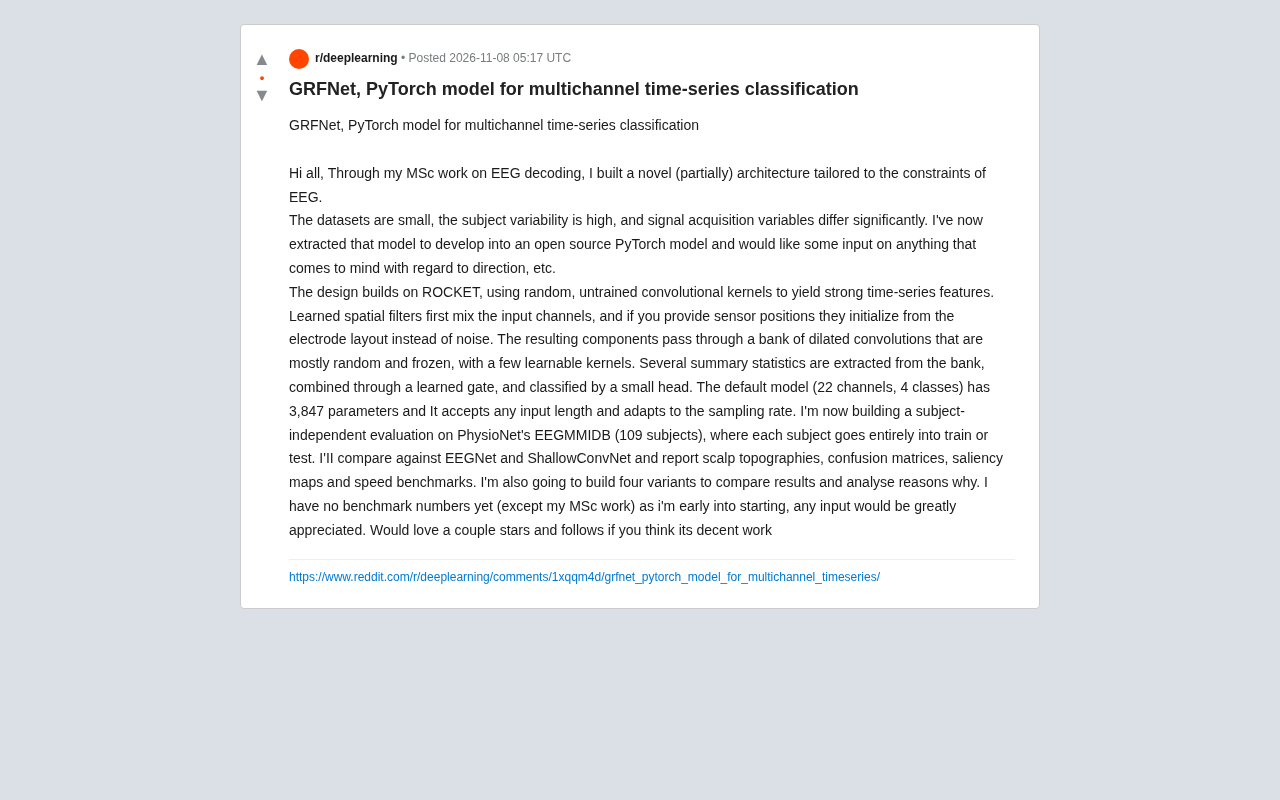
GRFNet: A Lightweight PyTorch Model Designed for Multichannel Time-Series Classification
GRFNet is a lightweight PyTorch model for multichannel time-series classification, originating from EEG decoding research. With only 3,847 parameters, it is based on the ROCKET architecture, combining random convolution kernels with learnable spatial filters, supports arbitrary input lengths, and will soon be evaluated on the PhysioNet dataset.
 Tech Frontiers
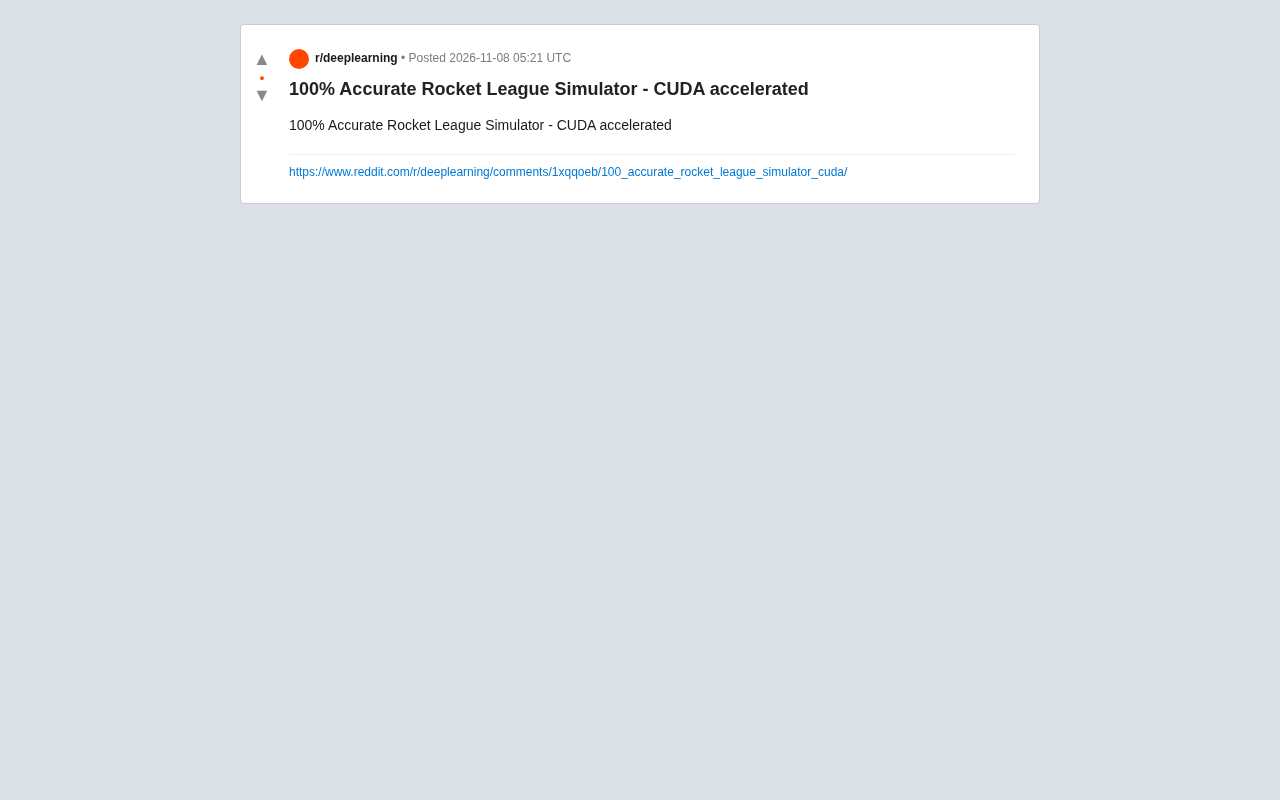
CUDA-Accelerated Rocket League Simulator: A Player-Made Hardcore Experiment
A Reddit post shows a "100% Accurate" Rocket League simulator accelerated with CUDA. We analyze its technical context, CUDA's value in game physics simulation, and the significance and limitations of such community projects.