GPT-6 Cyber Unearths 81 High-Severity Vulnerabilities as Ant's Ling-3.2 and Baidu's ERNIE-5.5 Compete on the Same Stage

OpenAI debuts a restricted cybersecurity model as open-source base models and agent infrastructure cost signals are released densely on the same day.
The article rounds up multiple dense AI developments on the same day. The most closely watched is OpenAI's cybersecurity-specific model GPT-6 Cyber, available through restricted Daybreak Red access, which the company says uncovered 81 previously unknown high-severity Firefox vulnerabilities—the article notes such capabilities may benefit both attackers and defenders. On the open-source side, Ant Ling launched the native multimodal model Ling 3.2-Flash (560B total parameters, 25B activated), while Baidu released the full pre-training weights of ERNIE 5.5-Flash-base (280B total parameters, 14B activated, 33.5T tokens), though without dialogue or instruction capabilities. Product-side news includes Gemini Omni 1.2 Flash's conversational video editing, Anthropic's read-only financial features, and Meta's real-time Avatar. On agent infrastructure, AgentScope open-sourced Piccolo, OpenRouter's median cache hit rate rose to 89%, and Vercel AI Gateway offered 50% off. There's also an unverified leak of Anthropic's 1.9x progress rate and personnel changes.
OpenAI Debuts GPT-6 Cyber, Its First Cybersecurity-Specific Model
Security-focused large models are evolving from "chat assistants" into genuine frontline scouts. OpenAI has released GPT-6 Cyber, a cybersecurity model, and the official claim is that it uncovered 81 previously unknown high-severity Firefox vulnerabilities. That number is worth pausing over: this isn't scanning for known CVEs, but discovering attack surfaces no one knew about before—suggesting the model has developed a degree of reasoning-based vulnerability discovery capability.
The release method also reveals its positioning—GPT-6 Cyber is offered through Daybreak Red under restricted access, and is not a public release. Products involving offensive capabilities are typically made available only to vetted security vendors, government agencies, and critical infrastructure operators. The closer the capability gets to a real attack chain, the less likely it can be offered directly to the general public like an ordinary chatbot.
There's a sobering implication worth noting: if a model can help defenders find 81 vulnerabilities, in theory it can also help attackers locate the same gaps faster. The offense-defense balance in cybersecurity may tilt once again with the emergence of such models.
Gated access is a common form of release for security-domain models: the product isn't open for public registration, but instead requires applicants to submit organizational credentials, use cases, and compliance commitments, then grants API or dedicated access via whitelist after review. The purpose of this mechanism isn't to manufacture artificial scarcity, but to control the diffusion of capability—when a model can be used for vulnerability discovery, reverse engineering, or attack-path inference, opening it to anyone is equivalent to handing offensive tools to everyone. Typical practices include binding to enterprise identity, limiting call frequency, keeping audit logs, and tiered authorization by customer type (defenders/research institutions). To judge whether a security model is truly restricted, look at three things: whether there's an independent admission review process, whether outputs are filtered for offensive content, and whether usage is traceable.
The Open-Source Camp Rallies the Same Night: Ant's Ling 3.2-Flash and Baidu's ERNIE 5.5
In contrast to OpenAI's closed-door approach, two major Chinese companies pushed model capabilities toward openness on the same day.
Ant Ling 3.2-Flash: Native Multimodal, 560B Total Parameters
Ant Ling released the native multimodal model Ling 3.2-Flash, with total parameters reaching 560B (originally stated as 560D) and 25B activated per token. In the official benchmarks, all three results exceeded Opus 5 Max. Native multimodality means that modalities such as text and images are modeled uniformly during pre-training rather than stitched together afterward. Given Ant's business scenarios—payments, risk control, AI applications—the potential for multimodal reasoning capabilities to land in real business is considerable.
Total parameters and activated parameters are the two key quantities for understanding MoE (Mixture of Experts) models. Total parameters refer to the total volume of model weights, determining the knowledge capacity the model can carry and its VRAM footprint; activated parameters refer to the number of parameters actually involved in computation during a single forward pass, directly determining inference compute cost and latency. Taking Ling 3.2-Flash's 560B total parameters and 25B activation as an example, the model internally consists of a large number of expert subnetworks, each token is routed to only a few of them, so per-token computation is close to a 25B dense model, but the knowledge surface approaches 560B scale. This is why current large models widely adopt MoE: trading for greater capacity under a limited compute budget. It's worth noting that large total parameters don't automatically mean better results—routing strategy, expert load balancing, and training data quality equally determine final performance.
Baidu ERNIE 5.5-Flash-base: Full Pre-Training Weights Released
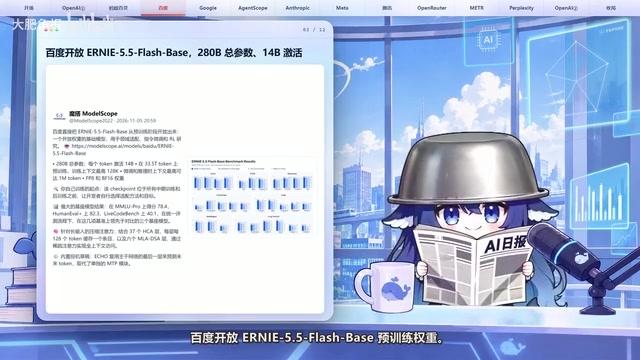
Baidu released the full pre-training weights of ERNIE 5.5-Flash-base: 280B total parameters, 14B activated, trained on 33.5T tokens. To be clear, this is a pre-training base model that does not include dialogue or instruction capabilities—it's not directly usable as a conversational product, but rather raw material for researchers and developers to fine-tune further.
The two approaches have different emphases: Ant showcased benchmark results against closed-source flagships, while Baidu chose to hand over base weights. For China's AI ecosystem, the latter's value may lie more in lowering the research barrier—being able to experiment with a 14B-activated model costs far less compute than full activation.
There's a clear process gap between a pre-training base model and a dialogue model. A base model has only undergone next-token prediction training; what it learns is language distribution and world knowledge, and what it outputs is "continuation" rather than "answers." To become a usable conversational product, it still needs instruction fine-tuning (SFT), preference alignment (such as RLHF/DPO), and post-training steps like tool calling and safety refusals. Therefore, releasing full pre-training weights delivers "raw material" rather than "finished product": researchers can build on it for domain continued pre-training, custom alignment, or distilling smaller models, but using it directly for conversation will yield garbled continuation text. This form of openness has high value in academic and engineering communities because it shifts the most expensive pre-training compute cost to the publisher, leaving downstream to bear only fine-tuning costs.
Product-Side Developments: Video Editing, Financial Assistant, and Real-Time Avatar
Google Gemini Omni 1.2 Flash: Conversational Video Editing
Google is rolling out Gemini Omni 1.2 Flash. Subscribers can edit videos in the Gemini App through multi-turn conversation, and Ultra users can generate and edit videos up to 15 seconds long. The core value of conversational editing lies in turning "editing" into "describing requirements," significantly lowering the barrier for non-professional users.

Anthropic's Financial Features: Read-Only Across the Board
Anthropic launched Claude's financial features in beta in the US. Users can connect accounts of their choosing and ask financial questions in everyday language. The key design lies in the permission boundary: read-only across the board—Claude cannot transfer, manage, or invest funds. In financial scenarios, being able to make recommendations but not move money is the most realistic compliance posture.
Meta Muse Real-Time Avatar: Voice to Interactive Character
Meta launched Muse Real-Time Avatar in the US, converting voice into an interactive avatar with facial expressions and gestures. There are also reports that it launched simultaneously in Mexico. Driving expressions and gestures in real time imposes extremely high latency requirements, and the usability of such products is more worth watching than their visual effects.
Agent Infrastructure and Cost Signals: Piccolo, Cache Hit Rate, and AI Gateway
Agent deployment depends on underlying infrastructure, and several pieces of news this day all point to the infrastructure layer.
AgentScope open-sourced Piccolo, with decision models available in 27B, 9B, and 4B tiers; it works by presenting candidate options, scoring them, and returning probabilities. The official claim is that Piccolo 27B achieved 92.21% on the Geffen test. This "option scoring" paradigm is well suited for embedding into tool calling, workflow decisions, and similar scenarios.
Cost-side signals are equally clear: OpenRouter reported a notable rise in cache hit rates for agentic scenarios, with the median climbing from just over 60% at the start of the year to 89%. This means the effective unit price of the same model is lower, and any business model relying on cost assumptions needs recalculation. On the same day, Membership 4 launched, and Vercel AI Gateway offered 50% off.
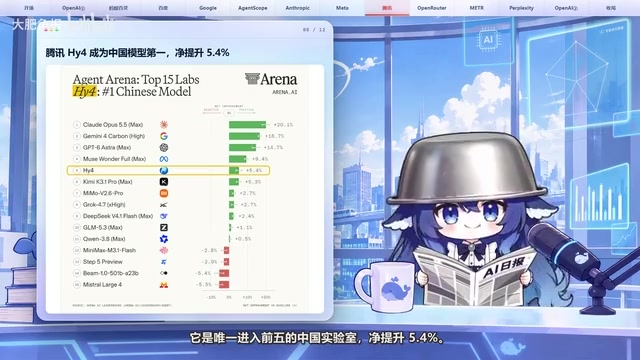
Combining Tencent membership data, Garena AI appears to have become the top Chinese model and the only Chinese lab in the top five, with a competitive gain of 5.4%.
Why cache hit rate matters in agent scenarios stems from their call structure: each round of agent decision-making re-feeds system prompts, tool definitions, conversation history, and intermediate results into the model, with highly repetitive prefixes. Inference services that support prompt caching reuse already-computed KV caches, billing the hit portion at a price far below normal input and significantly reducing latency. A hit rate rising from just over 60% to 89% means that in the same round of agent tasks, the billed proportion of repeated prefixes is greatly compressed, and the effective unit price shifts downward accordingly. For developers, this changes the assumptions of the cost model: estimating budgets by total input tokens overestimates overhead, and designing cache-friendly prompt structures (fixed prefixes, moving volatile content later) becomes an optimization in itself.
The Speed Race and Personnel Changes
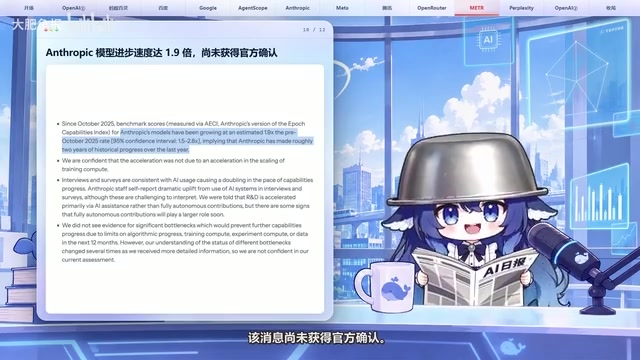
According to a leak, Mitchell's report claims Anthropic's model progress rate reached 1.9x. This claim has not been officially confirmed. Mitchell estimates AI's own contribution at about 80%, while explicitly stating this judgment is highly uncertain. If the 1.9x growth rate holds, it means the capability doubling cycle is compressed by nearly half, but a single-source, unverified estimate can only serve as a reference, not a conclusion.
Other personnel and product developments worth noting: Perplexity is launching proactive Agent Teammates, first available to Max users on web, with mobile coming soon, capable of executing Computer tasks in isolated environments, with skills, memory, and tools; according to The Information, Cat Wu joined OpenAI to lead product management for Core Products, having previously helped lead Claude Code at Anthropic.
From vulnerability discovery to open-source base models, from video editing to agent cache costs, almost none of the day's news falls into the old "chatbot" lane. The main battleground of competition is shifting toward system-level capabilities that are usable, executable, and cost-controllable.
One-line Summary
OpenAI debuts a restricted cybersecurity model as open-source base models and agent infrastructure cost signals are released densely on the same day.
Paragraph Summary
The article rounds up multiple dense developments in the AI field on the same day. The most closely watched is OpenAI's release of the cybersecurity-specific model GPT-6 Cyber, available through restricted Daybreak Red access, which the company says uncovered 81 previously unknown high-severity Firefox vulnerabilities—the article notes such capabilities may benefit both attackers and defenders. On the open-source side, Ant Ling launched the native multimodal model Ling 3.2-Flash (560B total parameters, 25B activated), while Baidu released the full pre-training weights of ERNIE 5.5-Flash-base (280B total parameters, 14B activated, 33.5T tokens), though without dialogue or instruction capabilities. Product-side news includes Gemini Omni 1.2 Flash's conversational video editing, Anthropic's read-only financial features, and Meta's real-time Avatar. On agent infrastructure, AgentScope open-sourced Piccolo, OpenRouter's median cache hit rate rose to 89%, and Vercel AI Gateway offered 50% off. There's also an unverified leak of Anthropic's 1.9x progress rate and personnel changes.
Related articles
 Tech Frontiers
MuJoCo: An Analysis of DeepMind's Open-Source General-Purpose Physics Simulator
An in-depth analysis of Google DeepMind's open-source physics simulator MuJoCo: high-performance C++ kernel, MJCF modeling format, contact solving principles, MJX GPU acceleration, and robot reinforcement learning use cases.
 Tech Frontiers
Claude API Quick Start: The Official Quickstarts Project Collection
Anthropic's official claude-quickstarts project collection helps developers quickly build deployable apps with the Claude API. Nearly 20k stars, Python-based, great for beginners and prototyping.
 Tech Frontiers
AI Agents Connecting Directly to APIs: Which Calls Can Be Safely Allowed?
AI agents can call any API, but the real challenge is deciding which calls can be safely allowed. This article analyzes allowance decisions from three dimensions—intent matching, least privilege, and controllable impact—and argues that the control layer should sit outside the agent, combined with audit traceability to build a trustworthy API call governance mechanism.