GPT-6 Security Model and the AI Attack-Defense Escalation: This Week in AI

AI becomes both vulnerability guardian and attack lever, with both sides accelerated by the same batch of models.
This week in AI: both attack and defense are being accelerated by AI. On defense, OpenAI's GPT-6 Saber—available only to vetted teams—used a multi-agent pipeline to find 948 Linux kernel root-escalation paths at million-dollar API cost, with patches submitted. On offense, the Volta infostealer calls an LLM to assess what is most valuable on a victim's machine. Cursor Build Apps extends agents to deployment, Google proposed Agent Substrate to cut agent costs, and Binance disclosed a full social engineering chain from malicious installer to forged signatures. C++26 failed its ISO vote, and text watermarking became a default compliance action.
This Week's Keyword: AI Goes Head-to-Head in Security
This week's AI news marks a clear turning point: AI is no longer just a tool that helps people write code—it has simultaneously become a guardian that hunts for vulnerabilities and an attacker that steals data. According to a weekly roundup by the YouTube tech news channel NNews, OpenAI rolled out GPT-6 Saber, a model dedicated to vulnerability discovery and patching, and its internal pipeline uncovered 948 paths by which an ordinary user could escalate to root in the Linux kernel. On the other side, the Windows infostealer Volta, discovered by security firm Cisco Talos, calls an LLM to judge what is most valuable on a victim's machine. Both sides of the attack-defense equation are being accelerated by AI at the same time—the most noteworthy signal of the week.
1. Model Evolution: Security-Specific Models and Generation Capabilities Advance on Two Fronts
GPT-6 Saber: A "White Hat" Model for a Select Few
GPT-6 Saber, which OpenAI showcased this week, is not a general-purpose chat model. It is positioned to discover system vulnerabilities, verify whether they are real, and output reports and remediation plans—a process close to a full penetration test. The model is not open to the public and is provided only to security teams vetted by OpenAI.
A noteworthy design detail is the "permission boundary": according to OpenAI, Saber only attacks within authorized scope. The reason is that once a penetration test crosses the line, it turns from a technical issue into a legal one. On the ExploitGym benchmark, the model's performance improved markedly. This demo also corresponds to the "permission control when creating agents" footage in the channel.
Caption: The demo involves agent creation and permission scope control.
The ExploitGym benchmark mentioned here is a test environment for evaluating a model's vulnerability discovery and exploitation capabilities. Unlike general coding benchmarks, such benchmarks typically provide real or simulated target systems, requiring the model to autonomously carry out reconnaissance, construct inputs, verify exploitability, and propose fixes. Scoring looks not only at whether a flaw is found but also at whether the report is reproducible and whether the model stays within authorized boundaries. It therefore measures end-to-end penetration capability rather than single-point code completion accuracy. Only by understanding this can one judge what Saber's "marked improvement" actually means: it is closer to an automated tester that delivers results.
Image and Video Generation: Faster, More Stable, Cheaper
OpenAI's image model Images 2.6 supports generating animated GIFs, which can bring a brand mascot to life or turn a product photo into a looping animation. The company says it is noticeably faster and better maintains consistency of the same character or logo across multiple rounds of editing. The capability is now available in ChatGPT and Codex, and on the API side it offers two versions: Flare, which favors speed, and Sunburst, which favors quality.
Google, meanwhile, launched Gemini Omni 1.2 Flash for video generation, available in the Gemini API, Google Cloud, and Google Bits. A single video can be up to 15 seconds long, and it follows input images, assets, and scene transitions more faithfully. Its interaction model resembles chat-based editing: describe "change the sky to a starry night" in natural language, and the model makes the change immediately. Google also offers a cost-saving tip—generate at low resolution first, then upscale before export.
2. Agents Move from Writing Code to Deployment and Collaboration
Cursor Build Apps: Deliver a Complete App in One Sentence
Cursor's Build Live Apps extends the agent's capabilities from "writing" to "shipping." After a user states a requirement, the agent creates the database, configures login, performs basic security checks (for example, scanning for leftover environment variables in the repository), and finally returns a deployed access link. It currently supports GitHub and Cursor Origin repositories. This solves the pain point for non-expert users who "have the code but don't know where to put it."
Leftover environment variables in repositories are a high-frequency risk point during agent deployment because many projects write database passwords and third-party API keys into .env files or build configurations, and once such files are committed or bundled into front-end artifacts, they are exposed along with the public link. When an agent automatically creates a database and configures login, it often reads these variables; without scanning and cleaning them first, deploying means publishing credentials along with the app. Basic security checks are therefore not optional but a necessary gate before going live. Common practices include checking .gitignore coverage, scanning build artifacts for key patterns, and moving sensitive configuration to server-side hosting.
Code Review Becomes the New Bottleneck
Agents now open PRs faster than humans can review them. Cognition launched DevinReview 2.0, claiming that the cost per PR review has dropped substantially (to just tens of cents in dollar terms), that it finds no fewer issues than before, and that it supports incremental review—after a PR is updated, only the new parts are reviewed. Note that these figures come from Cognition itself; actual results should be verified in your own repositories.
Copilot and Kiro Expand
GitHub Copilot has entered JetBrains' Air agent platform, where tasks can be delegated directly and count against the Copilot plan rather than JetBrains quota; it is also integrated into Xcode on macOS with no extension installation required, though there are system version and Xcode beta version requirements. Kiro has enabled v3 of its CLI and desktop by default, bringing cloud-based remote sessions, repository-level memory, routine automation, and an autonomous mode that always runs in a sandbox. Kiro Crew also introduced Bots: persistent agents that can be named and given an avatar and personality, capable of pushing a goal forward for hours on end—for example, adding semantic search to an app—while retaining their own memory and decision records.
Anthropic's Message Threads and Claude Code Restrictions
Anthropic launched Message Threads to solve a very specific problem: previously, when an agent communicated with Claude, it had to resend the entire conversation, tool calls, and results each time, which slowed things down. Now history stays on the server, and new requests send only the delta. The company says this doesn't save tokens—it's just faster—and with it enabled by default in Claude Code, long conversations speed up noticeably.
On another front, according to multiple media reports, Claude Code adjusted its prompting strategy to refuse requests that help clone others' games. The backdrop is that many indie and major game developers worry that once a new title's trailer is public, it could be fully replicated wholesale through vibe coding. The restriction is said to apply only to Claude Code, and whether other editors using the same models will follow is unclear—a point of divergence worth watching.
3. Cloud and Infrastructure: Rebuilding the Foundation for the Agent Era
Google proposed Agent Substrate: when an agent enters a waiting state (waiting for a model reply, an API, or human confirmation), it saves state and shuts down the machine, then wakes it up when there is work to do—restoring in under half a second, according to Google. Billing is based on active time, which can significantly reduce agent operating costs. The project has been donated to the Cloud Native Computing Foundation (CNCF, the organization behind Kubernetes) and is available in GKE 1.0, with the goal of becoming a common container-level standard.
AWS, meanwhile, filled in three pieces of the puzzle for agents: Bedrock Agent Core's Web Answers lets an agent get a finished answer with source citations in a single call; the agent workspace adds Linux and Windows 11 environments with administrator privileges; and Amazon Connect can invoke MCP tools, so when a customer asks about purchase records, it directly pulls CRM history.
The Code Hosting Layer Is Also Being Pushed by Agents
Agents running in parallel and committing at high frequency are turning Git into a bottleneck. Anthropic previously demonstrated a Git alternative called Scion; OpenAI chose not to start from scratch but instead built its own Git-compatible service, Pando—engineers still use Git workflows, but upload speeds can be several times faster, with daily throughput reaching the petabyte level. OpenAI made clear this is only an internal tool and is not for sale.
Patches for Databases and Developer Experience
Google launched AlloyDB Express, an instant-on database for prototyping: reportedly ready in 2 seconds, launchable directly via MCP, automatically shut down after 15 minutes idle, restored on the next call, and smoothly transitioned to production once the prototype matures. It is currently in preview.
On GitHub's side, Dependabot can now automatically update skills and prompts managed as code; an accessibility.md file will appear in repositories to declare a project's accessibility. Vercel, meanwhile, intercepts NPM dependencies before installation: if a version matches its list of malicious packages and critical vulnerabilities, deployment is halted outright, enabled by default on all plans.
4. Security Incidents: A Textbook Social Engineering Attack
Timeline of the Binance Breach
This is the most information-dense security incident of the week. According to Binance's disclosure, the attack began when a developer in the wallet department downloaded a tool installer containing malicious code. Although the security team replaced the computer and remediated it, the attacker had already obtained internal information. What followed was elaborately designed phishing: the attacker used a Binance stint in one engineer's public profile to pose as a recruiter arranging an "interview," showed a personal video to build trust, then requested a project file download under the guise of a "technical test," through which the malicious program entered the work computer, tampered with existing tools, and erased traces.
The attacker then used internal tools to move laterally and control other employees' computers, obtained container deployment credentials, and ultimately deployed a service capable of forging Binance transaction signatures to initiate withdrawals. Even after Binance suspended withdrawals, the attack did not end—the adversary exploited Ethereum's properties to write a malicious contract onto the chain, where on-chain content cannot easily be revoked. Binance said it would bear all losses and has frozen some funds and restored the vast majority of assets.

Caption: The demo shows the step where the attacker forges transaction signatures.
The core lesson of this incident has nothing to do with code: any file awaiting execution that comes from an "interview" or "collaboration" should first be run in an isolated environment such as a virtual machine, container, or cloud host.
Once deployed, contracts on public chains like Ethereum are difficult to delete or modify—the technical root of why the attack in this incident was hard to stop. On-chain data is maintained collectively by nodes worldwide, and there is no centralized administrator who can take content down; revocation usually happens only through a switch reserved within the contract itself or a community governance fork. By writing the malicious contract onto the chain, the attacker effectively gained a persistently available entry point for forging signatures that could not be eliminated even after the internal environment was cleaned up. This also explains why the response to such incidents tends to focus on freezing funds, tracing addresses, and upgrading signature verification logic rather than simply deleting malicious code.
GitBook and Trigger.dev Breached
According to disclosures, GitBook was breached through a login-related issue that gave intruders employee access, reaching internal repositories, Cloudflare, and infrastructure. GitBook proactively took itself offline for 16 hours to eliminate the threat and rotated all keys, advising that all data be treated as compromised, including tokens and integrations with GitHub and GitLab. Trigger.dev confirmed that attackers reached application environment variables, potentially involving database keys and API keys, and has notified affected parties to change credentials. Users of both platforms should rotate their keys as soon as possible.
Other Security Matters That Must Be Addressed
- Google's security team dissected the XCPE backdoor: preinstalled at the factory on more than a million Android TV boxes, it can turn devices into a controlled network.
- "LLM theft" deserves vigilance: stealing an enterprise's model access for personal use or resale, with cases generating hefty bills in a single day. Treat API keys like credit cards.
- Better Auth's Expo plugin has an identity forgery issue, and already-issued credentials are not validated; update and rotate keys.
- Prefab UI's sandbox does not deliver the promised isolation—it can execute code, read the network, and even escape; upgrade immediately.
User Concerns About Data Usage
One team reported that the "improve the model with your data" toggle in Codex was turned off by default, then turned back on without notifying users. Separately, a Claude Code user reported on GitHub that requests to web pages carry the user's email as the user agent, with no validation. The community has plugins to work around this, but it is not default behavior. The companies involved have not yet responded publicly; for issues like these, it's advisable to check your own traffic and configuration.
5. Open Source and Research: C++26 Rarely Fails an ISO Vote
C++26 failed to pass the final ISO vote—quite rare in C++ history. A two-thirds majority is required, and the controversy centers on the contracts feature. The parties involved will meet on November 16 to decide whether to fix, delay, or find another way forward.
NVIDIA open-sourced two projects for AI workloads on Kubernetes: workload map describes workload structure in a unified way so that tools understand it consistently; attribution locates the root cause of large-scale training failures—after a GPU failure, a flood of errors often appears, and the last one is usually not the culprit. Both are at an early stage. Hugging Face, meanwhile, proposed using scaled-down versions of models for quick testing to catch hidden defects that "don't crash but are already broken," such as a model reading a word it shouldn't know ahead of time.
Where the 948 Root Paths Came From
This is the hardest-core research of the week. OpenAI organized a large-scale multi-agent pipeline to run penetration testing against the Linux kernel, and of more than two thousand valid findings, 948 could give an ordinary user root privileges. The API cost of the whole process reached the million-dollar level, and all patches have been submitted to the Linux community but still need to be reviewed one by one by each maintainer. The deeper implication is this: when one side uses AI to find vulnerabilities at scale, the other side's defense must also use AI, or the gap will widen rapidly.
The attack side is escalating too. Volta, discovered by Cisco Talos, steals passwords, cookies, sessions, cloud keys, and crypto wallets; its novelty is that after stealing, it builds a profile of the victim and hands it to an LLM to assess "what is most worth stealing," switching to another model if one refuses. AI is no longer just writing malicious code—it is also acting as the attacker's analyst.
There are two more signals worth recording on the research side: OpenAI's Astra model, after GPT-6 provided a functional definition, independently completed the enclosure, circuit board, interface, and software design for a walkie-talkie-style hardware device, with no direct human edits to the drawings throughout; OpenAI also acquired Pierre, the company behind open-source projects such as CodeStorage, which corroborates its Pando direction.
6. Platform Policy and Compliance Developments
Text Watermarking Becomes the Default
Starting November 3, content generated by Claude Mythos 5, Opus 4.7, and Sonnet 4.6 carries an invisible watermark; xAI has done the same for Grok since November 7, enabled by default in its API. Both companies say this is to comply with EU AI regulations, does not affect output quality, and requires no code changes. Watermark detection is not yet available to the public.
Apple Opens Up Siri Integration
Apple opened CDI to developers (starting with iOS, iPadOS, macOS, and visionOS beta 27.3), allowing developers to declare to Siri which intents their apps support, similar to how MCP integration works. For example, if a user says "find me a place for ten people this weekend and book it," Siri can invoke the corresponding app to get it done. Because Siri is a multilingual assistant, the capability also covers Spanish.
Safari 27.3 Beta adds an adaptive dark mode: when a site only has a light theme, Safari converts it automatically and ensures text remains readable; sites that already declare a dark scheme or explicitly declare light-only are unaffected. The App Store, meanwhile, requires that apps offering location sharing, dating, or virtual companion features declare this and restrict availability to users 18 and older, with the declaration completed in the next update.

Caption: A segment from the weekly roundup covering policy and feature analysis.
GitHub and Google Compliance Timelines
GitHub has postponed the default block on pull_request_target to December 2 and scheduled two drills during which related workflows may fail. This targets a classic attack surface in public repositories: a forker opens a PR that triggers an action in the target repository, thereby stealing the repository's secrets. Google, meanwhile, brings Gemini into the classroom along with a new problem: according to The Verge, if some US schools disable AI features for student accounts, search stops working as well—adding a "do we want Google?" question on top of "do we want AI?"
Other Moves Worth Noting
OpenAI raised its bug bounties, with critical cases eligible for higher rewards provided the rules are followed, though clear, reproducible proof is required. Cognition introduced tiered budgets for Devin, allowing ACU quotas to be allocated by department, team, and project to help organizations manage AI spending internally. On the AWS side, RDS now shows the cost of each backup, DynamoDB supports direct import from S3, S3 Tables can migrate legacy Hive tables to Iceberg, Lambda improves parallelism for Kafka message processing, and FSx for Lustre improves high-concurrency performance for small files; OpenSearch can retain full trace chains for agents (based on OpenTelemetry), Security Hub provides dependency inventories to locate vulnerability impact in minutes, and Cognito's availability commitment has been raised to 99.99%.
Conclusion: Defenders Must Run Just as Fast
Taken together, one main thread is very clear this week: GPT-6 Saber, CodeMender, and the 948 kernel privilege-escalation paths represent AI as a defensive force; Volta, LLM theft, and the Binance social engineering attack represent AI as an attack lever. The capabilities on both sides come from the same batch of models—the only difference is who adopts them first. For development teams, the most practical actions this week are: rotate the keys associated with GitBook and Trigger.dev, upgrade Better Auth and Prefab UI, run any externally sourced executable in isolation, and check whether your agents are accidentally leaking data or email addresses.

Caption: A segment from the weekly roundup discussing service availability commitments.
Background
The idea of shutting down machines when agents enter a waiting state comes from the "scale to zero" model in serverless computing: traditional long-running processes occupy memory and billable time even when idle, whereas an agent's typical workload alternates between many short bursts of inference and long waits, with a high proportion of idle time. Saving runtime state, releasing compute resources, and quickly restoring them when there is work to do shifts billing from "uptime" to "actual active time." The difficulty lies in complete state snapshots and sub-second restoration, especially of in-memory session context, file descriptors, and network connections. The project's donation to CNCF signals its ambition to be adopted jointly by different cloud platforms as an open standard.
One-line Summary
AI becomes both vulnerability guardian and attack lever, with both sides accelerated by the same batch of models.
Paragraph Summary
The watershed in this week's AI news is that both attack and defense are being accelerated by AI at once. On defense, OpenAI launched GPT-6 Saber, a vulnerability-discovery model available only to vetted teams, whose multi-agent pipeline found 948 paths for ordinary users to escalate to root in the Linux kernel at a million-dollar-scale API cost, with patches submitted to the community. On offense, the Windows infostealer Volta, discovered by Cisco Talos, calls an LLM to assess what is most valuable on a victim's machine. In addition, Cursor Build Apps extends agents from writing code to deploying it, Google proposed Agent Substrate to cut agent operating costs, and Binance disclosed a complete social engineering attack chain from a malicious installer and fake-interview phishing to forged transaction signatures. C++26 failed its final ISO vote, and text watermarking became a default compliance action on several platforms.
Related articles
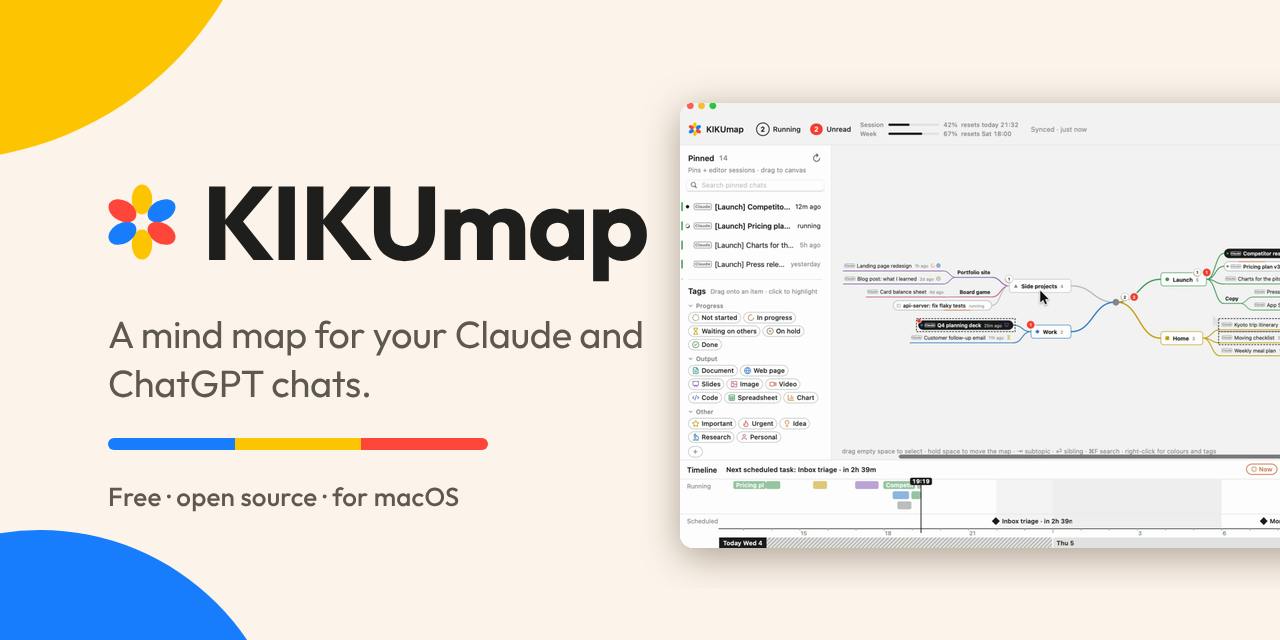
KIKUmap: Manage Your Claude and ChatGPT Conversations with Mind Maps
KIKUmap is a macOS menu bar app that visualizes Claude and ChatGPT conversations as mind maps with real-time status. Free and open source.
Hugging Face Executive Warns: Cyberattacks Are Eroding the Openness of Open-Source AI
Hugging Face executive Irene Solaiman warns that rising cyberattacks on open AI platforms may force stricter security limits, threatening the openness of the open-source community and affecting the developer ecosystem.
Google Cloud Launches Healthcare Version of Gemini: Integrating Clinical Data and Automating Workflows
Google Cloud releases healthcare version of Gemini, focusing on unified clinical data and automated workflows to reduce administrative burnout. Analysis of positioning, challenges, and the healthcare AI landscape.