GPT Image 2.6 Extra High Falls Flat: Why Are AI Influencers Still Praising It?

A Pro user tests GPT Image 2.6 Extra High and calls it basically unusable, clashing with AI influencer praise.
A Reddit user on the Pro plan tested GPT Image 2.6 Extra High and bluntly called it "basically unusable": severe distortion of reference images, chaotic poses in multi-character scenes, disproportionate new characters, with problems further amplified in realistic styles. At the same time, safety filter false positives increased, frequently interrupting the creative process. In stark contrast, AI influencers on Twitter collectively praised the version as a "clear upgrade," raising questions about the authenticity of influencer reviews. The article analyzes reference image preservation and multi-character consistency as core shortcomings and reminds users not to trust influencer reviews, but to test with their own actual workflows.
User Testing: The New Model Is "Basically Unusable"
A Reddit user posted bluntly that GPT Image 2.6 Extra High has gotten so bad that it's "basically unusable." The user is on the Pro plan and specifically enabled "extra high thinking" mode, but the results were disappointing. According to their description, the new model severely distorts reference images, fails to pose multiple characters correctly in multi-character scenes, and produces disproportionate proportions when generating new characters—especially noticeable when aiming for realism.
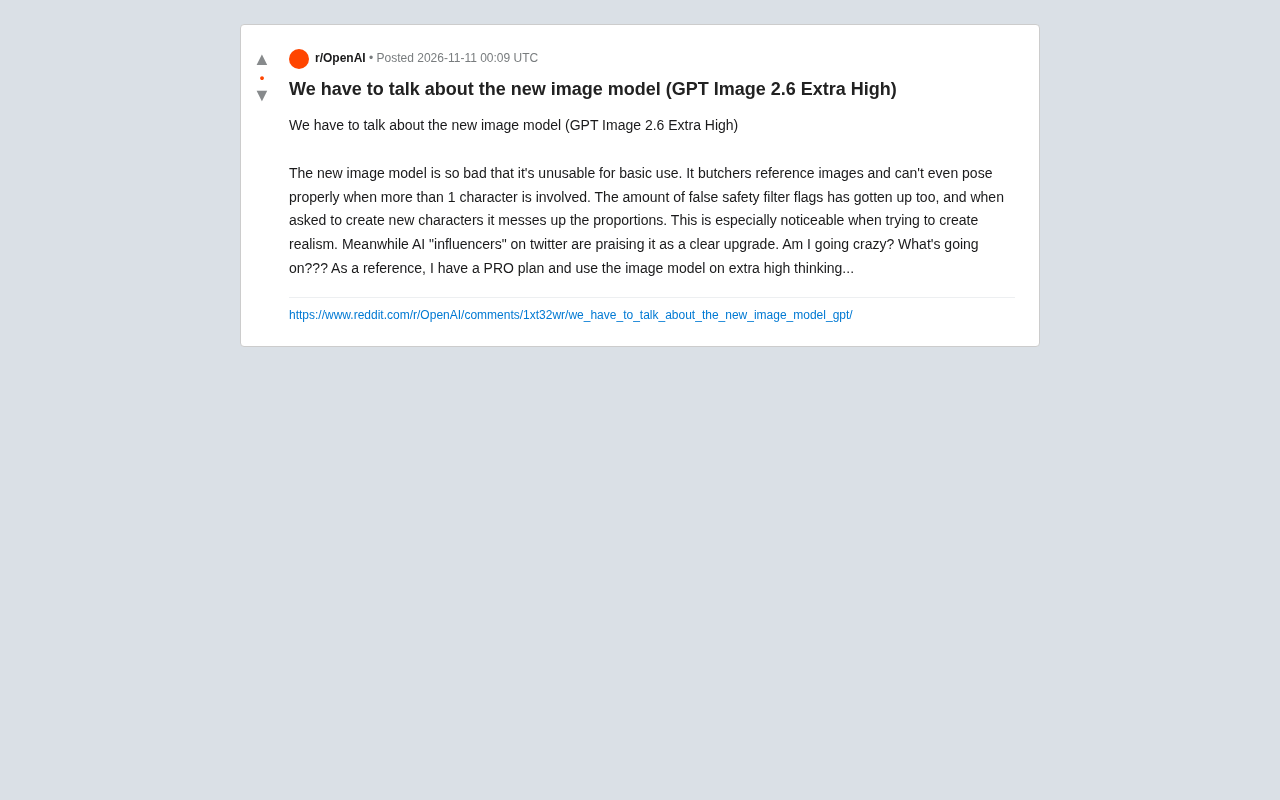
What confused this user even more was encountering more "safety filter false positives." Some completely harmless prompts were incorrectly blocked by the system, causing frequent interruptions to the generation process. They asked: "Am I crazy? What is going on?"
A Split in Reputation with AI Influencers
The post points out that in stark contrast, AI "influencers" on Twitter are collectively praising this version as a "clear upgrade." This gap between official promotion and real user experience has sparked considerable discussion. The user questioned whether these influencers had actually used the model in depth, or were simply catering to vendors for traffic.
This split is not an isolated case. In the AI image generation field, reviews early after a new model's release often come with a filter—influencers showcase carefully selected examples, while ordinary users face all kinds of flaws in daily use.
Technical Shortcomings: Reference Images and Multi-Character Consistency
Based on user feedback, the core problems with GPT Image 2.6 Extra High are concentrated in two areas:
Decline in reference image preservation. The user says the model "butchers reference images," meaning that when a reference image is input and modifications or style continuation are requested based on it, the output deviates too much from the original image and loses the point of the reference.
Failure of multi-character pose control. As long as more than one character appears in the frame, the model cannot arrange poses correctly, and interactions between characters appear stiff or disordered. For users who need to generate two-person photos, dialogue scenes, and similar content, this is a fatal flaw.
In addition, the problem of disproportionate proportions when generating entirely new characters is further amplified in realistic styles. Users originally expected "extra high" mode to bring more refined control, but the result was the opposite.
Reference image preservation is a key technical metric for image generation models, referring to the degree to which the model can maintain the identity features, style, composition, or details of the original image in the output after receiving one or more reference images. In diffusion models, this is usually achieved by mapping the reference image into a condition vector through an image encoder (such as CLIP or IP-Adapter) and then injecting it during the denoising process. If the condition injection is too strong, the output lacks creativity; if it is too weak, the reference image becomes meaningless. What users describe as "butchers reference images" is precisely a manifestation of failed semantic alignment between condition injection and the original image.
Multi-character consistency requires the model to maintain the accuracy of identity and pose separately for multiple different characters in the same frame. This is much more difficult than single-character generation because the model needs to solve the problem of attribute binding between characters and avoid features of different characters contaminating one another. Common solutions include regional attention masks, character-separating tokens, or ControlNet pose guidance. When model parameter count or multi-character samples in training data are insufficient, pose disorder, limb fusion, or disproportionate proportions are likely to occur.
Safety Filters: Increase in False Positives Sparks Dissatisfaction
Safety filter false positives are another major complaint. The user says the number of false positives has "gone up," but did not provide specific ratios or examples. These false positives not only interrupt the creative process but also force users to repeatedly revise prompts to bypass blocks, reducing efficiency.
For users paying for the Pro plan, this is especially frustrating—they pay more but get a more restricted experience.
Safety filters are content moderation mechanisms deployed at the output end of image generation models or the prompt input end, usually implemented by independent classifiers (such as CLIP-based NSFW detectors) or rule engines. Their goal is to block prohibited content such as pornography, violence, and hate symbols, but the classifiers themselves have a false positive rate—that is, harmless content is misjudged as violating rules. When model version updates cause changes in the output distribution, or filter thresholds are lowered to strengthen compliance, false positives increase. For paying users, false positives mean the generation process is interrupted and credits are consumed without results, so the experience gap is especially noticeable.
Conclusion: Don't Let Influencer Reviews Replace Your Own Judgment
This Reddit user's experience reminds us that the real performance of AI image models often falls short of the praise on social media. If you are considering using GPT Image 2.6 Extra High, it is advisable to test it first with your own actual workflow rather than trusting influencers' claims of an "upgrade." After all, whether a model is good ultimately depends on whether it can reliably solve your problems.
Related articles

Lewis's Scoring Completely Out of Control: An Absurd Observation of Gaming Entertainment
Lewis's scoring rules completely out of control in gameplay, switching from rewards to penalties at will, even offsetting deductions and additions to zero. This article analyzes the entertainment logic and rule transparency issues behind such absurd scoring.

The Democrats' Leftward Path for 2028: Blurry Labels and Backroom Games
Using Florida candidate Angie Nixon's case, this analysis examines the Democrats' leftward path for 2028: the mismatch between national media label wars and local voter perception, and how elite donations, polls, and endorsements will decide candidates' fates before the 2027 primary.

One Glass of Orange Juice Contains a Shocking Amount of Sugar: How Continuous Glucose Monitoring Changes Dietary Perception
A glass of orange juice contains up to eight teaspoons of sugar. Continuous glucose monitoring reveals individualized dietary responses. This article explores the link between blood sugar and brain health and how CGM helps ordinary people make smarter dietary choices.