Graded Convolutional Networks: Scale Invariance and Blur Robustness Without Scale Parameters

Graded Convolutional Networks achieve scale invariance without scale parameters via retraction and significantly improve robustness under unknown Gaussian blur.
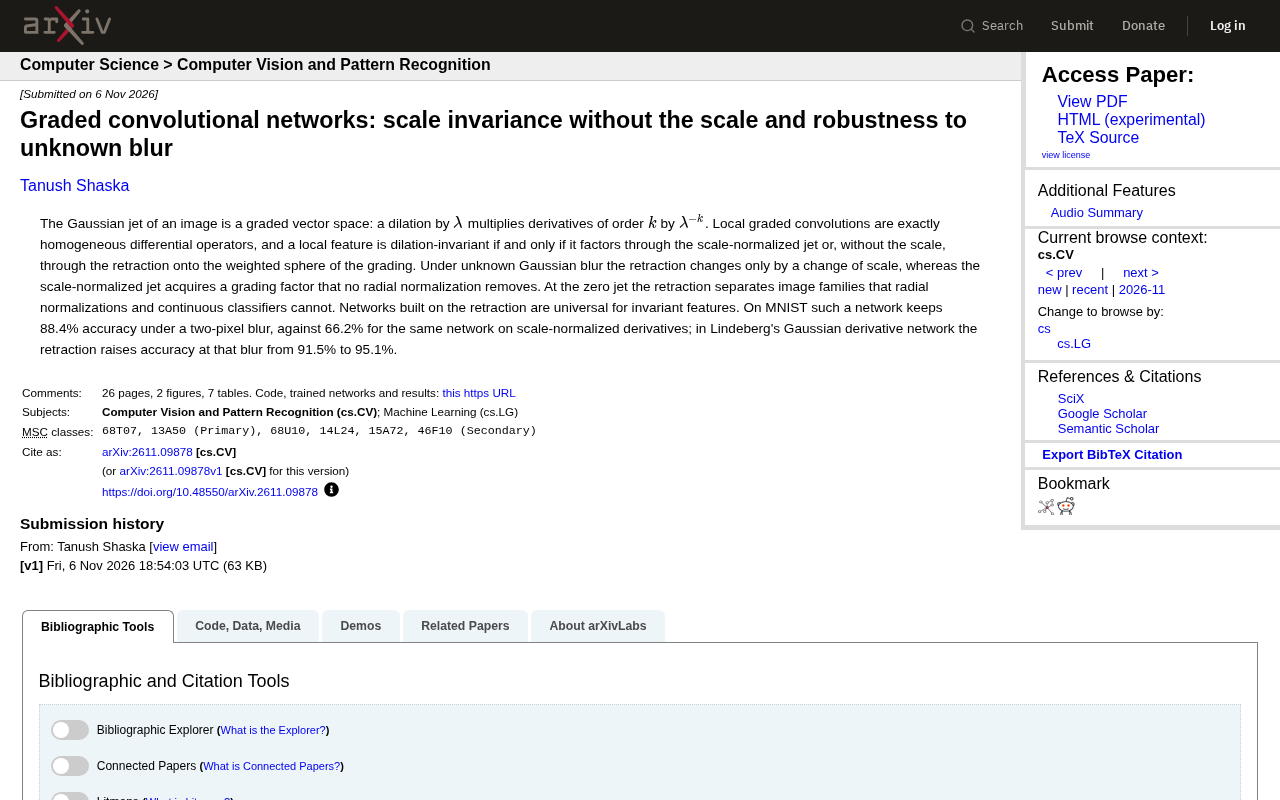
The article introduces Graded Convolutional Networks from an arXiv paper. The core insight is that the Gaussian jet of an image is a graded vector space: k-th order derivatives scale by λ^{-k}, and local graded convolution equals homogeneous differential operators. Scale invariance can be achieved via scale-normalized jet factorization or, without scale normalization, via retraction onto a graded weighted sphere. Under unknown Gaussian blur, retraction only rescales while scale-normalized jets produce a graded factor that radial normalization cannot eliminate. MNIST experiments show 88.4% vs. 66.2% accuracy under two-pixel blur, and retraction boosts Lindeberg's Gaussian derivative network from 91.5% to 95.1%. The paper also proves universality for invariant features.
In computer vision, scale invariance and blur robustness have long been challenging aspects of convolutional network design. Traditional methods rely on scale normalization (such as scale-normalized derivatives) to cope with changes in image scale, but these methods often fail when the blur is unknown. A paper from arXiv proposes a novel convolutional network based on graded vector spaces—Graded Convolutional Networks—which achieves scale invariance without explicit scale parameters through a "retraction" operation and exhibits stronger robustness under unknown Gaussian blur.
Core Idea: The Gaussian Jet of an Image as a Graded Vector Space
The core observation of the paper is that the Gaussian jet of an image is inherently a graded vector space. Specifically, when an image undergoes dilation with scale λ, the k-th order derivative is multiplied by λ^{-k}. This means that derivatives of different orders have different "weights," forming a natural hierarchical structure. Local graded convolution is exactly equivalent to homogeneous differential operators, which provides the theoretical foundation for designing scale-invariant networks.
Under this framework, a local feature is invariant to dilation if and only if it factorizes through the scale-normalized jet, or—when scale normalization is not used—through a retraction onto a graded weighted sphere. The retraction operation can be understood as projecting the jet onto a normalized space, thereby eliminating the effect of scale changes.
Gaussian Jet is a concept in differential geometry and image analysis, referring to the set of all-order partial derivatives of an image at a point, typically organized as a vector by order. For a 2D image, the zeroth order is the intensity value, the first order is the gradient (two components), the second order is the independent components of the Hessian, and so on. Stacking the derivatives of each order into a vector yields the jet representation at that point. The core value of the jet lies in providing a complete infinitesimal description of the local structure of the image, and under the Gaussian scale-space framework, derivatives of each order have a definite homogeneous transformation rule under scale dilation, making it a natural tool for constructing scale-invariant features.
Homogeneous differential operators refer to differential operators that satisfy a scaling relation: if an image undergoes dilation with scale λ, the operator output is multiplied by some power of λ. For example, the first derivative is multiplied by λ^{-1} under dilation, and the second derivative by λ^{-2}. Local graded convolution, if its kernel is weighted by order, is exactly equivalent to such homogeneous operators, thereby encoding scale behavior into the network structure itself rather than relying on post-hoc normalization.
Robustness Mechanism Under Unknown Blur
When an image is subjected to unknown Gaussian blur, the retraction operation undergoes only a change in scale, whereas the scale-normalized jet produces a graded factor that cannot be eliminated by any radial normalization. This explains why networks based on scale-normalized derivatives suffer significant performance degradation under blur.
At the zero jet, retraction can separate image families that radial normalization and continuous classifiers cannot distinguish. This separation capability reflects the unique advantage of the retraction operation, enabling the network to maintain discriminability even under blur conditions.
Radial Normalization refers to dividing a vector by its magnitude (or norm) to project it onto the unit sphere, thereby eliminating the effect of overall amplitude. In scale-invariance design, a common practice is to apply radial normalization to the scale-normalized jet to remove residual scale factors. However, radial normalization can only eliminate a scalar amplitude and cannot handle the graded factor caused by different powers scaling derivatives of different orders—this is precisely the root cause of the failure of scale-normalized jets under unknown blur. The retraction operation instead maps the jet onto a graded weighted sphere, handling each order according to its weight, thus preserving and exploiting the graded structure rather than simply flattening the amplitude.
Experimental Validation: Significant Improvement on MNIST
The paper conducts experiments on the MNIST dataset, comparing the performance of retraction-based networks and scale-normalized derivative-based networks under blur conditions. The results show that with two-pixel blur added, the retraction-based network still maintains 88.4% accuracy, while the same network architecture using scale-normalized derivatives achieves only 66.2% accuracy.
Furthermore, after introducing the retraction operation into Lindeberg's Gaussian derivative network, the accuracy under two-pixel blur improved from 91.5% to 95.1%. This improvement further validates the effectiveness of the retraction mechanism, especially in dealing with unknown blur.
Theoretical Significance and Potential Impact
The paper also proves that retraction-based networks are universal for invariant features. This means that the architecture can express any scale-invariant feature, providing a new theoretical tool for designing more robust vision systems. Compared with traditional scale normalization methods, graded convolutional networks not only avoid explicit scale parameter estimation but also maintain higher performance under blur conditions.
This research opens a new direction for convolutional network design: by exploiting the graded structure of image jets, scale invariance can be achieved without sacrificing discriminability. In the future, this approach is expected to be applied to more complex vision tasks, such as object recognition and medical image analysis, where scale changes and blur are common challenges.
Conclusion
Graded Convolutional Networks achieve scale invariance without scale parameters through the retraction operation and demonstrate significant robustness advantages under unknown Gaussian blur. Experiments show that on MNIST, the retraction mechanism can substantially improve accuracy under blur conditions, especially when combined with existing Gaussian derivative networks. This work provides a new theoretical perspective and practical solution for scale invariance and blur robustness.
One-line Summary
Graded Convolutional Networks use the retraction operation to achieve scale invariance without scale parameters and significantly improve robustness under unknown Gaussian blur.
Paragraph Summary
The article introduces Graded Convolutional Networks proposed in an arXiv paper. Its core observation is that the Gaussian jet of an image is inherently a graded vector space: the k-th order derivative is multiplied by λ^{-k} under scale dilation, and local graded convolution is equivalent to homogeneous differential operators. Based on this, a local feature is invariant to dilation if it factorizes through the scale-normalized jet, or—when scale normalization is not used—through a retraction onto a graded weighted sphere. Under unknown Gaussian blur, retraction undergoes only a scale change, whereas the scale-normalized jet produces a graded factor that cannot be eliminated by radial normalization, explaining the latter's performance degradation. MNIST experiments show that under two-pixel blur, the retraction network achieves 88.4% accuracy versus only 66.2% for the scale-normalized derivative network; after introducing retraction into Lindeberg's Gaussian derivative network, accuracy improved from 91.5% to 95.1%. The paper also proves that retraction-based networks are universal for invariant features.
Related articles

A New Proof on the Closedness of ReLU Network Sets: Single Hidden Layer is Weakly Closed, Two Hidden Layers is Not Closed
New research proves single-hidden-layer ReLU network sets are weakly closed in W^{1,p}, ensuring existence of solutions for Deep Ritz and similar methods; two-hidden-layer network sets are not closed, refuting an existing conjecture.

FlowMoP: A New Framework for Stochastic Multi-Person Motion Prediction
FlowMoP introduces a conditional flow matching framework that jointly generates diverse future motions for multiple agents, using B-spline reparameterization and a dual-stream Transformer for interaction-aware prediction. It outperforms deterministic baselines on CMU-Mocap and 3DPW and establishes the first motion prediction baseline on WorldPose.

Computer-Using Agents: A New General-Purpose Paradigm for Embodied AI
ECCV workshop competitions show computer-using agents (CUAs) can win multiple contests by turning embodied tasks into software interaction, without specialized tuning—revealing their potential as embodied generalists and a new path to general embodied AI.