Grok 4.7 Falls Short of the Hype? Benchmark Scores and Token Efficiency Under Fire

Grok 4.7 underperforms Grok 4.6 on benchmarks while nearly doubling token costs, despite Musk's bold claims.
Elon Musk aggressively promoted Grok 4.7 as a model that would "surpass all existing models" with better token efficiency. However, independent testing shows it scores lower than Grok 4.6 on multiple benchmarks, while per-task token consumption nearly doubles from 38k to 81k — even exceeding competitors like Fable 5.1. The case highlights the persistent gap between AI marketing hype and objective performance, reminding users and developers to evaluate new models on benchmark scores, real token costs, and response speed rather than version numbers or vendor claims.
Grok 4.7: High Expectations vs. Reality
Elon Musk has been hyping Grok 4.7 for over a month. As far back as the Grok 4.5 launch, he teased that 4.7 would be a "major release" that would "outperform every existing model." That kind of bold proclamation set the stage for an uncomfortable comparison once real-world results started coming in.
According to benchmark analysis from a YouTube channel, Grok 4.7 actually scores lower than its predecessor, Grok 4.6, across several tests — a stark contrast to the official messaging. When a highly anticipated model regresses on objective benchmarks, the earlier hype starts to look rather awkward.

The Gap Between Official Claims and Real-World Results
The official positioning for Grok 4.7 is that it's "better than Grok 4.6 in every way," with the only trade-off being "slightly slower response speeds" — offset by "improved token efficiency." On paper, this sounds like a comprehensive upgrade: more capable and more economical.
But the real-world data tears apart that core selling point. The video's creator flatly called it a "lie," arguing that the actual resource consumption tells a story that's the complete opposite of what was advertised.

The Token Efficiency Reality: Costs Nearly Double
The biggest gap between marketing and reality shows up in token consumption. "Better token efficiency" should mean completing the same tasks with fewer tokens and lower cost. The data tells the opposite story.
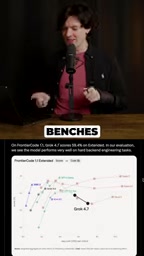
According to the figures cited in the video: Grok 4.6 x high consumes roughly 38k tokens per task, while Grok 4.7 surges to 81k tokens — nearly a 2x increase. In other words, completing the same task costs almost twice as much, directly contradicting the "better efficiency" claim.
How It Stacks Up Against the Competition
The cross-model comparison is even more telling. The video notes that Grok 4.7's 81k token consumption even exceeds models like Fable 5.1, putting it at a disadvantage on cost.
For developers and enterprise users billed by API usage, token consumption translates directly to real money. A model that shows no meaningful benchmark advantage while doubling your costs raises serious questions about its value in production environments.

What is a Token? A token is the basic unit of text that large language models process. Rather than reading characters directly, models split input and output text into tokens — roughly 1 token per 4 characters in English, or 1–2 tokens per Chinese character. API pricing is typically structured per million tokens, so token consumption directly determines your costs. "Token efficiency" measures how many tokens a model uses to complete a task at a given quality level: fewer tokens means higher efficiency and lower cost. For developers running large-scale batch workloads, token efficiency often matters more than benchmark rankings — a model that's slightly below the top tier but uses half the tokens may deliver far more value in production.
Making Sense of the Marketing Around Model Releases
The controversy around Grok 4.7 reflects a broader pattern in AI model launches: the gap between marketing expectations and objective benchmarks. Vendors routinely use absolute language like "surpasses all existing models" to drive pre-release hype, while the true measure of a model's value lies in reproducible benchmark scores and real-world costs.
For everyday users and developers, evaluating a new model should go beyond official announcements and focus on three hard metrics: independent benchmark scores, per-task token consumption (i.e., true cost), and response speed. The Grok 4.7 case makes it clear — a "new version" isn't automatically a "better version," and a higher version number doesn't guarantee greater practical value.
It's worth noting that the data cited here comes from a single YouTube source with limited detail on specific benchmarks and testing conditions. Before drawing firm conclusions, cross-referencing multiple independent evaluations is strongly recommended.
What is a Benchmark? A benchmark is a standardized test suite used to evaluate AI model capabilities. Common examples include MMLU (multidisciplinary knowledge and reasoning), HumanEval (code generation), and MATH (mathematical reasoning). Designed by academic institutions or third parties, these tests aim to provide objective, cross-model comparisons. That said, benchmarks have their limits: vendors may optimize specifically for certain tests (i.e., "benchmark gaming"), leading to impressive scores that don't reflect real-world performance. Testing environments and prompt design can also skew results. The industry generally recommends consulting evaluations from multiple independent organizations alongside real-world A/B testing to form a reliable picture of a model's practical value.
Related articles

OpenAI Math Breakthrough, Anthropic IPO, and Reasoning Model Tutorial
OpenAI unveils math, CS, and physics results, claiming proof that ETH is false; Anthropic files for IPO, disclosing revenue and customer data; SpaceX gets $40B GPU financing; open-source model tool-calling accuracy issues and constrained decoding; 8-video reasoning model tutorial.

14 Core Concepts of Reasoning Models: From Chain of Thought to GRPO Explained
A systematic breakdown of 14 core concepts of reasoning models: chain of thought, test-time compute, verifiers, RLVR and GRPO, distillation, and reward hacking, plus rules for controlling thinking-token costs to help you decide when reasoning is worth paying for.
OpenAI's Claimed Refutation of ETH Sparks Debate, Meta Bets Big on AI Infrastructure
OpenAI claims an AI-assisted discovery that challenges the Exponential Time Hypothesis (ETH) and launches the mid-tier GPT-6.1 Tera. Cloudflare discloses a cross-customer data leak postmortem, and Meta plans $95B in AI infrastructure financing.