GTC On-Site Breakdown: How Agentic AI Is Reshaping Work and Personal Life

NVIDIA GTC session shows agents moving from chat to action: hybrid architectures, enterprise automation, and local personal assistants.
The article recaps NVIDIA GTC's Agentic AI 101 session: AI is moving from conversation and reasoning to autonomous execution, with multiple forms coexisting long-term. A real agent architecture is a system with memory, routing, and specialized models; mixing frontier closed-source models with customized small open-source models balances accuracy, speed, and cost. On the enterprise side, ServiceNow's multi-agent system already resolves 90% of customer service tickets autonomously; on the personal side, compute is returning to the desktop, with NVIDIA entering via DGX Spark/Station hardware and the NemoClaw sandbox approach, emphasizing gradual permission grants. It closes with COSMOS AI scientist compressing six months of research into one day and offers pragmatic starting advice from subscribing to tools and opening up data to building your own assistant.
At NVIDIA GTC's Agentic AI 101 session, there was no piling up of compute specs. Instead, a presentation that felt almost like a product demo pulled agents from concept into reality. The speaker began with a handmade T-shirt printed with the conference map and ended with personal AI assistants and scientific research automation—a narrative arc that itself mirrors the ongoing shift in the AI industry's center of gravity.
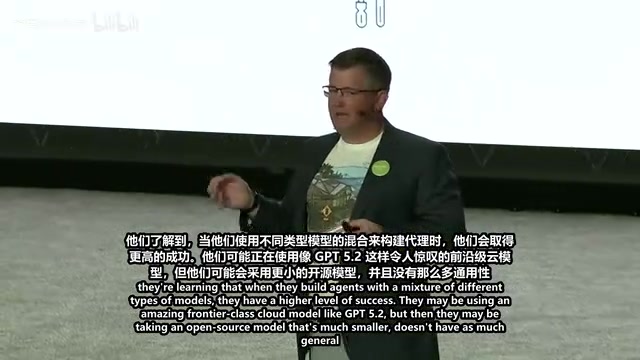
From Chatting to Doing: Four Leaps in AI Capability
The speaker traced the evolution of modern AI along a clear timeline. ChatGPT gave ordinary people their first taste of conversational AI; OpenAI's o1 model introduced reasoning, with AI beginning to break down problems, formulate plans, and self-evaluate—at the cost of longer wait times and higher token consumption; DeepSeekAd put reasoning capabilities into a large language model and opened it to the world, truly changing the landscape; and the emergence of the OpenClawAd project pushed AI from "giving answers" toward "doing it for you"—running autonomously, staying resident long-term, and even self-evolving.
The key judgment along this evolutionary path is: multiple forms of AI will coexist long-term. Asking about the weather doesn't require ten minutes of deep thinking—simple Q&A goes to chatbots; only complex coding and research tasks need agent intervention. The speaker showed an OpenClaw developer community growth curve that was nearly a vertical line, and he made a point of stressing "this is not a chart bug."
Reasoning models (such as OpenAI o1) have a core mechanism of "chain-of-thought"-style test-time compute scaling: before giving a final answer, the model generates a large number of internal reasoning tokens, decomposing the problem into sub-steps, trying different paths, and self-checking. This is fundamentally different from the traditional large model's "one-shot forward generation"—it shifts more compute from the training phase to the inference phase, so responses are slower and token consumption is higher, but accuracy improves significantly on tasks such as math, coding, and multi-step planning. This also explains the judgment in the article that "asking about the weather doesn't require ten minutes of deep thinking": reasoning capability is an expensive resource that can be invoked on demand, not the default path for every request.
The Real Architecture of an Agent: Far More Than a Model Plus an Interface
Many people think an agent is just a large model wrapped in a chat interface. The speaker corrected this misconception: an agent is more like a computer—its inputs can be text, images, video, or even scientific models; it has short-term and long-term memory and can remember conversation context from two weeks ago; internally, it is a system of models rather than a single model.
In this system, speech understanding, intent recognition, and image parsing are each handled by dedicated models, with a routing mechanism dispatching tasks. An important finding in practice is that mixing frontier closed-source models (such as GPT-5.2) with customized small open-source models yields higher success rates, faster responses, and lower costs. Small specialized models running locally reduce both token generation and overall overhead.
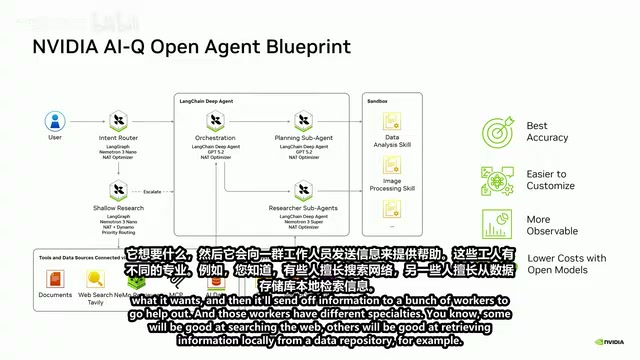
Agents also distinguish between skills and tools—a skill is "knowing how to do carpentry," while a tool is "the hammer and saw in hand." An agent can operate computer interfaces, call APIs and command lines, query structured databases, and read unstructured data such as PDFs and videos. Agents can also collaborate: a main agent dispatches subtasks to specialized sub-agents, aggregates the results, and then decides whether to issue additional requests.
Building an Agent On-Site, Brick by Brick
The talk played footage from the exhibition floor: a developer built a LangChain deep agent using physical building blocks—first choosing a "brain" block, then selecting MCP servers such as Telegram, Wikipedia, and Notes as tools, and then directly asking, "Check the weather in Santa Clara and send it to the work group." The agent completed the query and sent the message. The QR code on each block pointed to the corresponding GitHub repository, so participants could continue developing after leaving. This extremely low barrier to entry is exactly why the OpenClaw community exploded.
MCP (Model Context Protocol) is an open protocol for exposing external tools and data sources to large models or agents in a standardized way. You can think of an MCP server as a "capability plug": each server declares which tools it provides (such as checking weather, reading Wikipedia, or sending messages), and agents discover and invoke them through a unified interface without writing separate integration code for each tool. The on-site demonstration of building an agent with blocks was precisely an abstraction of MCP server selection into visual "blocks," each with a QR code linking to its repository—lowering the barrier to tool integration to nearly zero.
Enterprise Deployment: A Closed Loop for Service Ticket Automation
ServiceNow's case demonstrated the value of agents in serious business scenarios. Its multi-agent system handles customer service tickets: a case agent verifies details and screenshots and passes context to NVIDIA's deep research agent; a triage agent searches historical fixes, logs, and guides to locate the problem; a resolution agent confirms the root cause, performs the fix, and updates the record; and when escalation is needed, engineers receive a complete case file containing analysis, logs, and recommended actions.
The system is built on a hybrid model architecture integrating Claude frontier models, ServiceNow's own models, and NVIDIA Nemotron, using the NVIDIA IQ Blueprint. According to the presentation, 90% of tickets are resolved by autonomous agents, allowing engineers to focus on the hardest problems. The speaker also acknowledged that enterprise-grade agents must meet compliance, security, and organizational policy requirements—completely different from the freedom of personal prototyping.
Personal Assistants Return to the Desktop: DGX Spark and NemoClaw
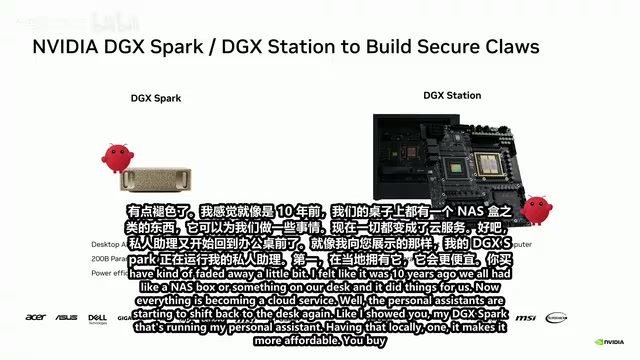
A notable trend: personal AI assistants are pulling compute back to local devices. The speaker showed his own setup—a headless DGX Spark connected to power and an Ethernet cable, running Nemotron 3 Super (120 billion parameters, only 12 billion active), as his private assistant "Magic."
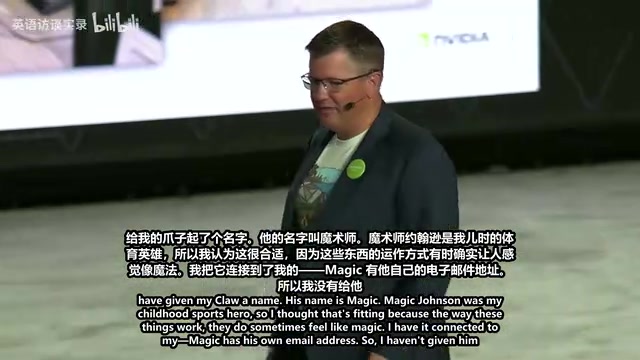
He adopted a cautious, gradual strategy: Magic has its own email address and only receives forwarded mail; it has read-only access to personal files; it is connected to the home automation system to control lights and irrigation, as well as home security. "I gave it context from 20 years of files, and it knows some things even I didn't know." He admitted that agents tend to use every available resource and sometimes go further than expected, so he recommends starting with small steps.
To address the risk of agents "jailbreaking," NVIDIA released the NemoClaw project, in which the open-source component Open Shell creates sandboxes and uses a policy engine to ensure agents do not overstep—even enforcing controls at the network layer. A built-in privacy router keeps sensitive tasks executed locally and calls external APIs only when policy permits.
Sandboxes and policy engines are key security layers when deploying agents in enterprises and personal settings. A sandbox provides an isolated runtime environment for the agent, restricting the files, processes, and network scope it can access; a policy engine verifies at runtime, action by action, whether the agent's behavior complies with predefined rules (for example, "read-only personal files" or "sensitive data does not leave the local device"). The open-source Open Shell component in the article combines the two and pushes control down to the network layer, aiming to preserve agent autonomy while preventing privilege escalation due to misjudgment or prompt injection. The privacy router is an extension of the same idea: it decides whether to execute on a local model or an external API based on task sensitivity, constraining data flows architecturally rather than relying only on prompts.
Hardware Tiers and a New Entry Point
NVIDIA is building a personal AI hardware ladder from desktop to workstation: DGX Spark is close to the size of a Mac Mini and suited to individuals; DGX Station is a game-console-sized workstation that can run trillion-parameter models and be shared by teams. The speaker used an interesting analogy—adding a DGX Station for a team is like hiring another employee.
On the open-source model side, the Nemotron series insists on open weights and as much data as possible; on the PinchBench benchmark, Nemotron 3 Super closely trails the major closed-source frontier models. Cosmos targets physical-world understanding, Alpamayo serves autonomous driving, Clara covers healthcare, and BioNemo focuses on biology.
The talk concluded with Edison Scientific's COSMOS AI scientist: a literature agent uses Nemotron Parse to scan massive numbers of papers, patents, and clinical trial records; an analysis agent uses cuML and cuDF to process large-scale biological data; and a molecule agent uses models trained with Nemo RL to reason about chemical structures. A research cycle that originally took six months was compressed into one day.
Where to Start
The speaker's advice was down-to-earth: first, start using the tools—even a $20 monthly subscription is worth it; push enterprise IT to relax restrictions; open up data—without data access, AI cannot truly help you; connect structured data to databases and route unstructured data through RAG pipelines, with ready-made blueprints available on build.nvidia.com; and finally, slowly build your own personal assistant—when installing OpenClaw, you can say no to every permission request at first, and open things up as you go.
Related articles

T3 Code: The Open-Source AI Coding Assistant's Comeback Story
T3 Code is an open-source AI coding assistant that unifies subscriptions like Codex and Claude, with powerful remote control and parallel task management.

Never Elected, Yet Ruled New York for 30 Years: The Ultimate Case Study in the Mechanics of Power
Robert Caro's biographies reveal how unelected Robert Moses ruled New York for 30 years through legal drafting and public authorities, and how Lyndon Johnson built leverage as a "powerless" Senate Majority Leader. Unpacking the underlying logic of accumulating and sustaining power.

The CPython 3.10 Recursion Trap and Synthetic Recovery in TokenGuard, an LLM Circuit Breaker
TokenGuard's author recounts a recursion crash caused by OrderedDict.pop in CPython 3.10 and introduces v0.3.0's Loop Nudge synthetic recovery, inline DLP scanning, and other new LLM agent circuit-breaker capabilities.