Hallmark: Say Goodbye to AI Template Looks and Give AI-Generated UIs Real Design Sense
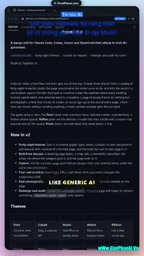
Hallmark injects design standards into AI coding tools so generated interfaces escape the template look.
The article introduces Hallmark, an open-source design skill built for AI coding tools like cloud code and cursor. The author notes that the root cause of identical, clichéd AI-generated interfaces is not insufficient model capability but the lack of clear design constraints. Hallmark provides 48 customizable themes so AI can directly apply polished design systems, and it automatically detects rough, uncoordinated interface issues in real browser environments, moving design quality checks forward into the generation stage. The project has received about 1,600 votes in the community, reflecting widespread developer anxiety about AI interface quality. The article argues its value lies in packaging "design taste" as a reusable skill, suited to rapid prototyping, AI coding workflows, and design consistency—though actual quality still needs verification.
Why AI-generated interfaces always have a "template feel"
When you use an AI assistant to generate a web page or app interface, the results are often disappointing: identical layouts, clichéd color schemes, and piled-up components with no hierarchy. The problem isn't that the model lacks capability—it's the absence of clear design constraints. The AI doesn't know what "good-looking" means, so it can only assemble the most common patterns found in its training data.
Hallmark, an open-source project introduced by a YouTube channel, targets exactly this pain point. It is essentially a design skill built specifically for AI coding tools like cloud code and cursor, enabling AI to follow human designers' aesthetics and standards when generating interfaces rather than mechanically applying templates.
AI coding tools and design skills
cloud code (i.e., Claude Code) is a command-line AI coding assistant released by Anthropic, while cursor is an AI-first editor deeply rebuilt on top of VS Code. Both support extending model behavior through rule files, plugins, or skill packages. A so-called "design skill" injects design systems, component specifications, and inspection rules into the model's context as structured files (such as Markdown instructions and configuration JSON), so the model automatically follows them when generating code instead of requiring the requirements to be re-described in every conversation. Compared with writing prompts by hand each time, skill packages are reusable, version-controllable, and better suited for unifying style across a team—this is the technical foundation that makes projects like Hallmark possible.
Hallmark's two core capabilities
48 customizable themes to end cookie-cutter results
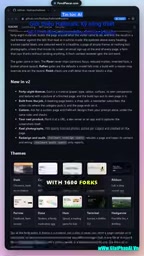
Hallmark ships with 48 customizable theme schemes. This means developers no longer need to manually tweak colors, adjust spacing, or experiment with fonts—the AI simply applies a polished design system when generating code, and the resulting interface looks visually closer to the work of a human designer. This is especially valuable for rapid prototyping: within minutes you get an interface that looks presentable, rather than a half-finished product that needs to be redone.
Automatic detection of "junk interfaces" in real browsers
Even more practical is its self-check mechanism. Hallmark can automatically identify rough, uncoordinated interface issues in a real browser environment—the so-called "rác giao diện" (interface junk). This design moves design quality checks from "human eye review" forward into the AI generation stage, reducing the cost of repeated iteration.
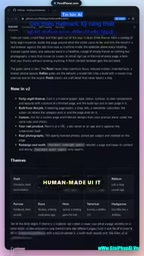
Interface self-checking in real browser environments
Such detection typically relies on browser automation tools like Playwright and Puppeteer to render AI-generated pages in a headless browser, then identifies problems through screenshot analysis, DOM structure checks, and validation of contrast and spacing rules—for example, overlapping elements, chaotic font-size hierarchies, insufficient color contrast, and inconsistent spacing. Compared with statically reading code, real rendering can uncover layout defects that only surface at runtime. Moving this step forward into the AI generation stage is like equipping the model with an automated "design reviewer," which can significantly reduce the cost of manual page-by-page review and repeated rework.
Community response: explosive attention with 1,600 votes
According to the YouTube video, the Hallmark project quickly went viral in the community, accumulating 1,600 votes (lượt phót). This number reflects the developer community's widespread anxiety about the issue of "AI-generated interface quality"—people don't lack generation tools; what they lack is design-layer capability that makes generated results truly usable.
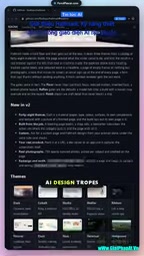
In terms of positioning, Hallmark captures a gap in the current AI coding toolchain: the model handles writing logic, but "design taste" needs to be injected separately. Packaging design specifications as reusable skills is far more efficient than having every developer write prompts and learn by trial and error.
The value of design systems and themes
A theme is not simply a color scheme but a complete set of design tokens: foundational variables such as colors, fonts, type scales, spacing scales, border radius, and shadows, as well as style specifications for components like buttons, cards, and forms. Without constraints, AI models tend to output the style combinations that appear most frequently in training data, which is why results look templated; given a structured theme, the model only needs to combine within the established token system, and the output naturally has consistency and hierarchy. The point of 48 themes is to cover different product tones (such as minimalist, tech, and business), letting developers choose by scenario rather than tuning parameters from scratch.
How to get it and where it applies
The video's author says you can get the project repository link by commenting "Hallmark" in the comments section.
In terms of use cases, Hallmark is best suited to the following needs:
- Rapid prototyping: producing visually acceptable interface drafts in a short time
- AI coding workflows: teams doing end-to-end development with cloud code or cursor
- Design consistency: projects that want multiple pages to maintain a unified visual language
- Less rework: reducing secondary revisions caused by rough interfaces
It should be noted that the above information mainly comes from a single YouTube source. Details such as the actual quality of the 48 themes and the accuracy of the self-check mechanism still need to be verified by actually using the repository code. If you are developing frontends with cloud code or cursor, Hallmark is worth adding to your toolbox and trying out.
Related articles

AI Coding Agent Leaks User Email: Inside the Claude Code Privacy Controversy
Claude Code was caught writing user emails into web request headers, sparking privacy concerns. We break down the technical root cause, Anthropic's fix, developer pushback, and tips for protecting yourself as an AI agent user.

Claude Code Allegedly Leaks User Emails: A Privacy Storm Triggered by a Fix
Claude Code was reported to potentially send user emails to visited websites, caused by a change introduced to fix another bug. This article covers the timeline, technical causes, team response, and data boundary issues for AI coding tools.

Claude Personal Email Leak Vulnerability Explored: Risks, Mechanism, and Temporary Fixes
Claude's personal email leak exposed: ClaudeCode writes real user emails into request headers when visiting sites requiring contact emails, causing scam email floods. This article explains the vulnerability, timeline, and temporary fixes like upgrading to 2.1.3.1.7+ and enabling the ccplugin-privacy plugin, while warning against using the skip permissions flag.