Hands-On Testing OpenAI's Four New APIs: From GPT-4 Turbo to AI Agent Commercial Deployment

Hands-on testing OpenAI's four new APIs and combining them to build an automatic novel cover AI Agent.
This article provides hands-on testing of the four APIs released at OpenAI's Developer Day — GPT-4 Turbo (128K context), DALL·E 3 API, Vision API, and TTS API — validating their capabilities in long text processing, image generation, image understanding, and speech synthesis. By chaining all four APIs together on the AI2Apps low-code platform, the author builds a novel cover auto-generation AI Agent, demonstrating the commercial potential of combining multimodal APIs.
OpenAI's Developer Day introduced several major updates, including GPT-4 Turbo, Vision API, DALL·E 3 API, and TTS API. In this article, I put each of these new capabilities through hands-on testing on the AI2Apps platform, and ultimately chained them together to build a commercially viable AI Agent — an automatic novel cover generator.
GPT-4 Turbo in Action: How Powerful Is the 128K Context Window Really?
The most eye-catching upgrade in GPT-4 Turbo is its 128K context window, meaning the model can process approximately 100,000 words of input in a single pass.
The context window refers to the maximum text length a large language model can process at once, measured in tokens. Tokens are the basic units of text processing — in English, roughly one word corresponds to 1–1.5 tokens, while in Chinese, one character typically maps to 1–2 tokens. Previously, GPT-4 offered 8K and 32K context window versions. The leap to 128K makes it possible to process entire legal contracts, academic papers, full novels, and other ultra-long documents. It's worth noting that expanding the context window also significantly increases computational cost, since the self-attention mechanism in Transformer architectures has quadratic complexity relative to sequence length. This explains why GPT-4 Turbo actually limits output length while dramatically expanding input capacity.
However, it's important to note that while input capacity has been massively increased, the output limit is actually only 4K tokens — even less than the original GPT-4's 8K output cap.
Setting up the test on AI2Apps was very intuitive: place input, LLM, and output components, chain them together, and run in a loop. When selecting the model, GPT-4 Turbo still carries a "preview" label, indicating it's still in the testing phase.
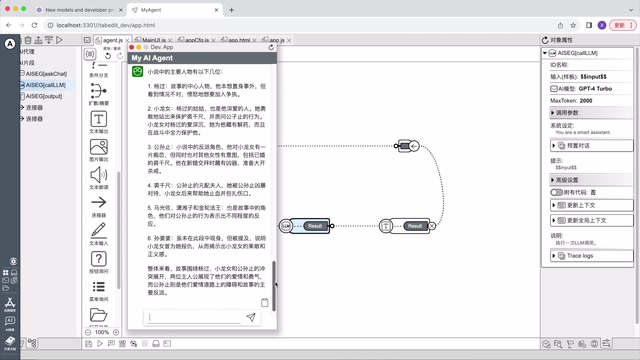
To verify the large context's real-world performance, I pasted a complete chapter from a Jin Yong martial arts novel and asked the model to summarize it. The results were impressive: the model read extremely fast and accurately identified main characters like Yang Guo and Xiaolongnü, even picking out "Granny Sun" — a character mentioned in the chapter but who never formally appears. This demonstrates GPT-4 Turbo's excellent attention to detail when processing long texts.
DALL·E 3 API in Action: A Qualitative Leap in AI Image Generation
DALL·E 3, OpenAI's next-generation image generation model released last month, is now available as an API for the first time.
DALL·E is OpenAI's text-to-image generation model series, spanning three generations of technological evolution. The original DALL·E (2021) was based on a GPT-3 variant architecture, using discrete VAE (Variational Autoencoder) to encode images as token sequences, then generating images autoregressively. DALL·E 2 (2022) shifted to a Diffusion Model architecture, using the CLIP model to bridge text and image semantics, resulting in a quantum leap in image quality. DALL·E 3's core breakthrough lies in training data annotation quality — OpenAI used GPT-4 to regenerate high-quality text descriptions for training images, solving the longstanding problem of models "not following instructions." This approach enables DALL·E 3 to precisely understand complex spatial relationships, quantity concepts, and abstract descriptions, dramatically improving prompt adherence.
In AI2Apps, setup simply requires adding an AI image generation component and connecting user input directly to the drawing module.
The first test was to draw "a big fat orange tabby cat lying on a sofa, belly up." Generation took about 20–30 seconds, and the image quality was genuinely impressive — the cat was adorable, and its pose matched the description perfectly.

The second test was more challenging: "a tree covered with sneakers." This surreal scene doesn't exist in reality, designed to test the model's imagination and creativity. The model not only understood this abstract concept but gave a very thorough interpretation of "covered" — sneakers densely packed all over the tree, truly an extreme rendition of the word.

Based on the test results, DALL·E 3 shows significant improvements over its predecessors in image quality, semantic understanding, and creative expression.
Vision API + TTS API: See, Describe, Then Read Aloud
Vision API: Powerful Image Understanding
GPT-4 Turbo with Vision (also known as GPT-4V) is a multimodal large language model capable of processing both text and image inputs. Its technical foundation involves aligning a visual encoder (typically based on ViT, or Vision Transformer architecture) with the large language model through training. Images are first converted into a series of visual tokens by the visual encoder, which are then fed into the Transformer alongside text tokens for joint reasoning. This architecture enables the model to not only recognize objects in images but also understand spatial relationships, text content, emotional atmosphere, and other high-level semantic information. Compared to traditional computer vision models (such as object detection or image classification), the advantage of multimodal large models lies in their open-ended understanding — they can answer any natural language question about an image rather than being limited to predefined category labels.
GPT-4 Turbo with Vision was already available in OpenAI's apps, but this is its first release as an API. In testing, I connected the Vision component after DALL·E 3's output, having the model interpret its own generated images.
Without being given a specific question, the Vision API automatically provided a comprehensive detailed description of the image, including the cat's fur color, eye color, pose, background environment, and more, demonstrating remarkably strong image reading capabilities.

TTS API: Text-to-Speech Completes the Multimodal Loop
TTS (Text-to-Speech) is the newly released speech synthesis API. Text-to-speech technology has evolved from concatenative synthesis to parametric synthesis to neural network synthesis. Current mainstream neural TTS approaches include Tacotron, FastSpeech, VITS, and others. Open-source projects like Coqui TTS and Bark can already generate quite natural speech. OpenAI's TTS API offers six preset voices — alloy, echo, fable, onyx, nova, and shimmer — with support for real-time streaming output. While it may not match some specialized solutions (like ElevenLabs) in voice cloning and emotional expression, its core advantage lies in seamless integration with the OpenAI ecosystem — developers can complete the entire pipeline of text understanding, image generation, image understanding, and speech synthesis using a single API key and consistent calling conventions.
While speech synthesis isn't new from an AI technology perspective — some open-source solutions even produce better results — OpenAI's integration into its API ecosystem makes building complete multimodal applications much more convenient.
In testing, I connected the TTS component after the Vision output, creating this complete pipeline: User input description → DALL·E 3 generates image → Vision interprets image → TTS reads the interpretation aloud. Using a British Shorthair cat as an example, TTS not only accurately read Vision's analysis but also described poetic details like "sunlight streaming through the window onto the cat, creating a soft halo of light around the edges of its fur."
Commercial Application: Building an AI Agent for Automatic Novel Cover Generation
By chaining all the new OpenAI APIs together, you can quickly build a commercially viable AI Agent — an automatic novel cover generator.
An AI Agent refers to an autonomous system capable of perceiving its environment, making decisions, and executing actions. Unlike simple single API calls, AI Agents emphasize multi-step reasoning and tool-calling capabilities — they can decompose complex tasks into subtasks and sequentially call different tools or APIs to achieve objectives. In this novel cover generator case, the Agent autonomously completes the entire decision chain of "reading comprehension → extracting visual elements → generating drawing instructions → quality evaluation → voice output." Since 2023, AI Agents have become an industry hotspot, with open-source projects like AutoGPT, BabyAGI, and MetaGPT emerging one after another, pushing this concept from academic research into engineering practice.
The workflow operates as follows:
- Input: User pastes novel chapter content
- GPT-4 Turbo Analysis: Through preset system prompts, the model automatically reads the novel content and generates appropriate drawing description instructions
- DALL·E 3 Drawing: Automatically creates the cover based on GPT-4 Turbo's generated instructions
- Vision Interpretation: Provides content description and quality assessment of the generated cover
- TTS Reading: Outputs the interpretation as speech
The key to this AI Agent lies in GPT-4 Turbo's system prompt configuration — you need to clearly tell the model that its task is to generate drawing instructions based on the novel content, so that upon receiving text, it can automatically complete the entire process from understanding to creation. The TTS component can also use different voice options (such as a female voice) to suit different application scenarios.
Conclusion: Each of OpenAI's Four APIs Has Its Strengths, with Enormous Combined Potential
Through this hands-on testing, the distinct characteristics of OpenAI's four new APIs become clear:
- GPT-4 Turbo's 128K context enables long document processing, though the 4K output limit is still a constraint to keep in mind
- DALL·E 3 API delivers a qualitative leap in image generation quality with significantly enhanced semantic understanding
- Vision API's availability dramatically lowers the barrier to building multimodal applications
- TTS API, while not a technical breakthrough per se, completes OpenAI's multimodal API ecosystem
More importantly, when these capabilities are combined through low-code platforms (like AI2Apps), developers can build commercially viable AI Agents in remarkably short timeframes. Low-code platforms further reduce the barrier to Agent development, enabling non-technical users to build complex AI workflows through visual orchestration. From novel cover generation to countless other creative applications, the path to AI Agent commercialization is accelerating. Gartner predicts that by 2028, 33% of enterprise software will integrate AI Agent functionality — meaning we're on the eve of an AI application explosion.
Related articles
 Tutorials
ChatGPT Plus Subscription Guide: Are GPT-5.5, image-2, and Codex Worth the Upgrade?
A detailed look at ChatGPT Plus features — GPT-5.5, image-2, and Codex — with a Plus vs Pro comparison and a complete step-by-step subscription guide for users outside the US.
 Tutorials
Harness AI Engineering in Practice: Using Claude Code to Master Enterprise-Level E-Commerce Development
Deep dive into Harness AI Engineering: master enterprise e-commerce development with Claude Code using the Rules, Skills, Wiki, and Changes framework.
 Tutorials
Cursor + Codex Dual-IDE Collaboration: A Practical Methodology for Open-Source Project Customization
A complete methodology for open-source project customization based on real-world experience, detailing the Cursor+Codex dual-IDE workflow, seven-stage process, MVP validation, and AI source code reading techniques.