Hands-On with Free Agentic Coding Tools: Doubling Java Web Development Efficiency
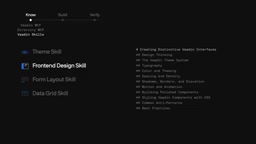
The free Vodden toolkit closes AI coding agents' outdated-version and weak-verification blind spots with deterministic tools.
Based on a video demo, this article introduces the free Vodden agentic coding toolkit. It identifies two structural flaws in AI coding agents: reliance on months-old training memory that leads to outdated API calls, and weak verification that relies on rebuilds, restarts, and screenshot guessing. Vodden counters with five components: a version-aware docs MCP Server, a plugin compatibility Server, Skills that inject coding standards, deterministic Agent Tools, and a DevLoop CLI for build-verify loops. Two controlled experiments show the full toolkit passes benchmarks with ~30% less time and ~20% fewer tokens; DevLoop alone gives ~27% speedup and ~18% cost reduction. The approach is pragmatic and transferable, but since it's tied to a specific framework and the benchmark is vendor-built, small-scale validation is advised.
Hands-On with Free Agentic Coding Tools: Doubling Java Web Development Efficiency
If you're using AI coding agents to build Java web applications, you've probably run into this scenario: the agent writes outdated API calls, or spends a huge amount of time repeatedly guessing whether its changes actually took effect. A new tool suite called "Vodden" aims to solve these two fundamental pain points — and it's completely free.
Based on the video demo, this article breaks down the design philosophy, measured results, and installation of this toolset, and offers an independent assessment of its value.
Two Blind Spots of AI Coding Agents
The video's author points out that regardless of your tech stack, AI coding agents suffer from two structural flaws.
The first blind spot is relying on training memory. Training data is often months behind, while modern software development moves far faster. As a result, agents may call deprecated APIs or substitute "good enough to run" hacks for properly designed implementations.
The second blind spot is weak verification capability. Agents are good at writing code, but struggle to determine whether a change actually took effect. They fumble their way through verification — rebuilding the project, restarting the app, taking screenshots and "guessing" the result from the image. This process is slow, token-hungry, and non-deterministic; inferring information from images has never been a reliable guarantee.
Breaking Down the Vodden Toolkit
To address these blind spots, the toolkit offers five components with clear division of labor.
1. Vodden MCP Server: Version-Aware Documentation Retrieval
It answers framework questions from real documentation and responds only for the Vodden version actually used in your project, preventing the agent from "recalling" incorrect APIs.
MCP (Model Context Protocol) is an open protocol that lets AI applications connect to external data sources and tools in a standardized way. Think of it as a "USB port" for AI agents: the agent doesn't have built-in knowledge of a specific framework; instead, it queries external information on demand through an MCP Server. An MCP Server is a standalone process that exposes several "tools" or "resources" that the agent can proactively call during reasoning to obtain facts. This is precisely the technical basis for Vodden MCP Server's ability to "answer only for the project's actual version" — the agent no longer relies on training memory but issues real-time queries to the documentation service each time. Developers following the MCP ecosystem may note that mainstream agents (such as Claude Code and Cursor) already support mounting custom MCP Servers, which is why such tools have strong portability.
2. Directory MCP Server: Plugin Compatibility Verification
Similar in function but aimed at the add-on ecosystem. It finds plugins and verifies their availability against your project's version, reducing rework caused by "installing it only to find it's incompatible."
3. Vodden Skills: Injecting Coding Standards and Patterns
This is a set of knowledge bases that teach the agent how to build high-quality Vodden apps and use APIs correctly, covering general design principles, patterns and anti-patterns, and best practices for each stage.
4. Agent Tools: Deterministic Check Commands
A small executable that provides the agent with fast, deterministic commands to replace steps that would otherwise require reasoning — for example, checking for common errors, scaffolding new projects, and checking theme and styling issues. Because execution is deterministic, output is consistent every time and consumes no tokens.
5. DevLoop CLI: The Build-Verify Loop
This is the core solution to the second blind spot. It replaces the agent's "guess-based verification" with deterministic commands: the agent can check app status and start or restart the app server via commands, thus answering definitively "is the app running?" and "did my change take effect?" With Hotswap enabled, the agent can also push code updates without restarting the server, making the verification loop even more efficient.
Hotswap is a technique for replacing loaded code without restarting the application. In the Java ecosystem, the traditional approach is to modify source, recompile, and restart the JVM — a time-consuming process that loses runtime state; Hotswap instead pushes new bytecode into the running process via the class-loading mechanism or debug interfaces, making changes take effect within seconds. For AI agents, this means the verification loop shrinks from "edit code → stop → restart → observe again" to "edit code → push → observe," significantly reducing verification cost and failure noise. Note that Hotswap generally supports method-body changes well but has limited support for class-structure changes (such as adding fields or modifying inheritance relationships); beyond that scope, a full restart is still required, and the agent needs to recognize such edge cases.
Measured Data: Two Controlled Experiments
The most persuasive part of the video is two side-by-side controlled experiments using the same model and the same prompts, with the only variable being whether these tools were available.
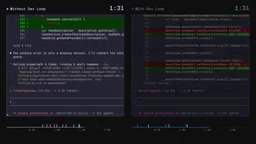
Full toolkit comparison: The left session used the full Vodden toolset, the right did not. The result: the right session failed the benchmark while the left passed; the left also took about 30% less time and consumed about 20% fewer tokens.
DevLoop-only comparison: To isolate DevLoop's contribution, the author ran another experiment enabling only DevLoop. The left agent spent many extra steps verifying changes, each consuming time and tokens; the right ran one command, read the exit code, and moved on. The DevLoop session was about 27% faster and about 18% cheaper.
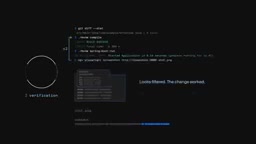
The author stresses this is just a simple example, but in real development changes are verified continuously, so these time and cost savings compound quickly.
VoddenBench: Proving Value with a Benchmark
The tool authors didn't stop at verbal promises. They built VoddenBench, a benchmark running real Vodden tasks, to verify whether the new tools actually help agents. Results show that across all tested models, the additional AI tools brought improvements. The authors also provide benchmark results and source code links, and update them continuously.
This approach deserves credit: vendor-built benchmarks have inherent conflicts of interest, but publishing source code and results at least allows external review — more sincere than pure marketing talk.
Agent benchmarks differ from traditional model capability evaluations: they assess not a model's ability to answer questions alone, but the end-to-end performance of the complete system of "model + tools + prompts" on real tasks. Typical metrics include task pass rate, completion time, and token consumption, with the combination often used to measure cost efficiency. The difficulty of such benchmarks lies in task design and environment isolation: tasks must be realistic yet not leak the solution, and scoring must be objective and reproducible. When a benchmark is vendor-built, be wary of selection bias — "tuning the task set for their own tools" — so external review of source code and task definitions, or small-sample comparisons on your own projects, is a safer way to adopt.
End-to-End Workflow
Stringing these tools together, a typical flow looks like this: you prompt the agent to implement a feature; the MCP Server provides the correct APIs matching the project version; Vodden Skills offers best-practice guidance; the agent writes code; Agent Tools immediately checks whether the agent made low-level mistakes; DevLoop verifies that the code changes are effective and informs the agent of deployment status. If either of the last two steps fails, the agent knows immediately, fixes it, and re-verifies deterministically.
The core philosophy of this design is to "fill the gaps where AI struggles" — the spaces between mainstream development workflows. The goal is clear: let tokens be spent on real work rather than consumed by the agent's guess loops.
How to Get and Install
The easiest way is to hand the installation information directly to your agent and let it install everything. The demo used Claude Code, but according to the video, these tools are also compatible with Codex, Cursor, Copilot, and others. The author also mentions an all-in-one Claude and Codex Marketplace plugin is coming soon. If you prefer manual configuration, step-by-step instructions are provided in the documentation.
Independent Assessment
The approach here is pragmatic: it doesn't try to make agents "smarter" but acknowledges their limitations and uses deterministic tools to fill in. Version-aware documentation retrieval solves the lagging training-data problem, and deterministic checks and status queries solve unreliable verification — both directions hit the mark.
Keep in mind that Vodden itself is a specific framework, and its tool ecosystem is naturally tied to it. For teams using that framework, this free toolset has almost no trial cost and is worth adopting directly. For developers on other stacks, the design philosophy — especially "replacing agent reasoning with deterministic commands" — offers transferable reference value, though the specific tools can't be applied directly.
Also, the benchmark is vendor-built; while transparent, it's advisable to run small-scale validation on your own projects before full adoption.
One-line Summary
The free Vodden toolkit closes two blind spots of AI coding agents — outdated version knowledge and weak verification — with deterministic tools.
Paragraph Summary
Based on a video demo, this article introduces a free agentic coding toolkit called Vodden. The author first identifies two structural flaws of AI coding agents: reliance on training memory that lags months behind, leading to outdated API calls; and weak verification, where agents can only guess whether changes took effect by rebuilding, restarting, and screenshotting — slow, token-hungry, and non-deterministic. Vodden counters with five components: a version-aware documentation MCP Server, a plugin compatibility verification Server, Skills that inject coding standards, Agent Tools providing deterministic check commands, and a DevLoop CLI implementing a build-verify loop. Two controlled experiments show the full toolkit helps agents pass benchmarks while cutting time ~30% and tokens ~20%; DevLoop alone delivers ~27% speedup and ~18% cost reduction. The author finds the approach pragmatic and transferable, but since the ecosystem is tied to a specific framework and the benchmark is vendor-built, recommends small-scale validation first.
Related articles

Mistral Large 4 Open-Sources a Trillion Parameters, Microsoft Offers Voluntary Severance to 60,000 Employees
Mistral Large 4 open-sources a trillion-parameter multimodal model with a coding agent score of 48; SanDisk earnings show AI inference reshaping NAND demand; Google Gemini adds in-app file editing, OpenAI raises Codex quotas, and Microsoft offers voluntary severance to 60,000 employees.
Mistral Large 4 Opens Its Weights: AI Morning Brief Roundup of Models and Ecosystem Trends
Mistral Large 4 opens its weights, a 1-trillion-parameter MoE architecture that can run locally on MacStudio; Meta's test-generation technology enters production; top tax benchmark pass rate only 10.8%; Canadian government takes a stake in Cohere; Doubao Work opens third-party model calls. This AI Morning Brief rounds up model, ecosystem, capital, and policy developments.
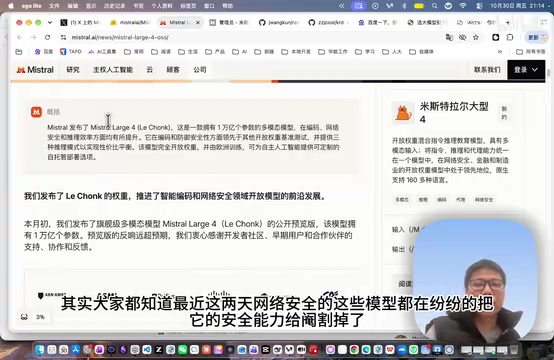
Mistral Large 4 Goes Open Source: A 1T-Parameter European Qwen Challenging DeepSeek
Mistral Large 4 is now open source: 1T total parameters, 52B activated, focused on coding and cybersecurity, with ~610G NVFP4 weights. We analyze its comparison with DeepSeek V4 Flash, API pricing, demo realism, and local deployment value.