Helion Raises $225 Million, Develops New Semiconductors to Boost Fusion Plant Output

Helion raises $225M to accelerate a 2028 Microsoft power plant, with in-house semiconductors planned to double output.
Helion Energy has raised another $225 million to advance its first fusion power plant, targeting Microsoft power supply in 2028. The article highlights its in-house new semiconductors, said to double output power by improving conversion efficiency, expanding competition from plasma physics to system-level engineering and potentially changing fusion economics. Challenges include timeline alignment and long-term device stability under high temperature and radiation.
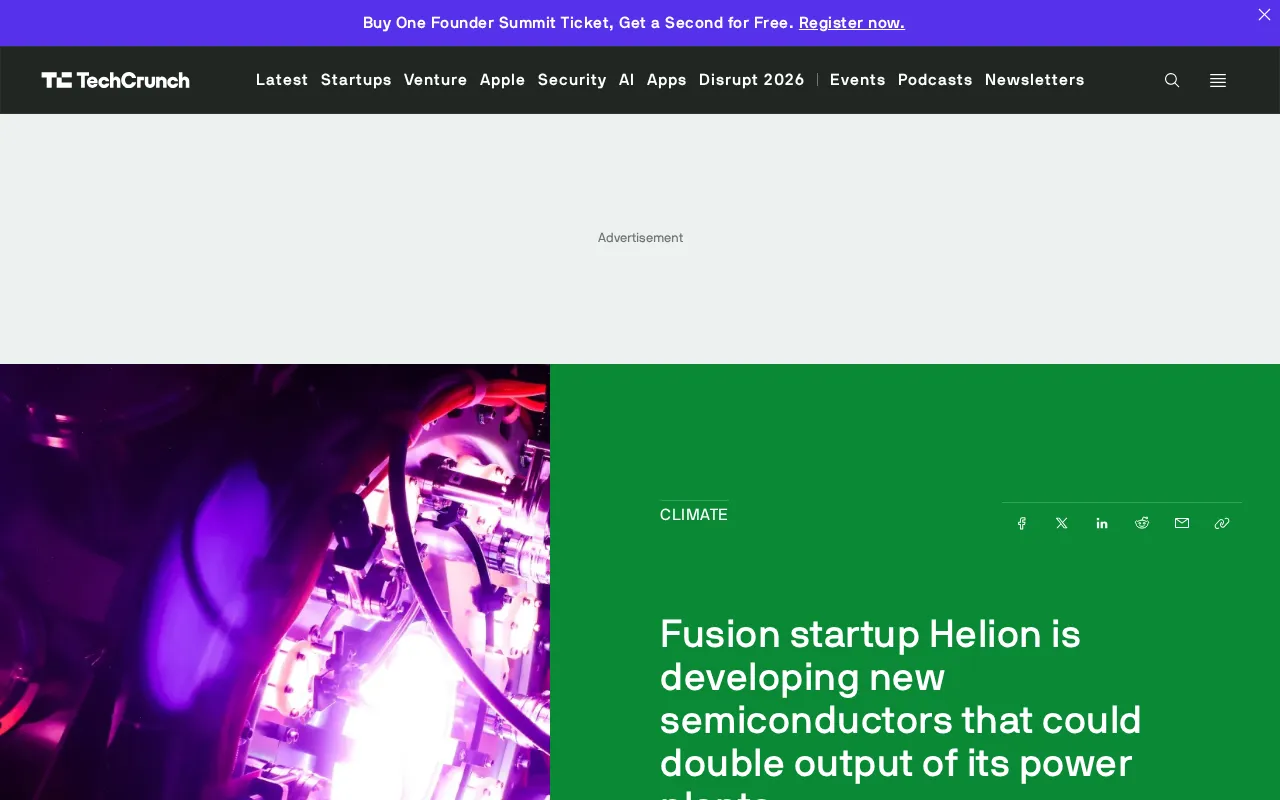
Fusion energy startup Helion has raised another $225 million to accelerate construction of its first fusion power plant. The plant is planned to supply power to Microsoft, with a target date set for 2028. But more noteworthy is Helion's development of a new semiconductor technology that is said to double the plant's output power.
Use of Funds and the Microsoft Power Supply Agreement
According to RSS sources, the $225 million raised by Helion will be used directly to advance development of its first fusion power plant. The plant's core mission is to provide electricity to Microsoft, with a target date of 2028. This means Helion not only needs to achieve breakthroughs in fusion technology but must also simultaneously solve a series of engineering challenges related to power conversion and grid interconnection.
From a business logic perspective, Helion's power supply agreement with Microsoft is one of the few publicly disclosed power purchase commitments in the fusion industry. The arrival of this funding at least indicates that investors still have confidence in the feasibility of the 2028 timeline.
The Key Role of New Semiconductors
Helion's new semiconductor under development has as its core value the improvement of power conversion efficiency. The energy produced by fusion reactions must be converted before it can be fed into the grid, and semiconductor devices play a key role in this process. The new semiconductors are said to potentially double the plant's output power, meaning that at the same scale of fusion reaction, Helion can deliver more electricity to the grid.
This technology path is not a traditional focus area in the fusion field. Most fusion startups concentrate their efforts on plasma confinement and reaction sustainment, whereas Helion has brought power electronics devices into its in-house R&D scope, reflecting its emphasis on system-level efficiency. If the performance improvements in semiconductors are realized, they could change the economic model of fusion power plants—higher output power means lower unit cost of electricity generation.
Power conversion in a fusion plant typically involves converting the high-energy particles or heat generated by plasma reactions into electrical energy through thermal cycles or direct energy conversion, then feeding it into the grid through rectification, inversion, and voltage transformation stages. In this process, power semiconductor devices (such as IGBTs, SiC MOSFETs, GaN HEMTs, etc.) perform switching and regulation functions, and their on-resistance, switching losses, and voltage withstand capabilities directly determine conversion efficiency. The so-called "doubling of output power" in engineering terms usually refers to doubling net grid electricity under the same fusion reaction power due to reduced conversion losses, or to semiconductors enabling the system to operate at higher power density. Wide-bandgap semiconductors (silicon carbide, gallium nitride) compared with traditional silicon devices have higher breakdown field strength and thermal conductivity, and are the main technology direction for improving efficiency. Helion's in-house semiconductor development means it needs to master device design, manufacturing processes, and packaging and thermal management—a significant capability extension for a fusion startup.
Engineering Challenges of Fusion Commercialization
Helion's roadmap faces multiple engineering challenges. The goal of supplying power to Microsoft by 2028 requires the plant to complete the entire process from construction to commissioning in a relatively short time. New semiconductors also require time from R&D to mass production, and whether the two can align on the timeline is a key variable for project success.
In addition, the electricity output from a fusion plant must be stably integrated into the grid, which places high demands on the reliability of the power conversion system. The long-term stability of semiconductor devices under high-temperature and high-radiation environments still requires validation through actual operating data. Helion's parallel advancement of semiconductor R&D and plant construction is an aggressive but risk-laden choice.
Semiconductor devices in fusion facilities face unique environmental stresses: neutron irradiation introduces defects into the semiconductor lattice, leading to reduced carrier lifetime and increased leakage current; high-energy particles can also trigger failure modes such as single-event burnout. In addition, when power conversion equipment is located near the plasma region, it must withstand strong magnetic fields and thermal radiation. Therefore, power devices used in fusion plants must undergo radiation-hardening design or physical shielding and be validated through long-term online operation for their degradation rates. Currently, semiconductor reliability data for fusion neutron spectra is extremely scarce, and most devices have only undergone irradiation testing simulated by fission reactors or accelerators. If Helion is to complete plant commissioning before 2028, it will need to simultaneously establish device irradiation testing standards and lifetime prediction models—a hidden risk on its engineering timeline.
Industry Significance and Points to Watch
Helion's move sends a signal: competition in fusion commercialization is expanding from the plasma physics level to engineering optimization of the entire plant system. Efficiency improvements in power electronics devices may become an important factor in whether fusion plants can be economically competitive.
Points worth tracking include: the specific technical parameters and testing progress of the new semiconductors, whether key plant construction milestones proceed on schedule, and the execution of the Microsoft power supply agreement. This information will help assess the actual pace at which fusion energy moves from experiments to commercial power supply.
Power purchase agreements (PPAs) in the fusion industry are a key signal for measuring commercialization progress. Unlike traditional energy PPAs, fusion PPAs typically include technology milestone clauses and price adjustment mechanisms to share the risk when technology falls short of expectations. Microsoft's agreement with Helion is one of the first publicly disclosed corporate power purchase commitments in the fusion field. Its structural details (such as guaranteed output, default clauses, and electricity price linkage methods) have not been fully disclosed, but the existence of such agreements provides fusion companies with bankable revenue expectations, helping to attract subsequent investment. When evaluating fusion projects, investors are increasingly focusing on the "system-level net electricity" metric—that is, the actual electricity delivered to the grid after deducting plant auxiliary power and conversion losses—rather than only looking at the fusion gain factor Q.
One-line Summary
Helion raises $225 million to accelerate a 2028 Microsoft power supply plant, with in-house semiconductors planned to double output power.
Paragraph Summary
Helion Energy has raised another $225 million to advance construction of its first fusion power plant, targeting power supply to Microsoft in 2028. The article focuses on its in-house new semiconductor technology, said to double the plant's output power, with the core being improved power conversion efficiency. This expands Helion's competitive dimension from plasma physics to system-level engineering optimization and could change the economic model of fusion plants. At the same time, the project faces engineering challenges such as aligning semiconductor R&D with the plant construction timeline and ensuring long-term device stability under high-temperature and high-radiation environments. Industry watch points include semiconductor technical parameters, construction milestones, and execution of the Microsoft power supply agreement.
Related articles

14 Core Concepts of Reasoning Models: From Chain of Thought to GRPO Explained
A systematic breakdown of 14 core concepts of reasoning models: chain of thought, test-time compute, verifiers, RLVR and GRPO, distillation, and reward hacking, plus rules for controlling thinking-token costs to help you decide when reasoning is worth paying for.
OpenAI's Claimed Refutation of ETH Sparks Debate, Meta Bets Big on AI Infrastructure
OpenAI claims an AI-assisted discovery that challenges the Exponential Time Hypothesis (ETH) and launches the mid-tier GPT-6.1 Tera. Cloudflare discloses a cross-customer data leak postmortem, and Meta plans $95B in AI infrastructure financing.

Data Scraping, AI Proofs, and Open Source Contracts: This Week's Deep Dive into the Tech World
From the 3D model crawler controversy and OpenAI's Lean formal proofs to AI agents challenging Brooks' Law and Debian rejecting LLM review, this week's tech discussions center on openness and verifiability.