Hierarchical Bayesian PANN: Population Modeling of Hyperelastic Laws Under Small-Sample Noisy Data

Hierarchical Bayesian PANN uses mixed-effects modeling to separate sample variation from noise, enabling population and individual predictions of hyperelastic constitutive laws from small samples.
Addressing the problem that hyperelastic constitutive laws of biological soft tissues and rubber vary significantly across samples while test data are scarce and noisy, Bayesian versions of traditional physics-augmented neural networks (PANN) can only fit a single sample or perform pooled fitting, failing to describe new samples' individual behavior. This study proposes a hierarchical Bayesian PANN that treats each sample as a draw from a population distribution with a shared polyconvex feature, jointly infers feature, sample, and population parameters via a nonlinear mixed-effects model and variational inference, and models measurement noise separately to avoid mistaking true inter-sample variation for noise. On synthetic populations, Treloar rubber, and healthy and aneurysmal aortic data, the method reaches deterministic PANN accuracy, outperforms three published methods in predicting new samples, and misclassifies no aortic sample into the wrong cohort with high confidence. Its limitation is underestimating uncertainty for untested curves, so credible intervals may be too narrow under extremely scarce data.
From Single-Sample to Population: Constructing the Hierarchical Bayesian PANN
The hyperelastic constitutive laws of biological soft tissues, rubber, and similar materials vary significantly across samples, yet in practice only scarce and noisy data from a small number of samples can be obtained. Although traditional physics-augmented neural networks (PANN) can learn constitutive relationships satisfying physical constraints from data, their Bayesian versions either target only a single sample or fit multiple samples in a pooled manner, failing to describe the individual behavior of new samples. A recent study proposed a hierarchical Bayesian PANN that simultaneously learns population commonalities and individual differences through a nonlinear mixed-effects model, validating its prediction and classification capabilities on synthetic data and real aortic tissue.
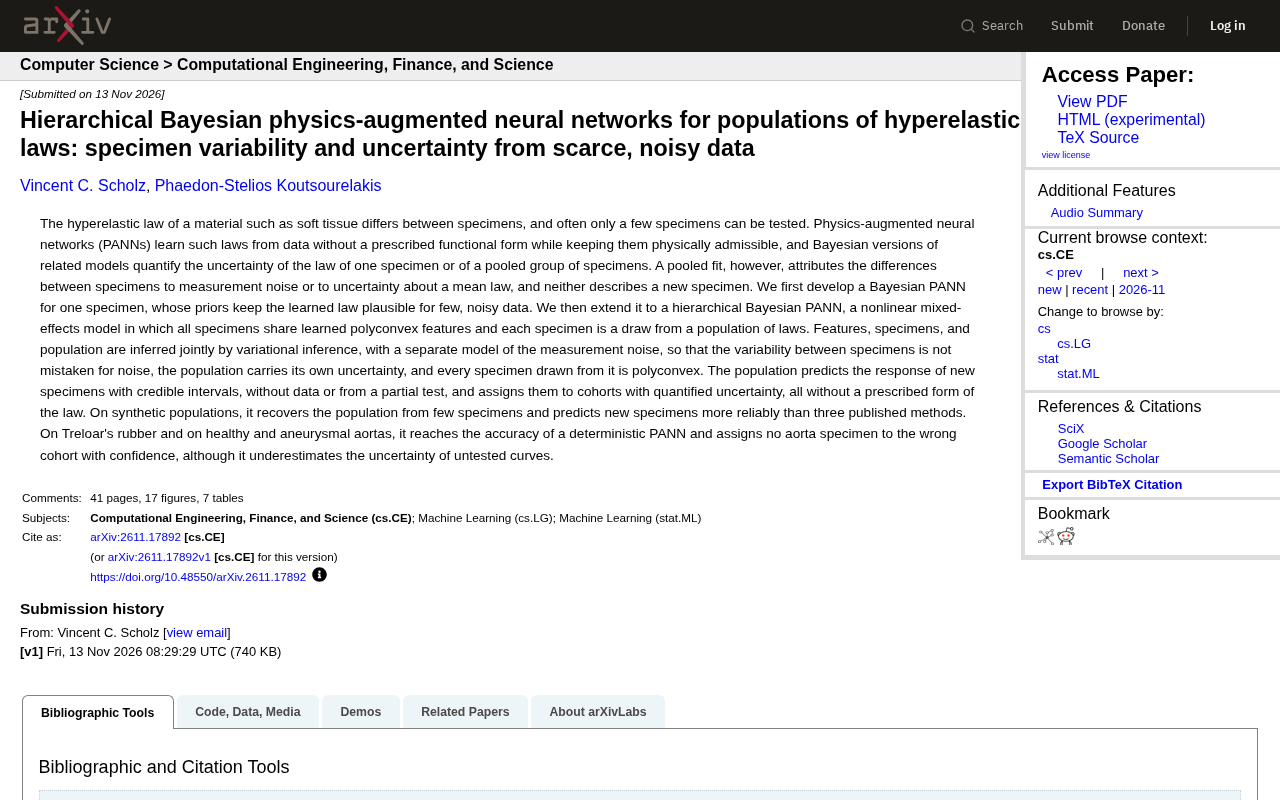
The study first establishes a single-sample Bayesian PANN whose prior design keeps the learned law physically plausible even under scarce, noisy data. It is then extended to a hierarchical Bayesian PANN—a nonlinear mixed-effects model in which all samples share a learned polyconvex feature, and each sample is a draw from the law population. Variational inference jointly infers the feature, sample, and population parameters, with measurement noise modeled separately, thereby avoiding misattributing inter-sample variation to noise. The population itself carries uncertainty, and every sample drawn from the population satisfies polyconvexity.
The key advantage of this hierarchical structure is that, whereas pooled fitting can only yield an average law or attribute differences to noise, the hierarchical model distinguishes "true inter-sample variation" from "measurement noise" and assigns uncertainty to the population distribution. This means that even without data from a new sample, or with only partial testing, the model can predict the new sample's response with credible intervals and classify it into the appropriate cohort with quantified uncertainty.
Polyconvexity is a core mathematical condition in hyperelastic constitutive theory. For isotropic hyperelastic materials, the strain energy density function must satisfy polyconvexity to guarantee the existence and stability of solutions to boundary value problems and to exclude non-physical deformation modes (such as material softening indefinitely under compression). Polyconvexity is weaker than strong ellipticity or rank-one convexity but applies to both compressible and incompressible materials. In PANN, constraining the network output to be a polyconvex function is equivalent to embedding known physical priors into the model structure, so that laws learned under data scarcity still fall within the physically admissible function space. The hierarchical Bayesian PANN further requires every sampled sample in the population to preserve polyconvexity, ensuring that individual predictions do not violate stability conditions.
A nonlinear mixed-effects model is a standard framework in statistical modeling for handling grouped/repeated-measures data: fixed effects describe the population-average trend, and random effects describe individual deviations. In this constitutive modeling context, the fixed effect corresponds to the polyconvex feature function shared by all samples, and the random effect is a draw of each sample from the population distribution. Unlike linear mixed models, the fixed effects here are parameterized by a neural network, giving it expressive power for nonlinear material responses. Variational inference is used to approximate the posterior over fixed effects, random effects, and noise parameters, enabling the model to simultaneously estimate the population distribution and the uncertainty of individual predictions under small samples.
Validation Results on Synthetic Data and Real Tissue
On synthetic populations, the method recovers the population distribution from a small number of samples, and its prediction reliability for new samples outperforms three published methods. On the Treloar rubber data and on healthy and aneurysmal aortic data, its accuracy reaches the level of the deterministic PANN, and it did not misclassify any aortic sample into the wrong cohort with high confidence—although the model underestimated the uncertainty of untested curves. This result indicates that the hierarchical Bayesian PANN, while maintaining physical admissibility, provides population-level and individual-level uncertainty quantification that traditional methods lack.
The Treloar rubber data is a classic benchmark dataset for calibrating hyperelastic constitutive models, published by Treloar in 1944, containing stress–extension ratio curves of natural rubber under three deformation modes: uniaxial tension, equibiaxial tension, and pure shear. The data are widely used to compare the fitting and prediction capabilities of different hyperelastic models, and their multi-mode nature makes them a standard test for examining the physical plausibility of constitutive laws. Including it in the validation here is intended to show that the hierarchical Bayesian PANN is effective not only on biological tissues but also achieves the accuracy of the deterministic PANN on classical rubber materials.
Multi-Source Perspective: Why Inter-Sample Variation Cannot Be Treated as Noise
According to the paper's analysis, the fundamental flaw of pooled fitting lies in attributing sample differences to measurement noise or to uncertainty in the mean law, neither of which can describe a new sample. The hierarchical model, by sharing a polyconvex feature, separating the noise model, and letting each sample be a population draw, turns inter-sample variation into a learnable signal rather than interference. This modeling approach is particularly critical for mechanical testing of biological tissues—where samples are scarce and individual differences are large, mistaking variation for noise leads to overconfident or significantly biased predictions for new samples.
Pooled fitting refers to merging all sample data into a single dataset for fitting, ignoring the sample grouping structure. Statistically, pooled fitting is equivalent to assuming that all samples come from the same population and that individual differences are merely noise; when true heterogeneity exists among samples, this leads to underestimation of the variance of parameter estimates and renders individual predictions meaningless. The hierarchical model, by introducing random effects, decomposes the total variation into between-group variance and within-group noise, thereby preserving information about individual deviations while estimating the population mean. This distinction is especially critical in biomechanical testing with small sample sizes and large individual differences.
Limitations and Implications
The model underestimates uncertainty for untested curves, suggesting that credible intervals may be too narrow when data are extremely scarce. In addition, the current validation focuses on hyperelastic laws, and whether the hierarchical framework can be generalized to other constitutive relationships remains to be explored. Nevertheless, this work provides an interpretable Bayesian path for material constitutive modeling under small-sample, noisy conditions: it does not presuppose a functional form, maintains physical admissibility, and simultaneously outputs the uncertainty of the population distribution and individual predictions. For engineering and biomechanics scenarios that require inferring the behavior of new materials from a small number of tests, this method has direct application potential.
Related articles
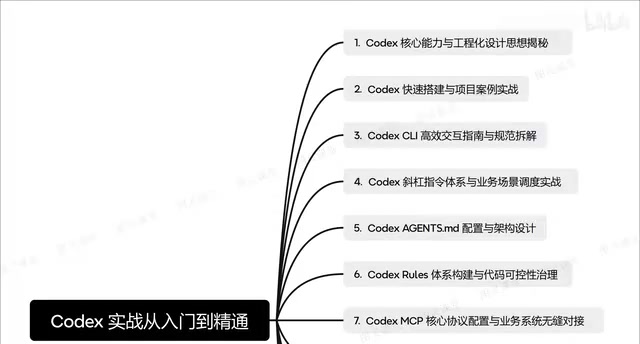
Codex in Practice: From Installation and Configuration to Multi-Agent Collaboration
Based on a Bilibili Codex course overview, this guide maps the full path of AI coding assistants from installation and agents.md context design to CLI commands, MCP integration, and multi-agent collaboration.

Claude Code Installation and Model Switching Guide for Users in China
How can developers in China install Claude Code reliably? This article compiles a Bilibili creator's hands-on solution: install via NPM, skip official login, use CC Switch to configure API Keys and freely switch between DeepSeek, Kimi, and other models to avoid account bans.

AI Supply Chain Security: What Canary Tokens Reveal
Starting from a Hacker News discussion, this article analyzes the role of canary tokens in AI supply chain security: how they detect abnormal access to model weights, training data, and credentials, as well as coverage blind spots and cost constraints during implementation.