Higher-Order Attention: Breaking Through the Information Bottleneck of Autoregressive Language Models
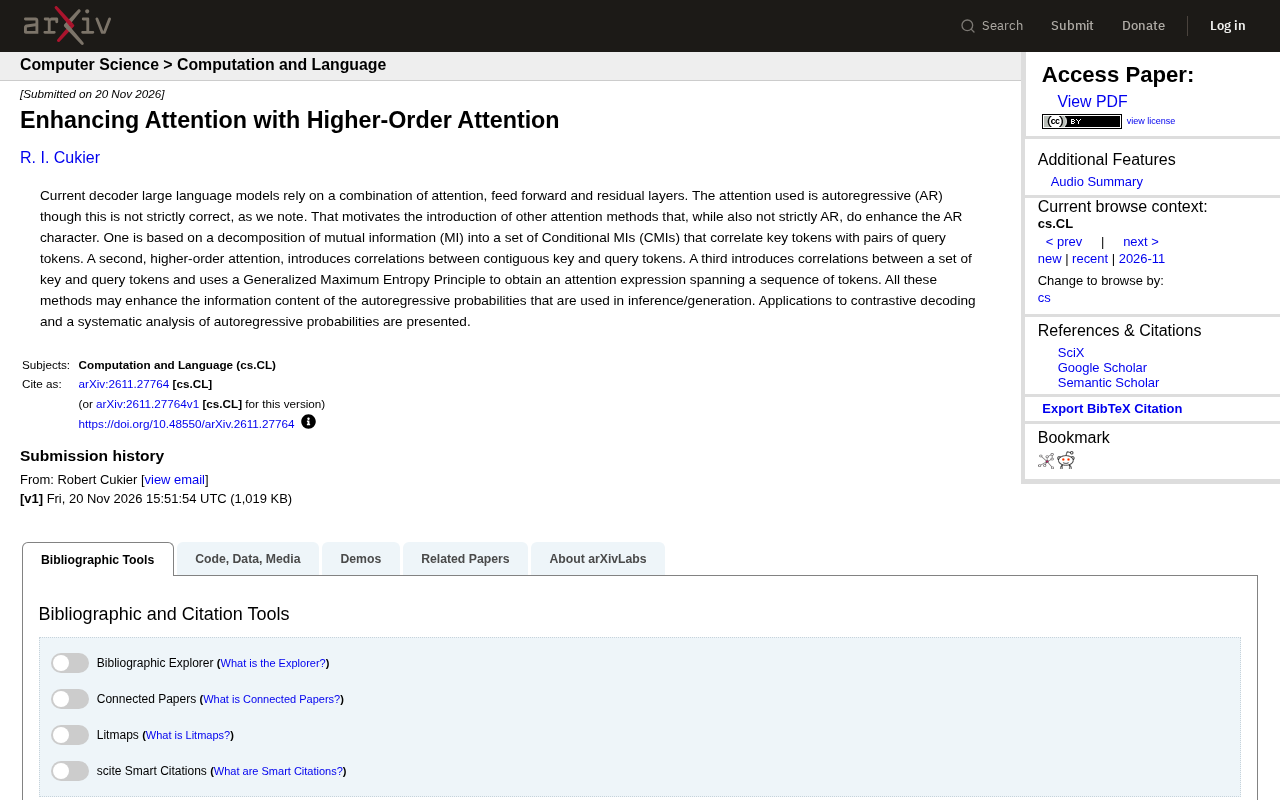
The study explores three higher-order attention mechanisms that break through the information bottleneck of decoder models by enhancing autoregressive properties.
The article re-examines the looseness of the "autoregressive" label in decoder attention, noting that standard attention uses full-prefix context rather than strict previous-token dependency. To strengthen autoregressive properties, it systematically explores three higher-order attention mechanisms: pairwise query modeling via conditional mutual information decomposition, higher-order attention based on correlations between consecutive tokens, and cross-token-sequence attention expressions based on the generalized maximum entropy principle. These methods show potential in contrastive decoding and autoregressive probability analysis, making distributions focus more on plausible continuations. However, they add computational complexity and remain unvalidated at scale; future work must balance efficiency and effectiveness and integrate with efficient variants like sparse attention.
Higher-Order Attention: Breaking Through the Information Bottleneck of Autoregressive Language Models
Current mainstream decoder-based large language models rely on a combination of attention, feed-forward layers, and residual layers. Although the attention mechanism is widely described as "autoregressive (AR)," this label is not strictly accurate—when generating each token, the model actually leverages the context of the entire prefix rather than relying solely on the previous token. This cognitive bias has spurred a series of new attention methods that enhance autoregressive properties. A recent study systematically explored three higher-order attention mechanisms, offering new ideas for improving generation quality.
Revisiting the "Autoregressive" Label: Why Is Existing Attention Not AR Enough?
Attention in traditional decoders is widely described as autoregressive, but strictly speaking, standard attention aggregates information from all historical positions when computing the output for the current token—this is more like full-prefix conditioning than a strict autoregressive dependency. True strict autoregression means each output is conditioned only on the immediately preceding token. This loose definition may cause models to overlook local temporal structure, thereby weakening causal consistency during generation.
The study points out that this imprecise AR property is precisely the motivation for introducing new methods: by explicitly modeling local correlations and higher-order dependencies between tokens, one can strengthen the autoregressive nature of attention and thereby increase the information content of the autoregressive probabilities used during inference and generation.
Autoregressive models in sequence generation tasks are strictly defined as producing each time step's output conditioned only on previously generated tokens, i.e., (p(x_t \mid x_{<t})). However, in Transformer decoders, the self-attention layer, when computing the representation at position (t), aggregates information from all historical positions (1) to (t-1) via key-value pairs—this is actually full-prefix conditioning, not a strict first-order Markov dependency. This discrepancy means the model may over-smooth local temporal patterns and weaken causal consistency. In addition, although the causal mask prevents future information leakage, it does not limit the extent to which the model depends on distant historical information. Therefore, researchers propose enhancing autoregressive properties by explicitly modeling interactions between local tokens, making attention allocation more consistent with the causal structure of sequence generation.
Analysis of Three Higher-Order Attention Mechanisms
Conditional Mutual Information Decomposition: Capturing Query-Pair–Key Associations
The first method is based on decomposing mutual information (MI), breaking overall MI into a set of conditional mutual informations (CMIs) that associate key tokens with query token pairs. Simply put, while traditional attention computes a matching score between each query and each key, CMI decomposition considers how the joint information of two query tokens relates to a given key token. This pairwise query modeling captures richer contextual interactions, making attention allocation more discriminative.
Mutual information (MI) measures the shared information between two random variables, defined as (I(X;Y) = H(X) - H(X|Y)). In attention mechanisms, the matching score between a query and a key can be viewed as a pointwise mutual information estimate. Conditional mutual information (CMI) further introduces a third variable as a condition, i.e., (I(X;Y|Z)), representing the additional information between (X) and (Y) given (Z). Decomposing overall MI into multiple CMIs allows the query-key association to be broken down into conditional associations between query pairs and keys, thereby capturing higher-order statistical dependencies. This decomposition, known in information theory as the chain rule, allows the model to incorporate synergistic information among queries into attention computation, rather than only independent query-key pairs. This provides richer discriminability for attention weights, especially for generation tasks requiring long-range consistency.
Higher-Order Attention: Correlations Between Consecutive Tokens
The second method, "higher-order attention," introduces correlations between consecutive key tokens and query tokens. Unlike computing dot products for a single query-key pair, this method treats adjacent keys and queries as a whole, modeling their synergistic patterns. For example, when generating a word, the model simultaneously attends to the combined effect of the previous key and the current key, thereby enhancing sensitivity to local sequence patterns. This design directly strengthens autoregressive properties, since dependencies between consecutive tokens are at the core of AR models.
Generalized Maximum Entropy Principle: Attention Expression Across Token Sequences
The third method takes a set of key and query tokens as input and uses the generalized maximum entropy principle to derive an attention expression spanning multiple tokens. The maximum entropy principle selects the most uniform distribution subject to given constraints; here it is used to construct attention weights that adaptively cover sequence segments. This approach is no longer limited to point-to-point matching but allocates attention at the overall sequence level, helping capture higher-order structures in long-range dependencies.
The maximum entropy principle advocates choosing, under known constraints, the probability distribution with maximum entropy—i.e., the most uniform and least certain distribution—to avoid introducing unfounded assumptions. In attention mechanisms, traditional softmax can be viewed as the maximum entropy solution under a normalization constraint. Generalized maximum entropy allows more complex constraints, such as expected feature matching or sequence-segment coverage constraints, thereby deriving more flexible attention weight expressions. This method takes a set of key and query tokens as a whole input and, by solving a constrained entropy maximization problem, obtains an attention distribution spanning multiple tokens. Its advantage lies in adaptively covering sequence segments rather than being limited to point-to-point matching, which helps model higher-order structures in long-range dependencies while maintaining the interpretability of the probability distribution.
Application Prospects: Contrastive Decoding and Autoregressive Probability Analysis
These higher-order attention methods do not remain at the theoretical level. The study demonstrates their application in contrastive decoding and conducts systematic autoregressive probability analysis. Contrastive decoding is a technique that improves generation quality by contrasting outputs from different models or different contexts; higher-order attention can provide richer probability signals, thereby improving the contrastive effect.
In addition, systematic analysis of autoregressive probabilities helps understand how these methods affect uncertainty during generation. Preliminary results indicate that enhancing AR properties can make probability distributions focus more sharply on plausible continuations, reducing arbitrariness in generation.
Contrastive decoding is a training-free decoding strategy that improves generation quality by contrasting the output probability distributions of two models (e.g., an expert model and an amateur model) or of the same model under different contexts. Specifically, it selects tokens for which the expert model assigns high probability and the amateur model assigns low probability, thereby avoiding repetitive, degenerate, or irrelevant continuations. Higher-order attention methods can provide richer probability signals because enhanced autoregressive properties make the model more sensitive to local temporal structure, thereby amplifying meaningful differences during contrast. In addition, autoregressive probability analysis involves studying the characteristics of the model's output conditional probability distribution at each time step, such as entropy, sharpness, and calibration. Enhancing AR properties can concentrate probability distributions more on plausible continuations and reduce randomness in generation, which is particularly important for reasoning tasks requiring high certainty.
Limitations and Future Directions
It is worth noting that these methods are still at the research stage and have not yet been validated in large-scale production models. Each of the three methods increases computational complexity: CMI decomposition requires pairwise query computation, higher-order attention involves joint modeling of consecutive tokens, and generalized maximum entropy requires solving a constraint satisfaction problem. How to balance efficiency and effectiveness is key to future engineering.
Another open question is whether these methods can be combined with existing efficient attention variants (such as sparse attention and linear attention). If AR properties can be enhanced without significantly increasing overhead, this could advance decoder model performance on long-text generation and complex reasoning tasks.
Overall, this research reminds us that the design of attention mechanisms is far from settled, and a rigorous examination of the concept of "autoregressive" can spur tangible improvements. As large models demand ever higher generation quality, higher-order attention may become an important component of next-generation decoder architectures.
One-line Summary
This study explores three higher-order attention mechanisms that break through the information bottleneck of decoder models by enhancing autoregressive properties.
Paragraph Summary
The article re-examines the looseness of the "autoregressive" label in decoder attention, pointing out that standard attention actually leverages full-prefix context rather than a strict previous-token dependency. To enhance autoregressive properties, the study systematically explores three higher-order attention mechanisms: pairwise query modeling based on conditional mutual information decomposition, higher-order attention based on correlations between consecutive tokens, and cross-token-sequence attention expressions based on the generalized maximum entropy principle. These methods show application potential in contrastive decoding and autoregressive probability analysis, enabling probability distributions to focus more on plausible continuations. However, they increase computational complexity and have not yet been validated in large-scale models; future work must balance efficiency and effectiveness and integrate them with efficient variants such as sparse attention.
Related articles
New Controversy Around the Riemann Hyp…
New Controversy Around the Riemann Hypothesis: Why Masullo's Proof Is Sparking Debate
Masullo's new work on the Riemann Hypothesis, introduced via John Carlos Baez's blog, sparked heated discussion on Hacker News with 163 points and 77 comments. This article covers the background, community reactions, and how to rationally view such mathematical claims.

MemOnce: A Scalable Memory Architecture for LLMs That Cuts 1M-Context GPU Memory by 1000x
MemOnce introduces a scalable memory architecture with memory encoding-decoding and sparse attention, cutting Qwen3.5-4B memory cache 1313x and prefill latency 6.9x at 1M context.

COP31 Climate Talks End Without Agreement Over Fossil Fuels and Finance Disputes
COP31 climate talks failed to reach agreement over fossil fuel phase-out and climate finance disputes. This article analyzes the core conflicts behind the breakdown and its impact on global climate governance.