How AI Agent Tool-Calling Loops Work: A Detailed Breakdown

An AI Agent is essentially a tool-calling loop, and its reliability comes from external engineering constraints, not the model's self-discipline.
The article reduces an AI Agent to a simple engineering structure: a user request plus a predefined tool list, a model that outputs structured tool-call intents, application code that executes them via MCP, and results fed back into context in a repeating loop. The model executes nothing itself; its capability boundary is set by the tool list. High-risk tools trigger a pause for human approval, tying autonomy to risk level, while a step limit and approval gate provide safety without relying on the model's self-restraint.
AI Agents are often described as "AI that can complete tasks autonomously," but their core mechanism is actually remarkably simple: a repeating tool-calling loop. Understanding this loop means understanding why an Agent can query databases, call APIs, and even issue refunds—and why it needs to be "watched."
The Starting Point: User Request and Tool List
Everything begins with a user message. For example, the user says "refund order 417." The application doesn't simply hand this sentence to the model and call it done; it also attaches a "list of tools the model is allowed to use." This is the first key decision in Agent design: the model's capability boundary is predefined by this list, and it cannot invent tools out of thin air.
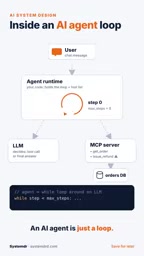
According to the breakdown in the original YouTube video, at this point the model does not answer directly. What it sees is a description of "which tools can be called," so its first priority is to determine whether it needs to use a tool to gather more information. This "act first, answer later" tendency is exactly the dividing line between an Agent and an ordinary chatbot.
Tool Calling: The Model Decides, the Code Does the Work
The model's first reaction is a tool call: calling the get_order tool with the order ID as the parameter. There's a detail here that is often misunderstood—the model itself doesn't execute any operation. It merely outputs a structured call intent, and the code you wrote is what actually runs the tool.
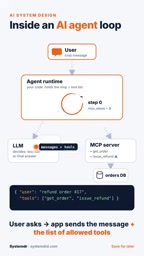
The code forwards this call to a server via MCP (Model Context Protocol), and the server then reads the order database. MCP plays the role of a standardized "switchboard operator" here, giving model-to-external-system communication a defined protocol so you don't have to write a private set of glue code for every data source.
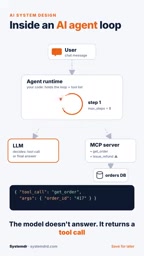
The result returned by the tool is appended to the conversation context. After receiving the order information, the model makes another judgment: should it call another tool, or can it answer now? This rhythm of "judge—call—feed back—judge again" is the loop itself.
tool call is structured data output by the model, typically following a specific format (such as OpenAI's function_call or Anthropic's tool_use block), containing the tool name and JSON parameters. It is essentially a special kind of "text completion"—the model isn't running a program; it's predicting "which tool should be called and what parameters should be passed." Because of this, the application layer must parse this output, validate parameter legality, and then execute it itself. The model knows nothing about the tool's actual behavior, return values, or even whether it exists; it can only infer purpose from the description text in the tool list. This also explains why the more precise the tool descriptions are, the lower the probability that the model picks the wrong tool; it also means that malicious or vague descriptions could induce the model to initiate dangerous calls—the tool list itself is an attack surface that needs careful design.
MCP (Model Context Protocol) is an open protocol proposed by Anthropic at the end of 2024 to standardize how model applications connect to external data sources and tools. It uses a client-server architecture: the Agent application acts as the client, communicating with individual MCP servers via JSON-RPC, with each server exposing a set of tools, resources, or prompt templates. In the Agent loop, MCP's value lies in abstracting "how tools are discovered, how they are called, and how results are returned" into a unified interface, so the same tool can be reused across different models and frameworks without rewriting integration code for each data source. It is often compared to "the USB-C port for AI applications." Note that MCP only handles connection standardization; it does not handle permissions and approvals—security gates still need to be implemented at the application layer.
Risky Tools and Approval Gates
Once the order information is in hand, the model decides to call issue_refund. Unlike read-only queries, this tool actually moves money. So the loop pauses here, waiting for human approval. The refund is executed only after approval, and the model then writes the final response based on the execution result.
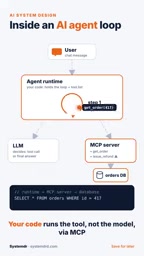
This pause point reveals a pragmatic design philosophy: an Agent's autonomy should be tied to the risk level of the operation. Query-type tools can be allowed to run freely, while tools for funds, deletion, or outbound communications need gates.
human-in-the-loop is a design pattern in Agent systems that embeds human judgment into automated workflows. In the tool-calling loop, it is usually implemented as an interception layer: when the model requests a tool marked as high-risk, the runtime pauses the loop, presents the tool name, parameters, and model intent to a human, and waits for approval, modification, or rejection before deciding whether to execute. A common engineering practice is to attach risk metadata to each item in the tool list (read-only/write/funds/outbound communication), and let a policy engine rather than the model decide which calls need to be intercepted. The key to this pattern is that approval happens before execution, and the approval result is fed back to the model as new context, so the model can adjust subsequent behavior based on the fact of "being rejected" rather than blindly retrying.
Two Guardrails: Step Limit and Approval Gate
The original video identifies two guardrails that keep an Agent safe. One is the maximum step limit, which prevents the model from falling into an infinite calling loop—in reality, the model may repeatedly call the same tool without converging, and the step limit is the last line of defense. The other is the approval gate, namely the confirmation mechanism for high-risk tools described above.
What these two guardrails have in common is that neither relies on the model's "self-discipline." An Agent's reliability comes from external constraints, not from reminders in the prompt. Leaving safety to the model's self-restraint is a common misconception in current engineering practice.
Why This Loop Model Matters
Reducing an Agent to a loop brings several direct engineering insights. Designing the tool list is equivalent to designing capabilities—adding one more tool adds one more surface of risk; context management is crucial because every round of tool results eats into the window; and the placement of approval points determines the division of labor in human-AI collaboration.
At the end, the original video previews a sequel on how Agents remember across sessions. This is exactly the next extension of the loop model above: when the loop ends and the session closes, how is the context accumulated by the Agent retained? This will be another level of design challenge.
For developers, the value of understanding this loop is not in memorizing the steps, but in realizing: an Agent's "intelligence" comes from the model, but an Agent's "reliability" comes from engineering constraints outside the loop.
One-line Summary
An AI Agent is essentially a tool-calling loop; reliability comes from external engineering constraints, not the model's self-discipline.
Paragraph Summary
The article reduces an AI Agent to a simple engineering structure: starting from a user request and a predefined tool list, the model judges whether it needs to call a tool, outputs a structured tool call intent, and the application code forwards it via MCP to an external service for execution; the result is fed back into context, and the model judges again, looping until it gives a final response. The model itself executes nothing, and its capability boundary is entirely defined by the tool list. For high-risk tools that move money, the loop pauses for human approval, tying autonomy to risk level. The two guardrails that maintain safety are the maximum step limit and the approval gate, neither of which relies on the model's self-restraint. The article emphasizes that an Agent's intelligence comes from the model, while its reliability comes from engineering constraints outside the loop; tool design, context management, and the placement of approval points are the core engineering decisions.
Related articles

world2vec: Building Mechanistic World Models with Latent Dynamics Learning
world2vec proposes a reward-free method for learning mechanistic world models via latent dynamics, faithfully reproducing systems over long horizons with at least an order of magnitude fewer parameters than DreamerV3, TD-MPC2, and LeWM, and achieving accurate system identification on 71 attractor benchmarks.

A New KL-DRO Paradigm: Adaptive Scenario Generation Around a Learned Density Model
KL-DRO research proposes centering the KL ball on a learned density model instead of the empirical distribution, with adaptive scenario generation guiding sampling toward the worst case. Experiments show lower cost under distribution shift when records are scarce and the model can extrapolate, with comparable in-distribution cost.

ODE Samplers for Discrete Diffusion Models: Exponential Residual Flows Accelerate Generation
Discrete diffusion models lack deterministic ODE sampling? This article introduces Exponential Residual Flows (ERFs), which introduce continuous residual variables per token to construct piecewise ODEs for deterministic sampling and support consistency distillation acceleration. Superior to prior methods on code and text generation tasks.