How AI Embeds into Organizational Structure: Three Forms of the Future Company

AI enters organizational structure in three positions: beneath, beside, and between—the core issue shifts from role replacement to human-machine responsibility orchestration.
The article moves beyond the conventional discussion of "which roles will be replaced by AI" and raises a more structural question: in what capacity will AI enter the org chart—beneath us, beside us, or between us. On this basis it forms a three-layer framework: AI as an execution-layer subordinate, as a parallel collaborating colleague, and as an intermediary connecting people. The three layers are not mutually exclusive but are evolutionary forms that may coexist. The article points out that treating AI as a subordinate brings new supervision and coordination costs; treating AI as a colleague requires organizations to make substantive adjustments in performance evaluation and responsibility allocation; and AI as an information intermediary may reshape organizational information flow and overall cognition without appearing on the org chart. The ultimate conclusion is that the future company is more likely to be a hybrid form, and the core issue of organizational design shifts from headcount planning to human-machine responsibility orchestration.
Core Question: Who Will AI Replace, or Will It Redefine "Who"
Mainstream discussion about the relationship between AI and organizations often stops at "which roles will be replaced." But a more worthwhile angle to pursue is: in what capacity will AI enter the org chart—beneath us, beside us, or between us? This way of asking the question itself shifts the focus from "human-machine replacement" to "human-machine orchestration."
The original material's title "The future of the firm" and subtitle "How AI might enter the org chart—beneath, beside, and between us" provide a three-layer analytical framework: AI as subordinate, AI as colleague, and AI as connective layer. These three layers are not mutually exclusive; they are more like three stages of organizational evolution or three coexisting forms.
AI Beneath Us: Restructuring the Execution Layer
The most intuitive form is treating AI as an executor, placing it in positions that handle repetitive, clearly rule-based tasks. This is nothing new—RPA and automation scripts have long been doing similar things. The difference is that large models have expanded the applicable scope of "subordinates" from structured processes to semi-structured and even unstructured tasks.
The organizational implication of this form is that management span may be redefined. A manager could theoretically "lead" more AI execution units, but that does not mean management becomes simpler—supervising AI output quality, handling exceptions, and defining responsibility boundaries themselves constitute a new management burden. Treating AI simply as cheap labor makes it easy to underestimate coordination costs.
RPA (Robotic Process Automation) refers to using software robots to simulate human operations on graphical interfaces, automatically completing repetitive tasks such as data entry, form filling, and cross-system transfer according to preset rules. It relies on deterministic rules and structured data; once an exception occurs in the process, human intervention is required. What large models change is that they can handle unstructured inputs (such as natural-language emails or vaguely described requirements) and possess a certain capacity for reasoning and generation, extending automation from "rule-driven" to "intent-driven." But this also means supervision must shift from checking whether rules were executed to evaluating output quality and reasonableness, and the structure of management costs changes accordingly.
AI Beside Us: The Boundaries of Colleague Relationships
The second layer is AI as a parallel collaborator, sharing work at the same level with people. This is harder to implement than the "subordinate" form because it requires organizations to make substantive adjustments in processes, permissions, and evaluation systems. When an AI system participates in output, whose performance record should it count toward? How should responsibility be divided when something goes wrong?
These are not technical questions but organizational design questions. The core reminder of the material is that the position where AI enters the org chart determines how rights and responsibilities are allocated. Placing AI "beside" us means the organization needs to recognize it as a collaborator with output capacity, not merely a tool. This poses challenges to existing assessment, promotion, and accountability mechanisms.
Accountability in organizations refers to institutional arrangements that clarify "who is responsible for a given result," typically including responsibility attribution, traceability paths, and bearing consequences. When output is jointly completed by humans and AI, the traditional accountability chain develops breakpoints: AI cannot bear consequences, and humans may lack complete explanation of AI's internal logic. Common organizational responses include setting up "human-in-the-loop" review nodes, requiring human sign-off on key decisions, and distinguishing "AI-assisted" from "human-led" in performance records. These arrangements are essentially redrawing responsibility boundaries after AI participates in collaboration, rather than being purely technical configuration issues.
AI Between Us: The Connective Layer and Organizational Adhesive
The most easily overlooked is the third layer—AI situated between people, taking on roles in information flow, coordination, and translation. A large amount of cost in organizations is consumed by communication friction: cross-department alignment, meeting minutes, context transfer. AI embedded in these "between" positions may have a more structural impact than replacing a specific role.
The deeper risk of this form is that as more and more organizational information flow passes through AI intermediaries, people's perception of the organization as a whole may be reshaped. AI decides what information is summarized and in what form it is presented, effectively participating in shaping organizational cognition. This layer of influence is not visible on the org chart, yet it may be more profound than the first two layers.
An information intermediary refers to an entity that performs filtering, aggregation, and translation roles between information producers and users. Traditionally this role is played by middle managers, project managers, or coordination positions, who decide which information is passed upward and at what granularity it is presented. When AI takes on this function, its filtering logic is determined by model design and prompting strategies, and may amplify certain information while ignoring other information. Organizational cognition is therefore no longer formed only by people but jointly shaped by humans and machines. This reminds organizations that when designing the AI connective layer, they need to preserve visibility and auditability of information-filtering rules, avoiding cognition being quietly reshaped by opaque intermediaries.
Coexistence and Trade-offs of the Three Forms
Looking at the three layers together, the future company is more likely to be a hybrid form: AI executing at the bottom layer, collaborating at the middle layer, and coordinating at the connective layer. What真正 requires organizational decision-making is not "whether to use AI" but where to place AI in the architecture, how much autonomy to grant it, and what responsibility it should bear.
This also means that the core issue of organizational design shifts from "headcount planning" to "human-machine responsibility orchestration." The material does not provide specific answers, but the value of the questions it raises lies in this: first ask about position, then talk about replacement.
One-line Summary
AI enters organizational structure in three positions: beneath, beside, and between—the core issue shifts from role replacement to human-machine responsibility orchestration.
Paragraph Summary
The article moves beyond the conventional discussion of "which roles will be replaced by AI" and raises a more structural question: in what capacity will AI enter the org chart—beneath us, beside us, or between us. On this basis it forms a three-layer framework: AI as an execution-layer subordinate, as a parallel collaborating colleague, and as an intermediary connecting people. The three layers are not mutually exclusive but are evolutionary forms that may coexist. The article points out that treating AI as a subordinate brings new supervision and coordination costs; treating AI as a colleague requires organizations to make substantive adjustments in performance evaluation and responsibility allocation; and AI as an information intermediary may reshape organizational information flow and overall cognition without appearing on the org chart. The ultimate conclusion is that the future company is more likely to be a hybrid form, and the core issue of organizational design shifts from headcount planning to human-machine responsibility orchestration.
Related articles

Why Does Self-Play AI Always Get Crushed by Cheap Units? An RTS Developer's Account of the Dilemma
An independent developer trained an RTS commander AI with pure self-play, only to find it dominated historical versions but was crushed by human players using cheap tier-1 units. This article analyzes the causes of self-play strategy collapse, explores solutions such as exploiters, diversity rewards, and reward design, and introduces the open Bot Kit and AI league plan.
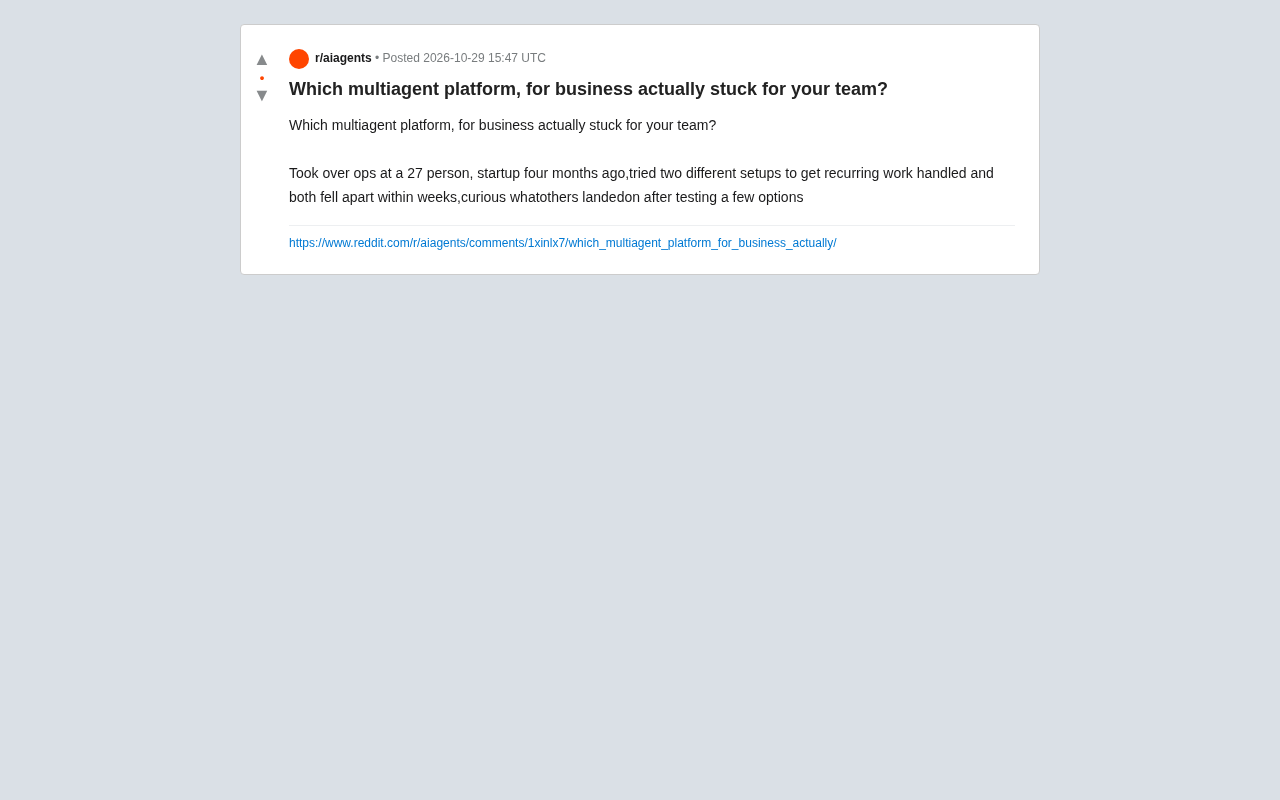
Which Multi-Agent Platform Wins? A Small Team's Battle Scars and Selection Considerations
A 27-person startup's ops lead tried two multi-agent platforms in four months and both failed. This article analyzes why small-team deployments break down, and offers selection guidance on integration depth, observability, and progressive rollout.

Thrive Holdings Takes ADT Private in $7.6 Billion Deal
Thrive Holdings acquires ADT for $7.6 billion in an all-cash take-private deal expected to close in Q1 2027. Analysis of the deal structure, ADT's asset value, and impact on the smart home security industry.