How Can Embedded Engineers Transition to Edge AI? Insights from Practitioners

Embedded engineers transitioning to edge AI: filling gaps in the deployment toolchain and system-level thinking is key.
The article responds to an embedded engineer's confusion about moving into edge AI, noting that daily work centers on model compression, quantization, hardware adaptation, and deployment debugging rather than algorithm training. Embedded backgrounds offer advantages in C/C++, RTOS, and memory management, but need to fill gaps in inference frameworks and quantization toolchains such as ONNX Runtime, TensorRT, and TFLite Micro. It recommends deployment-loop projects, highlighting cross-disciplinary skills, and open-source contributions, while noting overlooked gaps like system-level thinking, hardware co-design, and performance modeling.
Introduction: An Embedded Engineer's Transition Dilemma
An engineer working on automotive embedded software in India, with about one year of experience, has a skill set covering C/C++, Python, embedded systems, ARM, RTOS, and Linux fundamentals. He is learning the basics of machine learning and deep learning and plans to build hands-on projects around ASR/TTS, model deployment, ONNX, quantization, and edge hardware inference. He posed several questions to practitioners in the Edge AI / On-Device AI field: What does the actual day-to-day work look like? Which skills and tools matter most? How can someone with an embedded background target relevant roles and land interviews? Are strong projects and deployment experience enough, or are there other gaps?
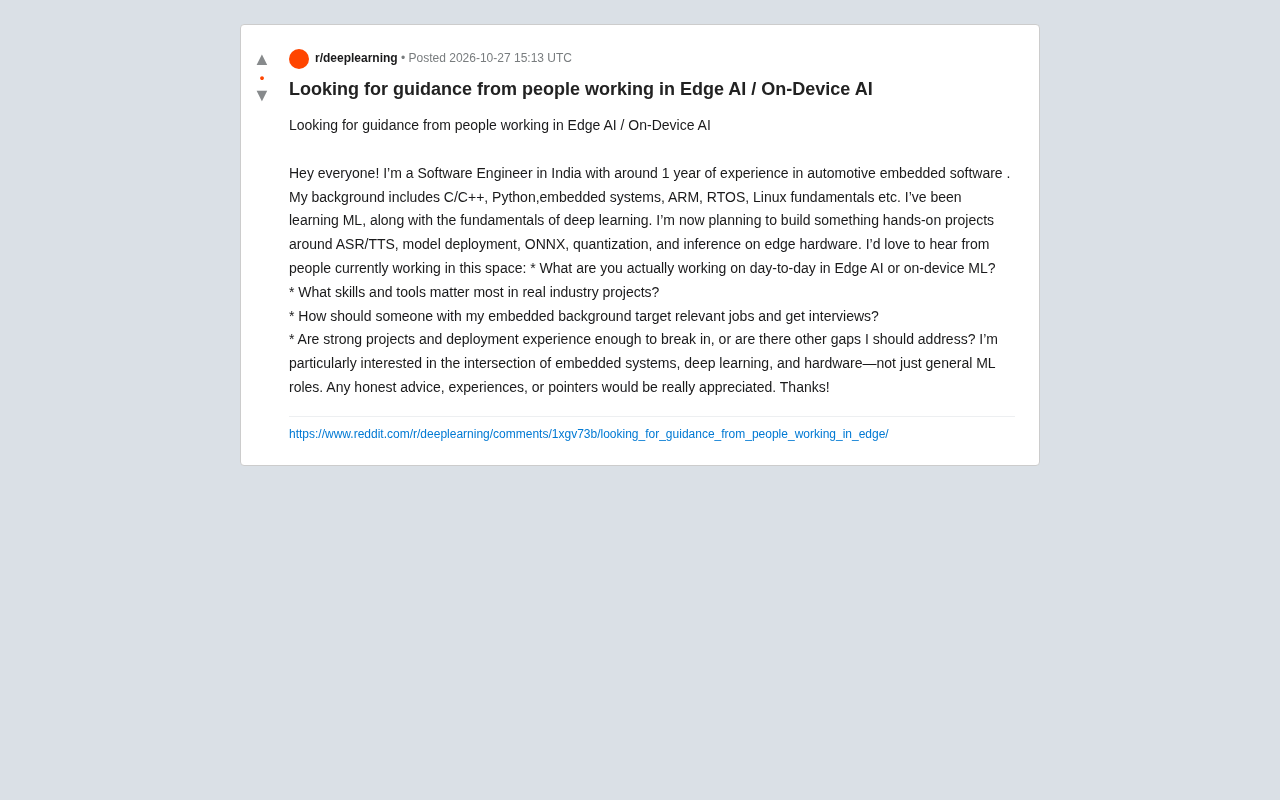
These questions touch on the core pain points of talent transitioning into edge AI. This article combines community discussions and industry practice to offer in-depth answers.
What Do Edge AI Practitioners Do Day to Day?
Edge AI work is not simply about training models; it revolves around "making models run well on resource-constrained devices." Typical tasks include: model compression and quantization (converting FP32 models to INT8 or even lower precision), operator fusion and graph optimization, inference engine adaptation for specific hardware (such as ARM CPUs, NPUs, DSPs), memory and power budget management, and end-to-end pipeline construction (from sensor input to inference output).
According to several practitioners, a large amount of daily time is spent debugging deployment issues rather than on algorithmic innovation. For example, an engineer deploying keyword spotting on an ARM Cortex-M mentioned that several percentage points of accuracy drop after quantization may require weeks of iteration to compensate for; another engineer working on smart cameras said that thermal design constraints often become the bottleneck earlier than model accuracy.
Which Skills and Tools Are Most Critical?
Embedded Fundamentals Are a Differentiating Advantage
For those transitioning with an embedded background, C/C++ proficiency, understanding of memory hierarchy and interrupt handling, and RTOS scheduling experience are scarce assets. Many candidates with a pure ML background lack these, making them helpless when it comes to edge-side optimization.
The Deployment Toolchain Matters More Than Training Frameworks
In real projects, inference frameworks such as ONNX Runtime, TensorRT, TFLite Micro, and OpenVINO are used far more frequently than PyTorch training code. Familiarity with quantization tools (such as the ONNX quantization toolkit, TFLite converter) and performance analysis tools (such as ARM Streamline, perf) is a plus.
ONNX (Open Neural Network Exchange) is an open model representation format designed to allow models exported from different training frameworks (such as PyTorch and TensorFlow) to be loaded by various inference engines. ONNX Runtime is a cross-platform inference engine led by Microsoft, supporting CPU, GPU, and various accelerator backends, and is commonly used on edge devices to replace the inference path bundled with training frameworks. TensorRT is NVIDIA's inference optimization library for its own GPUs, significantly reducing latency through layer fusion, precision calibration, and kernel auto-tuning, but it is limited to NVIDIA hardware. TFLite Micro is the microcontroller version of TensorFlow Lite, designed specifically for MCUs with KB-level memory and without dynamic memory allocation. OpenVINO is Intel's inference toolkit for its CPUs, integrated GPUs, and VPUs. Understanding the applicable boundaries of these frameworks (hardware binding, operator coverage, degree of quantization support) is a prerequisite for selection.
Hardware-Aware Model Design
Understanding the compute characteristics of the target hardware (such as MAC array size, whether Winograd convolution is supported, memory bandwidth limits) can guide model architecture choices. Some practitioners point out that writing efficient operators for NPUs or performing operator replacement often improves end-to-end performance more than hyperparameter tuning.
Winograd convolution is a fast convolution algorithm that reduces the number of multiplications in standard convolution by about 2.25 times (in the 3×3 convolution case) through transformation; many NPUs and DSPs have dedicated hardware support for it. If the model structure or operator implementation cannot leverage this acceleration path, actual performance will be far below the theoretical peak. MAC array (multiply-accumulate array) is the core compute unit of NPUs/TPUs, and its size (e.g., 64×64) determines the upper limit of multiply-accumulate throughput per cycle; the number of channels and spatial dimensions of each model layer must match it to achieve full utilization. Memory bandwidth is often the real bottleneck of edge inference: even with sufficient compute, the time to move weights and activations can dominate end-to-end latency, which explains why operator fusion that reduces memory access is often more effective than simply reducing FLOPs.
How to Target Roles and Land Interviews?
Projects Should Demonstrate a "Deployment Loop"
Simply running model inference on a laptop is far from enough. It is recommended to build a complete project from model training → quantization → target hardware deployment → performance profiling, and record comparisons of accuracy, latency, and memory usage before and after quantization. For example, deploy a voice wake-word recognition model on a Raspberry Pi or ESP32 and provide end-to-end latency and power consumption data.
Post-Training Quantization (PTQ) is the most commonly used low-barrier approach: use a small amount of calibration data to collect activation distributions and map FP32 weights and activations to INT8 without retraining, but the accuracy loss may be significant. Quantization-Aware Training (QAT) inserts fake quantization nodes into the training forward graph so that the model adapts to quantization errors during training, usually recovering most of the accuracy loss at the cost of training resources and labeled data. Choosing PTQ or QAT depends on accuracy tolerance, data availability, and iteration cycle, and this is also a decision point worth clearly documenting in a deployment-loop project.
Highlight Cross-Disciplinary Capabilities on Your Resume
Combine embedded experience with ML projects in your narrative, for example: "Implemented sensor data acquisition and preprocessing in an RTOS environment and integrated a quantized inference engine, keeping single-inference latency within an acceptable range." Avoid vague statements like "familiar with deep learning."
Community and Open-Source Contributions
Participating in edge AI-related open-source projects (such as TFLite Micro or ONNX Runtime hardware backends) can effectively demonstrate your abilities. Some practitioners mentioned that seeing a candidate who has submitted PRs to inference frameworks significantly raises interview priority during hiring.
Are Strong Projects and Deployment Experience Enough? What Other Gaps Exist?
Project experience is a stepping stone, but not everything. According to discussions, the following gaps are often overlooked:
- System-level thinking: Edge AI involves coordination among multiple subsystems such as sensors, communication, power management, and security; focusing only on the model itself is not enough.
- Hardware co-design awareness: Understanding how hardware accelerators work and being able to communicate effectively with hardware teams.
- Performance modeling capability: Being able to estimate the latency and memory requirements of a model on target hardware early in design, rather than discovering infeasibility after deployment.
- Domain knowledge: Automotive, medical, industrial, and other scenarios have their own real-time and functional safety requirements; those with an embedded background should proactively supplement the standards and constraints of the target industry.
Performance modeling refers to estimating latency and memory usage before a model is deployed, based on the compute power, memory bandwidth, and operator support of the target hardware, using analytical models or roofline analysis. Common methods include counting the model's MACs and parameters, estimating memory access per layer, deriving theoretical upper limits against hardware specifications, and comparing with measured values to locate bottlenecks. Mastering this capability allows infeasible solutions to be ruled out at the architecture selection stage, avoiding rework from "finding out it won't run after training is complete"; it is also an important dividing line between senior edge AI engineers and junior deployers.
Conclusion
Edge AI is an interdisciplinary field. Embedded engineers' low-level fundamentals are a natural advantage, but they need to proactively fill in the deployment toolchain, hardware-aware design, and system-level thinking. Starting with deployment-loop projects, combined with open-source contributions and a clear cross-disciplinary narrative, is a viable path into this field.
One-line Summary
Embedded engineers transitioning to edge AI: filling gaps in the deployment toolchain and system-level thinking is key.
Paragraph Summary
The article responds to an embedded engineer's confusion about moving into edge AI, pointing out that daily work in this field focuses on model compression, quantization, hardware adaptation, and deployment debugging rather than algorithm training. Embedded backgrounds offer differentiated advantages in C/C++, RTOS, and memory management, but need to fill gaps in inference frameworks and quantization toolchains such as ONNX Runtime, TensorRT, and TFLite Micro, and develop hardware-aware model design awareness. For job hunting, it recommends building deployment-loop projects from training to quantization to target hardware deployment, quantifying accuracy, latency, and memory metrics, highlighting cross-disciplinary capabilities on the resume, and using open-source contributions to raise interview priority. In addition, hidden gaps such as system-level thinking, hardware co-design, and performance modeling are often overlooked.
Related articles

Only 40% of Statistics Cited by AI Are Traceable: A Credibility Crisis Emerges
A Hacker News discussion notes that only 40% of statistics cited by AI can be traced to specific studies. This article analyzes the causes, the impact on content creators and users, and practical ways to reduce risk.

Simantic: A Firmware Emulation Platform Built for AI Agents
Simantic, a YC F26 project launched on Hacker News, provides firmware emulation for AI agents, letting them interact with low-level hardware software in virtual environments and lowering the barrier to embedded testing.

Why Do Excellent Developers Remain Wary of Agentic Development?
Hacker News discussion reveals why excellent developers are wary of agentic development: surrender of control, demo-production gap, and blurred responsibility boundaries.