How Did a Vendor Platform Become a Bank Fund Theft Channel?

Attackers used a third-party vendor's legitimate credentials to steal bank funds within the trust boundary, exposing flaws in static authorization models.
A fund theft occurred at France's Crédit Mutuel Arkéa: attackers did not directly breach the bank's systems but compromised a third-party vendor platform and used its legitimate credentials to authorize and transfer funds. The bank's boundary controls failed to intercept it because the operation appeared entirely legitimate within the trust boundary. The structural crux is the time gap in authorization models—permissions are statically preset at integration rather than dynamically evaluated at execution, so vendor credentials far exceed actual needs. In agentic financial workflows, AI agents inherit broad delegated permissions, further amplifying the risk. Industry consensus views this as a design flaw in authorization models rather than a single-point failure, with divergent solutions: tightening onboarding permission scopes or introducing real-time behavioral monitoring and dynamic authorization. The core lesson is that legitimate credentials can become the most dangerous attack vector.
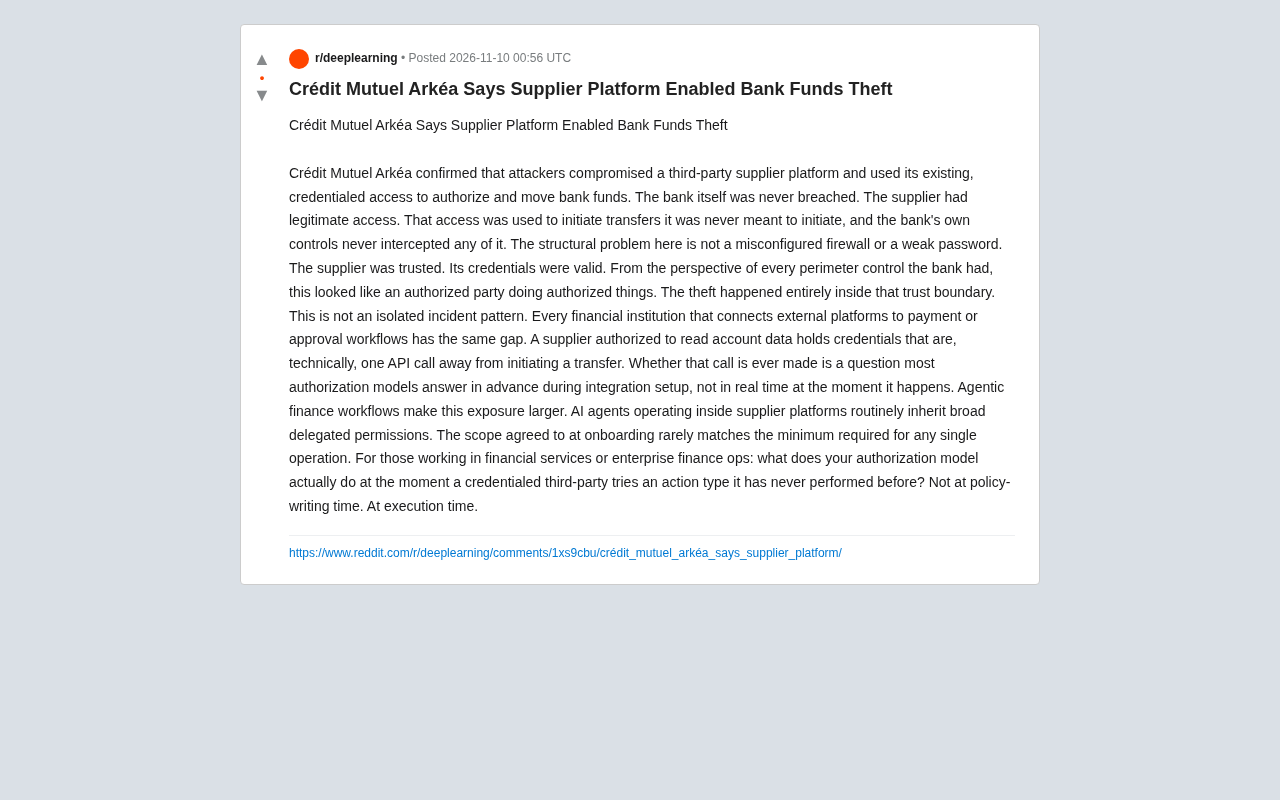
According to discussions in the Reddit community, Crédit Mutuel Arkéa recently confirmed an unusual fund theft incident: the attackers did not directly breach the bank's systems, but instead compromised a third-party vendor's platform and used that vendor's existing legitimate credentials to authorize and transfer bank funds. The bank's own systems were never breached, and the vendor had legitimate access rights—the problem was that this access was used to initiate transfers it should never have initiated, and the bank's controls failed to intercept it at every stage.
The Core of the Incident: Theft Within the Trust Boundary
The structural crux of this incident is not a firewall misconfiguration or a weak password. The vendor was trusted, and its credentials were valid. To all of the bank's boundary controls, this was simply an authorized party performing an authorized operation. The theft occurred entirely within the trust boundary. This reveals a widely overlooked blind spot: when a third-party platform is connected to payment or approval workflows, the credentials it obtains are technically just one API call away from initiating a transfer.
Trust Boundary is a core concept in security architecture, referring to the logical boundary between systems or organizations across which data and instructions are allowed to flow freely. Inside the boundary, entities are typically considered authenticated and trusted; outside the boundary, additional verification is required. Traditional security models invest heavily in boundary protection (firewalls, intrusion detection, VPNs, etc.) while assuming by default that the behavior of entities inside the boundary is benign. However, when a third-party vendor is granted credentials to access payment workflows, it sits within the trust boundary, and its operations no longer trigger boundary alerts. Attackers exploit precisely this blind spot: there is no need to breach the boundary—only to borrow a legitimate identity within it. This also explains why the bank's entire suite of boundary controls failed to intercept the activity: they monitor "who is outside the door," not "whether the person inside the door is doing something out of bounds." The introduction of Zero Trust architecture was precisely intended to break this default trust in internal networks or already-authenticated entities.
The Time-Gap Problem of Authorization Models
Most authorization models answer the question "will this call be allowed" at the integration setup stage, rather than judging at the real-time moment when the call occurs. This means that a vendor authorized to read account data may have credentials that also carry the ability to initiate transfers—whether that ability is used depends on the static policy at integration time, not on dynamic evaluation at execution time. For financial services or corporate treasury operators, the key question is: when a third party holding credentials attempts a type of operation it has never performed before, what does your authorization model actually do at the moment of execution? Not when the policy is written, but at execution time.
The distinction between static authorization and dynamic authorization is key to understanding this incident. Static authorization (such as scopes in OAuth 2.0 or RBAC role bindings) determines the permission set at integration or token issuance time; thereafter, each call only checks "is the token valid, and does the scope include this operation" without evaluating context. Dynamic authorization (such as ABAC, PBAC, or continuous access evaluation) makes real-time decisions on each request based on multidimensional attributes including user identity, device state, behavioral baseline, transaction amount, time, and location. The advantage of static models is low latency and ease of implementation, but the cost is that once granted, permissions remain valid long-term and it is difficult to distinguish "an operation never performed before" from "a routine operation." Dynamic models can identify anomalous operation types and trigger step-up authentication or blocking, but they require richer behavioral baseline data and more complex policy engines. In this incident, the vendor's credentials had transfer capability but had never executed a transfer—precisely the typical scenario that static models cannot distinguish.
Agentic Financial Workflows Amplify Risk
Agentic financial workflows further expand this exposure. AI agents running within vendor platforms typically inherit broad delegated permissions, and the permission scopes agreed upon during onboarding rarely match the minimum necessary permissions for any single operation. The combination of this privilege creep and static authorization models creates fertile ground for unauthorized operations within the internal trust boundary.
Agentic Workflow refers to a process in which AI agents with autonomous decision-making capabilities chain together multiple steps and invoke external tools to complete complex tasks. Unlike traditional fixed scripts or rule engines, agents dynamically choose which APIs to call and in what order based on the goal. In financial scenarios, this means an agent may combine capabilities such as reading accounts, calculating limits, and initiating payments. The problem is that agents typically inherit the delegated permissions of the vendor that deployed them, and the permission scopes agreed upon during onboarding are often defined in units of "features" rather than "minimum operations," resulting in privilege creep. More challenging still, the autonomy of agents means they may initiate combinations of operations that human operators never anticipated, and static authorization models are utterly unprepared for this. The principle of least privilege (PoLP) and just-in-time (JIT) authorization are the main directions for mitigating this risk.
Multi-Source Perspectives and Industry Implications
This incident is not an isolated pattern. According to Reddit discussions and industry analysis, every financial institution that connects external platforms to payment or approval workflows faces the same gap. The consensus is that the root cause is a design flaw in the authorization model, not a single-point security failure. Divergence lies in the priority of solutions—some argue for tightening permission scopes during vendor onboarding, while others believe real-time behavioral monitoring and dynamic authorization are needed. Whichever path is taken, the core lesson is the same: legitimate credentials within the trust boundary can become the most dangerous attack vector.
For fintech practitioners, this incident raises a question that must be answered: at the moment of execution, how does your authorization model handle a new type of operation initiated by a third party holding credentials?
One-line Summary
Attackers used a third-party vendor's legitimate credentials to steal bank funds within the trust boundary, exposing flaws in static authorization models.
Paragraph Summary
A fund theft incident occurred at France's Crédit Mutuel Arkéa: attackers did not directly breach the bank's systems but instead compromised a third-party vendor platform and used its legitimate credentials to authorize and transfer funds. The bank's boundary controls failed to intercept it at any stage because the operation appeared entirely legitimate within the trust boundary. The article points out that the structural crux lies in the time gap of authorization models—permissions are statically preset at integration time rather than dynamically evaluated at execution time, causing vendor credential permissions to far exceed actual needs. In agentic financial workflows, AI agents inherit broad delegated permissions, further amplifying the risk. Industry consensus holds that this is a design flaw in authorization models rather than a single-point failure, and views diverge on solutions: tightening onboarding permission scopes or introducing real-time behavioral monitoring and dynamic authorization. The core lesson is that legitimate credentials can become the most dangerous attack vector.
Related articles
Behind Jensen Huang's Resignation: Where Does Nvidia's China Business Go?
Jensen Huang resigns as Nvidia CEO, but the original report notes the bigger story lies in Nvidia's China business dealings and the U.S. government's stance. This article sorts out the background and open questions.

Alzheimer's Is Preventable and Manageable: A Neurologist's Five Brain-Protection Rules
A neurologist says Alzheimer's is mainly a metabolic brain disease and highly preventable. Here are five controllable risk factors—from breaking medication dependency to moving more and eating better.
Uber Confirms Data Breach: Thousands of Drivers' License Information Stolen via Fireworks AI
Uber confirms thousands of drivers' license information stolen in a data breach, with data stored by AI cloud company Fireworks AI. This article analyzes AI supply chain security blind spots, risks of enterprise AI service procurement, and recommendations.