How Diffusion Language Models Improve the Stealthiness of Black-Box Attacks

Replacing random mappings with diffusion language models generates natural black-box adversarial prompts, greatly reducing perplexity and revealing biased risk estimates.
The paper proposes coupling the continuous latent-space black-box adversarial attack framework to a continuous diffusion language model (dLLM), using a learned language distribution instead of traditional random mapping to decode latent variables into text. Under RareTrap (sampling) and ThinkTrap (optimization), character-level perplexity of generated prompts drops from 10^3–10^7 to 3–5 and from 20–28 to 4.3–5.4, making prompts statistically indistinguishable from natural text. The study also finds risk estimates under the two mappings may differ by an order of magnitude, showing random-mapping-based evaluations deviate severely from the true threat. It warns that perplexity-based guardrails are easily bypassed, defenses must shift to semantic detection, and risk estimation should use attacks aligned with natural language distributions.
Title
How Diffusion Language Models Improve the Stealthiness of Black-Box Attacks
Meta Description
This paper proposes replacing random mappings with diffusion language models, reducing the character-level perplexity of black-box attack prompts from 10^3-10^7 to 3-5, greatly improving stealthiness and revealing that risk estimates may differ by an order of magnitude.
Article Content
Black-box adversarial attacks aim to trigger malicious behavior in large models through input prompts—for example, inducing the model to "overthink" and thereby expose its internal risks. Traditional methods sample or optimize in a continuous latent space and then decode into text via a random mapping. However, this random mapping is not learned from the language distribution, so the generated prompts are often highly unnatural, easily detected by input guardrails, and risk estimates based on such prompts cannot reflect the true threat in natural-language scenarios.
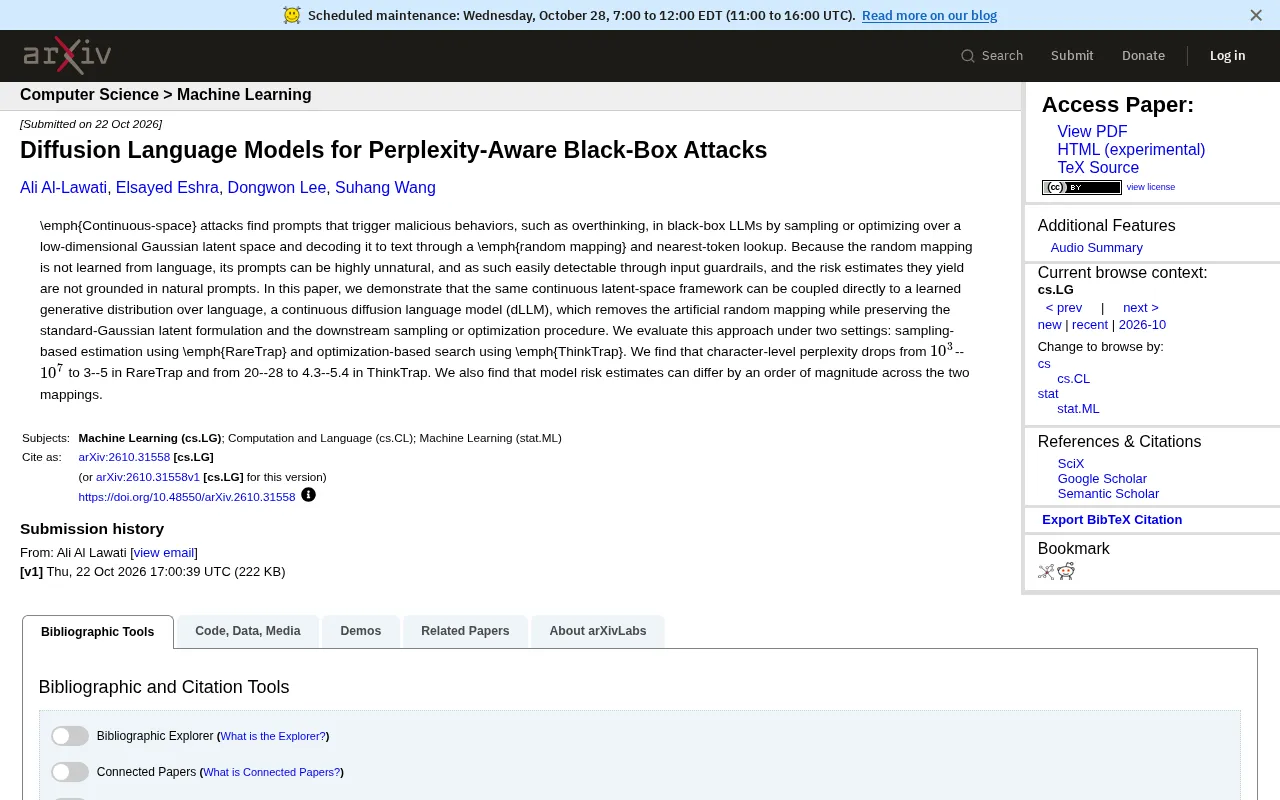
A recent paper proposes directly coupling the continuous latent-space framework to a learned language generation distribution—a continuous diffusion language model (dLLM)—thereby eliminating the artificial random mapping while preserving the standard Gaussian latent-space formulation and the downstream sampling or optimization pipeline. The study evaluates this method under two settings: sampling-based RareTrap and optimization-based ThinkTrap.
From Random Mapping to Learned Distribution: A Paradigm Shift in Attacks
Traditional continuous-space attacks decode low-dimensional Gaussian latent variables into text through a random mapping and nearest-neighbor word lookup. Because the mapping is unrelated to language, the generated prompts have extremely high character-level perplexity—reaching 10^3 to 10^7—making them highly susceptible to perplexity-based guardrails.
The paper's core innovation is to replace the random mapping with a dLLM. A dLLM is itself a language distribution learned from large-scale corpora and can decode Gaussian latent variables into natural, fluent text. In this way, attackers can still sample or optimize in continuous space, but the resulting prompts are statistically indistinguishable from natural text in their linguistic properties.
Perplexity is a metric measuring how "surprised" a language model is by a piece of text, defined as the inverse of the geometric mean of the text sequence's probability. Lower character-level perplexity means the text better conforms to the language model's statistical patterns. Natural text typically has character-level perplexity in the single digits to tens, whereas prompts generated by random mapping can reach perplexity as high as 10^3 to 10^7 due to irregular character combinations. Perplexity is often used as a lightweight anomaly-detection feature in input guardrails, because maliciously constructed adversarial prompts tend to exhibit abnormally high perplexity.
A continuous diffusion language model (dLLM) is a class of models that applies diffusion models to text generation. Unlike traditional autoregressive language models that generate word by word, a dLLM generates text in a continuous latent space through a denoising process: starting from Gaussian noise, it obtains a latent representation through multi-step denoising, then decodes it into a word sequence. Because a dLLM learns the language distribution of large-scale corpora during training, its latent-space-to-text mapping is "learned" rather than random, and it can therefore generate natural, fluent text. This makes it an ideal component for replacing random mappings.
Experimental Evaluation: A Sharp Drop in Perplexity
The study compares the effects of random mapping and dLLM mapping under two attack scenarios. In sampling-based RareTrap, character-level perplexity drops from 10^3–10^7 to 3–5; in optimization-based ThinkTrap, perplexity drops from 20–28 to 4.3–5.4. This means the generated prompts are nearly indistinguishable from normal text as far as the language model is concerned, significantly improving the stealthiness of the attack.
More critically, the model risk estimates under the two mappings can differ by an order of magnitude. This indicates that risk assessments based on random mapping deviate severely from the true risk under natural prompts and may lead to misjudgments in security policies.
RareTrap and ThinkTrap are two black-box adversarial attack strategies. RareTrap is sampling-based: it randomly samples multiple latent variables in continuous latent space, decodes them into prompts, and queries the target model to find samples that can trigger abnormal behaviors such as "overthinking." ThinkTrap is optimization-based: it optimizes latent variables in continuous latent space using gradient estimation or evolutionary strategies to make the target model produce high-risk internal reasoning. Both require decoding latent variables into text; traditional methods use random mapping, whereas this paper switches to dLLM decoding.
Implications for AI Safety and Guardrail Design
This research reveals an important issue: input guardrails that rely on statistical features such as perplexity can be easily bypassed by attacks based on learned distributions. When the perplexity of attack prompts drops to the level of natural text, guardrails need more semantic detection methods rather than relying solely on surface-level statistical anomalies.
At the same time, the bias in risk estimation reminds defenders that when assessing model vulnerabilities, they should use attack methods aligned with the natural language distribution; otherwise, they may underestimate or overestimate the actual risk. dLLM-based attacks provide a more realistic threat model, helping to design more robust defense strategies.
Limitations and Future Directions
The paper focuses mainly on the character-level perplexity metric and does not address semantic-level detection. In addition, the computational overhead of dLLMs may be higher than that of random mappings, and the actual attack cost needs further evaluation. Future work could explore how to use such attacks for red teaming and develop detection methods against learned-distribution attacks.
Overall, this research combines continuous latent-space attacks with language generation models, greatly improving the naturalness of prompts while maintaining attack effectiveness. It is quite important for the security evaluation of black-box LLMs.
One-line Summary
Replacing random mappings with diffusion language models generates natural, fluent black-box adversarial prompts, greatly reducing perplexity and revealing biases in risk estimation.
Paragraph Summary
This paper proposes coupling the continuous latent-space black-box adversarial attack framework to a continuous diffusion language model (dLLM), using a learned language distribution instead of traditional random mapping to decode latent variables into text. Under the two attack settings RareTrap (sampling) and ThinkTrap (optimization), the character-level perplexity of generated prompts drops from 10^3–10^7 to 3–5 (RareTrap) and from 20–28 to 4.3–5.4 (ThinkTrap), making the prompts statistically indistinguishable from natural text. The study also finds that model risk estimates under the two mappings can differ by an order of magnitude, indicating that evaluations based on random mapping deviate severely from the true threat. This work warns that input guardrails relying on perplexity are easily bypassed, that defenses need to shift toward semantic detection, and that risk estimation should adopt attack methods aligned with the natural language distribution.
Related articles

T3 Code: The Open-Source AI Coding Assistant's Comeback Story
T3 Code is an open-source AI coding assistant that unifies subscriptions like Codex and Claude, with powerful remote control and parallel task management.

Never Elected, Yet Ruled New York for 30 Years: The Ultimate Case Study in the Mechanics of Power
Robert Caro's biographies reveal how unelected Robert Moses ruled New York for 30 years through legal drafting and public authorities, and how Lyndon Johnson built leverage as a "powerless" Senate Majority Leader. Unpacking the underlying logic of accumulating and sustaining power.

The CPython 3.10 Recursion Trap and Synthetic Recovery in TokenGuard, an LLM Circuit Breaker
TokenGuard's author recounts a recursion crash caused by OrderedDict.pop in CPython 3.10 and introduces v0.3.0's Loop Nudge synthetic recovery, inline DLP scanning, and other new LLM agent circuit-breaker capabilities.