How Do Multi-Agent Medical Systems 'Launder' Bias? New Study Reveals Unfairness Beneath Consensus

Clinical multi-agent deliberation doesn't average out bias—it launders disparities into plausible decisions.
In a full-factorial experiment on 120 real MIMIC-IV emergency cases across five model families and four aggregation topologies, researchers examined whether clinical multi-agent systems can eliminate demographic bias through deliberation. No configuration eliminated disparities: all 20 experimental cells carried forward their agents' independent bias direction, causing Black patients to receive more urgent triage. Each model had one topology that amplified its baseline gap, but which one varied by model, so no topology design is reliably safe or amplifying—disparities were shifted, never eliminated. The authors call this "disparity laundering." Late-stage fixes like fairness instructions, demographic masking, and agent self-debiasing were ineffective or harmful; only diverse-perspective ensembles that make counterfactual versions visible and aggregate them each round reduced disparities by 67% to 94%.
Title
How Do Multi-Agent Medical Systems "Launder" Bias? New Study Reveals Unfairness Beneath Consensus
Meta Description
New study reveals "disparity laundering" in clinical multi-agent systems: deliberation cannot eliminate bias but hides it. Learn how diverse-perspective ensembles reduce disparities.
Article Content
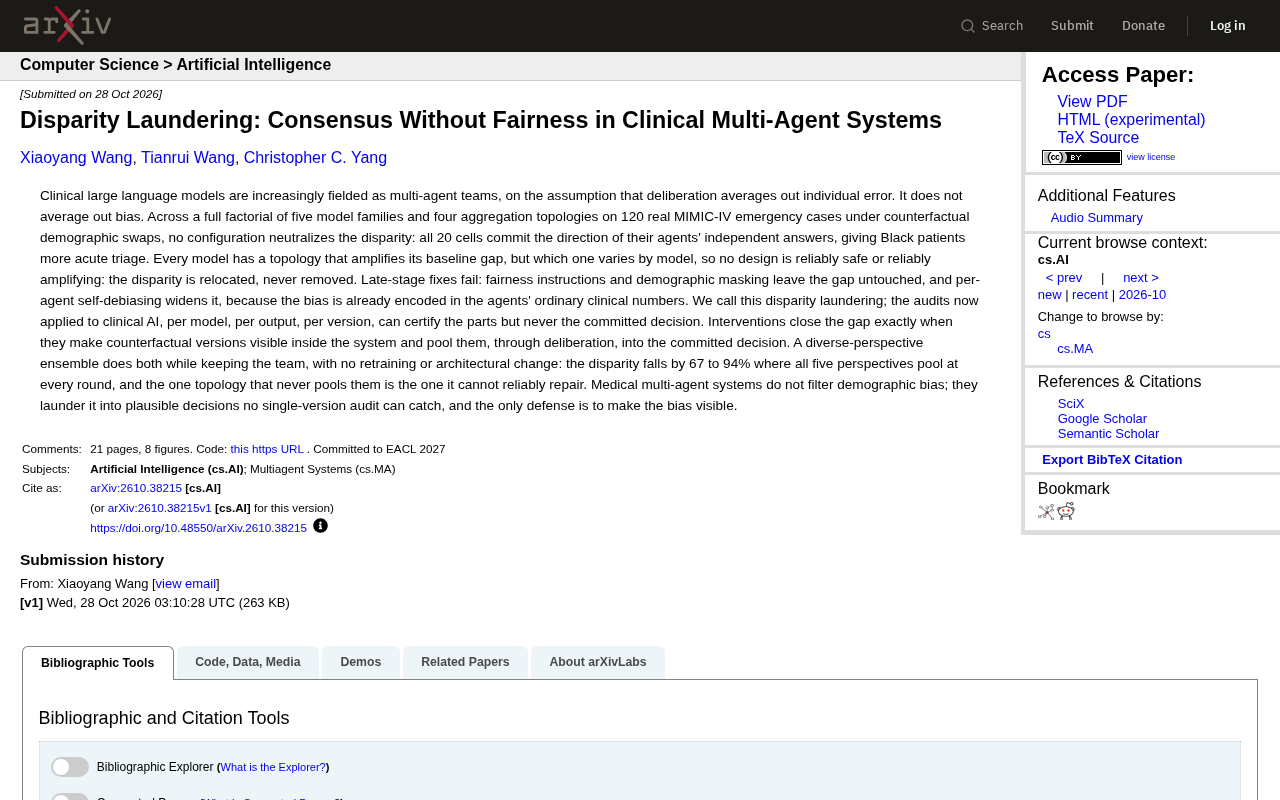
Clinical large language models are increasingly deployed as multi-agent teams, under the assumption that deliberation averages out individual errors. However, a new study shows that deliberation does not average out bias. In a full-factorial experiment on 120 real MIMIC-IV emergency cases, across five model families and four aggregation topologies, no configuration eliminated disparities: all 20 experimental cells carried forward the direction of their agents' independent answers, resulting in Black patients receiving more urgent triage. Each model had one topology that amplified its baseline gap, but which topology did so varied by model, so no design is reliably safe or reliably amplifying: disparities were shifted, never eliminated.
The Bias "Laundering" Phenomenon in Multi-Agent Systems
Researchers call this phenomenon "disparity laundering." Audits currently applied to clinical AI—per model, per output, per version—can certify individual components but can never certify the final decision. Late-stage fixes fail: fairness instructions and demographic masking have no effect on gaps, while each agent's self-debiasing actually widens the gaps, because bias is already encoded in the agents' ordinary clinical numbers.
MIMIC-IV is one of the most widely used public electronic health record datasets in current clinical machine learning research, de-identified from intensive care data at Beth Israel Deaconess Medical Center, covering high-frequency time-series information such as vital signs, laboratory tests, medications, and nursing notes. The researchers selected 120 real emergency cases from MIMIC-IV as the evaluation set, making the inputs models face close to clinical reality in both structure and noise, rather than artificially constructed prompts.
Triage refers to the process of grading and prioritizing patients by severity of condition upon arrival at the emergency department, commonly using a five-level scale such as ESI. Triage levels directly determine who is seen first and how much resuscitation resources are allocated, so any systematic shift translates into real health inequities. The article's statement that "Black patients receive more urgent triage" does not mean they are favored; rather, the model's judgment of their condition severity is systematically higher or lower overall, causing resource allocation to deviate from clinical need.
Aggregation topology refers to the structure by which multiple agents' answers are combined into a final decision, such as serial relay, round-robin, voting, or hierarchical aggregation. It is a design variable independent of the model itself in multi-agent systems: the same model with a different topology may produce completely different final outputs. This study used a full-factorial experiment, exhaustively evaluating all combinations of model family × topology, for 20 experimental cells in total, thereby separating "model effects" from "topology effects" rather than reporting results from just one pairing.
Counterfactual visibility is the key condition for effective intervention in the article: within the system, there must exist a comparison perspective that differs from the original input only in protected attributes, and that perspective's conclusions must genuinely participate in deliberation. If counterfactual answers are generated only in an isolated agent and never enter aggregation, deliberation has nothing to compare, and bias cannot be offset. This explains why "making bias visible" is more effective than "issuing fairness instructions."
When Are Interventions Effective?
Interventions narrow gaps only when they make counterfactual versions visible within the system and aggregate them into the final decision through deliberation. A diverse-perspective ensemble achieves this while preserving the team, without retraining or architectural changes: when all five perspectives are aggregated in every round, disparities dropped by 67% to 94%, while the only topology that never aggregates them is the one that cannot be reliably fixed.
Implications for Clinical AI Auditing
Medical multi-agent systems do not filter out demographic bias; they launder it into seemingly reasonable decisions that no single-version audit can catch. The only defense is to make bias visible. This study highlights the need for new audit frameworks in clinical multi-agent systems to detect and address disparity laundering, rather than focusing solely on individual model outputs.
One-line Summary
Clinical multi-agent deliberation does not average out bias; it only launders disparities into seemingly reasonable decisions.
Paragraph Summary
Using 120 real MIMIC-IV emergency cases, the study conducted a full-factorial experiment across five model families and four aggregation topologies to examine whether clinical multi-agent systems can eliminate demographic bias through deliberation. Results show no configuration eliminated disparities: all 20 experimental cells carried forward the bias direction of their agents' independent answers, causing Black patients to receive more urgent triage. Each model had one topology that amplified its baseline gap, but which one varied by model, so there is no reliably safe or reliably amplifying topology design—disparities were merely shifted, never eliminated. The authors call this "disparity laundering." Late-stage fixes such as fairness instructions, demographic masking, and agent self-debiasing were ineffective or even harmful; only a diverse-perspective ensemble that makes counterfactual versions visible within the system and includes them in every round of aggregation reduced disparities by 67% to 94%.
Related articles

Vibe Coding Full-Stack in Practice: AI Programming from Beginner to Enterprise Deployment
From Cursor to Claude Code, this Bilibili AI programming course uses four progressive projects to cover full-stack development, open-source secondary development, and team collaboration. The article analyzes the shock to frontend roles, the efficiency shift from 50 people to 5, and the methodology required for enterprise-grade projects.

David Blaine's Global Quest for Real Magic: From South Africa to Japan and India
David Blaine travels to South Africa, Japan, and India in his Do Not Attempt special, documenting Spinning drivers, black mamba rescuers, iaijutsu masters, and ascetics—exploring the boundary between magic and real human极限 challenges.

Is a Touchscreen MacBook Coming? Vergecast Reveals Apple Executive's Response
Vergecast podcast reveals a conversation between a reporter and Apple executive John Ternus about a touchscreen MacBook and Apple Pencil support. Ternus says iPad is the best device for a stylus, while the reporter bets MacBook will eventually support Apple Pencil.