How Does Neuro-Symbolic Reinforcement Learning Achieve Automatic Compliance in AI Portfolios?
Neuro-symbolic RL embeds compliance probability into the training objective, letting continuous-action policies internalize investment mandates and cut violation rates to 4.8%.
This study proposes a continuous-action neuro-symbolic RL method inspired by Probabilistic Logic Policy Gradient (PLPG) to address deep RL's inability to guarantee compliance in portfolio allocation. It estimates the probability that policy actions satisfy symbolic investment mandates via reparameterized Monte Carlo sampling, adding this term to the training objective so the agent internalizes rules while pursuing returns. On a six-rule regime-conditioned mandate, the method reduces violation rates from 96–98% (unconstrained RL) and 33.4% (reward-penalty baseline) to 4.8%, with no post-hoc compliance checks or action corrections at inference. The work highlights neuro-symbolic potential for rule-sensitive domains like finance, while noting future challenges in complex rule representation and real-world validation.
When AI Traders Meet Investment Compliance
Institutional portfolios are typically constrained by investment policy statements that specify asset allocation limits, often tied to market regime information. Deep reinforcement learning (RL) has been shown to optimize financial performance, but it generally cannot enforce rule compliance, making it unsuitable for real-world deployment. Existing neuro-symbolic approaches such as Probabilistic Logic Policy Gradient (PLPG) provide constraint-satisfying RL through differentiable symbolic supervision, but assume a finite and discrete action space.
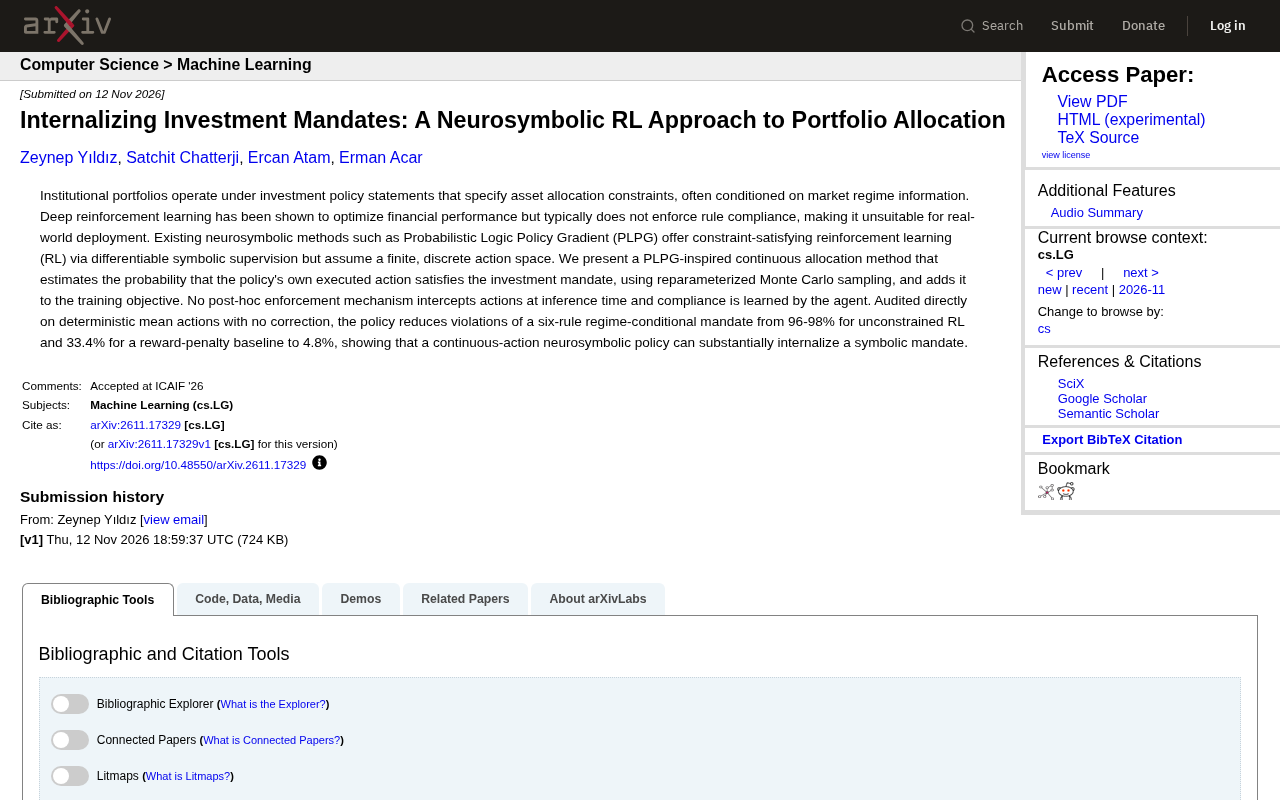
A recent study proposes a continuous allocation method inspired by PLPG that estimates the probability that actions executed by the policy itself satisfy the investment mandate, using reparameterized Monte Carlo sampling, and adds this to the training objective. At inference time there is no post-hoc enforcement mechanism intercepting actions—compliance is learned by the agent. Audited directly on deterministic mean actions without any correction, the policy reduces the violation rate on a six-rule regime-conditioned mandate from 96–98% for unconstrained RL and 33.4% for a reward-penalty baseline to 4.8%, demonstrating that continuous-action neuro-symbolic policies can substantially internalize symbolic mandates.
Why Traditional Reinforcement Learning Is Unreliable for Investment Compliance
Deep RL has shown potential for optimizing returns in finance, but it has a fatal flaw: it only cares about the reward signal, not the rules. In investment management, compliance is not optional—institutions must adhere to asset allocation constraints in their investment policy statements, and these constraints often depend on market regime (e.g., different limits in bull and bear markets).
An unconstrained RL agent may violate these rules in pursuit of high returns, making real-world deployment infeasible. A common remedy is to add penalty terms to the reward function, but this only provides soft guidance and cannot guarantee compliance. The paper's data show that the reward-penalty baseline still has a violation rate as high as 33.4%, far from satisfactory.
The Evolution of Neuro-Symbolic Methods: From Discrete to Continuous
Neuro-symbolic AI attempts to combine the perceptual capabilities of neural networks with the reasoning capabilities of symbolic systems. In reinforcement learning, Probabilistic Logic Policy Gradient (PLPG) is a representative method that lets policies learn to satisfy constraints during training through differentiable symbolic supervision. However, PLPG assumes a finite and discrete action space, which limits its application to continuous action spaces—and portfolio allocation is precisely a continuous action problem (asset weights can be any real numbers).
The key innovation of this study is extending the ideas of PLPG to continuous action spaces. It uses reparameterized Monte Carlo sampling to estimate the probability that actions executed by the policy itself satisfy the investment mandate, and adds this probability as an additional term to the training objective. In other words, during training the agent not only maximizes expected returns but also simultaneously maximizes the probability that its actions are compliant.
The core idea of Probabilistic Logic Policy Gradient (PLPG) is to compile logical rules into differentiable computational graphs, allowing gradients to backpropagate from rule satisfaction to policy parameters. Specifically, it uses probabilistic logic programs (such as ProbLog or DeepProbLog) to transform first-order logic rules into constraints on probability distributions, and jointly optimizes rewards and rule satisfaction probabilities via the policy gradient theorem. However, PLPG's discrete action assumption stems from its rule evaluation mechanism: logical rules are typically defined over finite sets of propositions, and continuous action spaces cannot be directly mapped to the truth values of discrete propositions. The key challenge in extending PLPG to the continuous domain is how to sample continuous actions and estimate the probability that they satisfy symbolic rules while keeping gradients computable. Reparameterization tricks (such as Gumbel-Softmax or pathwise derivatives) are common means to solve this problem, allowing sampling from continuous distributions while preserving gradient flow, thereby embedding rule satisfaction probabilities into end-to-end training.
How to Internalize Rules? A Core Breakdown of the Method
The core of the method is to embed compliance directly into the policy optimization process rather than patching it afterward. Specifically:
- Probability estimation: For each state, the policy network outputs the parameters of the action distribution (e.g., the mean and variance of a Gaussian). Through reparameterized sampling, action samples are drawn from this distribution, and the probability that these samples satisfy the symbolic rules is computed.
- Symbolic rule representation: The investment mandate is encoded as logical rules, such as "equity weight does not exceed 60%" or "bond weight is at least 30% when market volatility is high." These rules are converted into computable probabilities via differentiable logic programs.
- Joint optimization: The training objective combines the conventional RL loss (such as the PPO or DDPG loss) with a compliance probability term, so that the agent actively avoids violations while pursuing returns.
One detail: at the inference stage there is no post-hoc compliance check or action correction mechanism. Compliance is fully internalized by the agent, meaning the policy itself has learned to generate compliant actions.
Reparameterized Monte Carlo sampling is a technique that turns a stochastic sampling process into a differentiable operation. In continuous action spaces, the policy typically outputs the parameters of a distribution (e.g., a Gaussian), and actions are obtained by sampling from that distribution. Standard sampling operations are not differentiable because randomness blocks gradient propagation. The reparameterization trick rewrites the sampling process as a deterministic transformation: for example, for a Gaussian distribution, an action can be expressed as ( a = \mu + \sigma \odot \epsilon ), where ( \epsilon \sim \mathcal{N}(0, I) ) is independent noise. In this way, gradients can backpropagate through ( \mu ) and ( \sigma ), allowing policy parameters to be updated according to the rule satisfaction probability. In this method, the probability that actions satisfy the investment mandate is estimated through multiple reparameterized samples; this estimate is differentiable with respect to policy parameters and can therefore be directly added to the training objective for joint optimization. The variance of the Monte Carlo estimate decreases as the number of samples increases, and in practice one must trade off computational cost against estimation accuracy.
Experimental Results: A Sharp Drop in Violation Rate
The research team evaluated the method on a six-rule regime-conditioned mandate, where the rules involve asset allocation limits that vary with market regime. The audit was performed directly on deterministic mean actions without any correction. The results are as follows:
| Method | Violation Rate |
|---|---|
| Unconstrained RL | 96–98% |
| Reward-penalty baseline | 33.4% |
| This method (neuro-symbolic continuous RL) | 4.8% |
The violation rate drops from nearly all violations under unconstrained RL to 4.8%, an order-of-magnitude improvement. Compared with the reward-penalty baseline, it is also nearly 7 times lower. This shows that continuous-action neuro-symbolic policies can effectively internalize symbolic mandates and significantly improve compliance.
A regime-conditioned mandate refers to a set of rules in which investment constraints change dynamically with the market regime. For example, under a low-volatility regime the equity allocation cap might be 70%, while under a high-volatility regime it drops to 50%; the minimum bond allocation ratio may also adjust with the regime. This conditional dependence makes the compliance problem no longer a static constraint but a state-dependent dynamic constraint, increasing the difficulty for the RL agent to learn. A six-rule regime-conditioned mandate means there are six such rules, each of which may contain multiple conditional branches. During auditing, deterministic mean actions (i.e., the mean of the policy's output distribution, rather than sampled actions) are used directly without any post-hoc correction, which more faithfully reflects the level of compliance internalized by the policy. The violation rate is defined as the proportion of time steps in test trajectories where an action violates any rule.
Implications for Financial AI Deployment
This study addresses a key obstacle to the practical deployment of reinforcement learning in finance: compliance. Traditionally, compliance checks are often implemented as post-hoc filters or hard-coded rules, but such approaches may interfere with the policy optimization process or fail to handle complex conditional rules. By internalizing compliance into the policy, the agent can learn to obey rules during training, thereby generating actions that both pursue returns and remain compliant.
Of course, the method still has limitations. For example, it relies on differentiable representations of symbolic rules, which may be difficult to handle for very complex rules; moreover, the experiments were conducted in simulated environments, and rules in real markets may be more dynamic and ambiguous. Nevertheless, this research opens up new possibilities for applying neuro-symbolic reinforcement learning in finance.
Future Directions and Challenges
Possible future research directions include extending to more complex rule types (such as temporal logic constraints), handling uncertainty and partial observability, and validating the robustness of the method in real trading environments. In addition, how to balance compliance and profitability remains a question that requires deeper exploration—overemphasizing compliance may make policies overly conservative and cause them to miss return opportunities.
Overall, this study demonstrates the potential of neuro-symbolic methods for solving real-world reinforcement learning deployment challenges, especially in domains where rules are critical, such as finance, healthcare, and autonomous driving.
Related articles

US Army Plans to Detonate Nearly 10,000 Pounds of Unstable Explosives in Iowa
The US Army plans to detonate nearly 10,000 pounds of unstable lead azide at the Middletown ammunition plant in Iowa, raising safety concerns. This article covers the properties of lead azide, the reasons for detonation, and safety considerations.

DeepSeek SuperAgent Architecture Explained: A New Multi-Task Concurrent Agent Paradigm
DeepSeek Harness proposes SuperAgent architecture: a Router+Worker two-layer team model solving context confusion, loop blocking, and local sleep in multi-task Agents.

AI Now Generates GIFs Directly: The Era of Unlimited Custom Stickers Has Arrived
AI can now generate GIFs directly. Learn how to use GPT's Images 2.6 to create sticker GIFs with reference images and story prompts, plus sprite sheet frame-level editing, real-person performances, and chat log generation.