How Much AI Is the Right Amount? An Overlooked Balancing Act
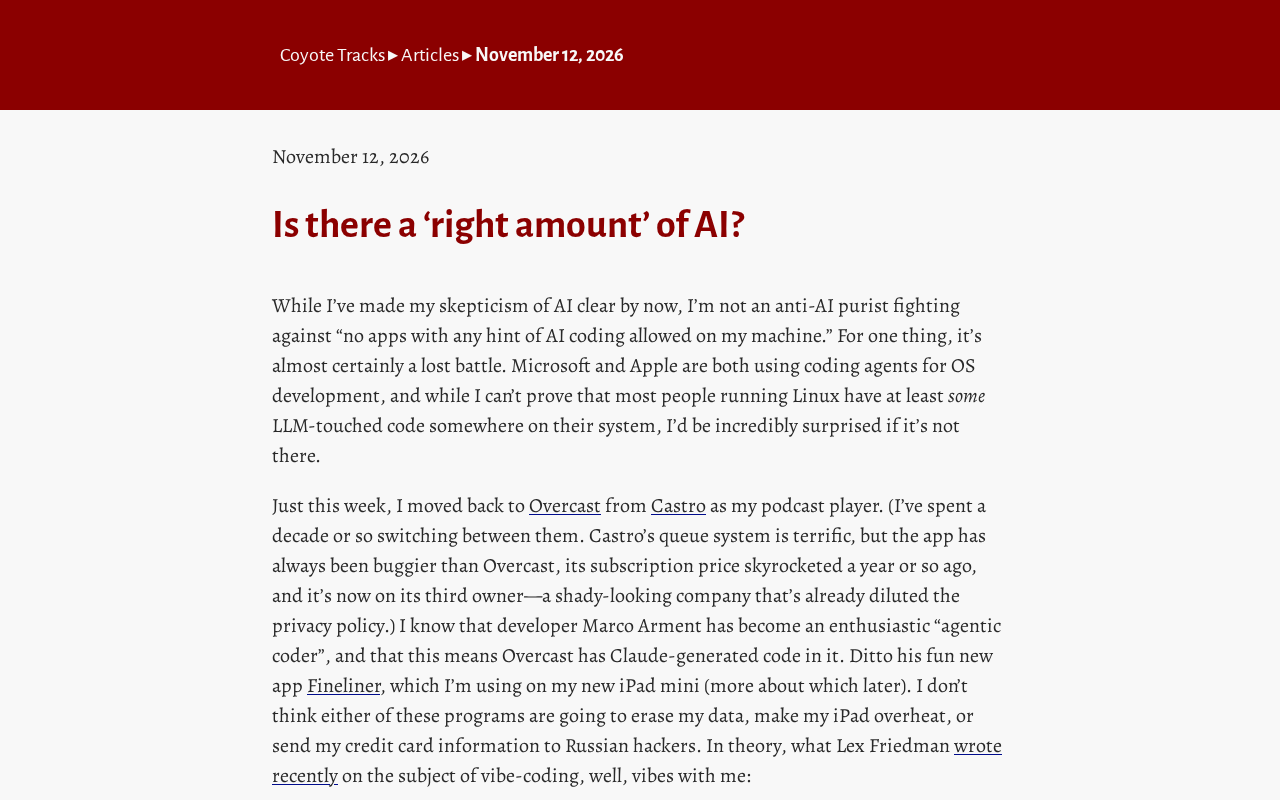
AI's "correct amount" isn't a fixed number but a variable calibrated dynamically to task verifiability and personal capability.
Starting from a thought-provoking question on Hacker News, the article explores whether there's a "correct" amount of AI to use. It argues that tools themselves aren't right or wrong, but usage intensity changes behavior, and AI intervenes more deeply by producing usable answers directly. It offers three dimensions for judging appropriate usage: task verifiability determines risk; whether skills are amplified or replaced can be tested by "does capability drop when AI is off"; and whether output truly passes human judgment, since lower generation costs don't mean review costs vanish. The takeaway: treat AI usage as a regularly calibrated variable—increase it for highly verifiable, low-risk tasks, keep human leadership for judgment and fact-checking, and run "offline tests" to confirm core skills aren't diluted.
A seemingly simple yet thought-provoking question appeared on Hacker News: Is there a "correct amount" of AI to use? The post itself only garnered 3 upvotes and 1 comment—hardly a hot discussion—but the issue it touches on is far from trivial. As AI tools become more deeply embedded in writing, programming, and decision-making workflows, "how much to use" is shifting from a technical question to a habit that requires active management.
Why "Usage Volume" Becomes a Problem
Tools themselves aren't right or wrong, but the intensity of use changes people's behavioral patterns. After search engines became ubiquitous, the way people memorize detailed information changed; after navigation apps became widespread, our reliance on direction sense shifted too. AI's depth of involvement far exceeds these tools because it doesn't just provide information—it directly produces usable answers, code, and text.
The resulting concerns cluster at two extremes: use too little and you may miss out on efficiency gains; the risk of using too much is more insidious—judgment gets outsourced, sensitivity to output quality declines, and you actually become slower in situations that require independent thinking. What makes this post worth expanding on is that it reframes the "should we use AI" debate into the more pragmatic "how much should we use."
Three Dimensions for Judging the "Right Amount"
Task Verifiability
If you can quickly verify AI output—say, generating a regex, a SQL query, or a format conversion result—then the risk of increasing usage frequency is low, because errors will be caught immediately. Conversely, in domains that are hard to verify (long-chain reasoning, factual summaries, compliance-related judgments), the cost of over-reliance manifests with a delay. Whether usage is appropriate largely depends on whether you can take responsibility for the results.
According to the direction of discussion in the Hacker News thread, the community is less concerned with banning or wholesale acceptance than with establishing boundaries.
Verifiability here refers to whether users can determine whether AI output is correct at low cost and in a short amount of time. This concept aligns with the "fast feedback loop" in software engineering: the more immediate and clear the feedback, the lower the cost of trial and error, and the more suitable it is to delegate more work to automated tools. Conversely, tasks like long-chain reasoning and open-ended factual summaries lack objective, immediate means of verification—errors often only surface downstream or later in time, forming "silent failures." Therefore, a practical way to judge whether a scenario can handle increased AI usage is to first ask: if the AI's answer is wrong, how long will it take me to find out? The higher the detection cost, the more you should retain human leadership.
Is the Skill Being Replaced or Amplified?
Take writing code with AI, for example. Some people treat it as a pair-programming partner, still making their own decisions at key design points; others toss in requirements and paste the results into the repository. The former amplifies capability; the latter slowly replaces it. An actionable test: after turning off AI, does your speed and confidence in handling similar tasks drop noticeably? If the answer is yes, your usage has crossed beyond the gain zone.
Cognitive offloading is a concept in psychology referring to people transferring cognitive burdens such as memory, calculation, or reasoning to external tools or other people. Moderate cognitive offloading can free up mental resources for higher-level judgment—for example, using a calculator instead of mental arithmetic. But excessive offloading causes the offloaded ability to degrade from lack of practice, a phenomenon also known as "skill atrophy." What's special about AI is that it offloads not just low-level calculation but also writing organization, code structure design, and other aspects previously considered core capabilities. The key to distinguishing "amplification" from "replacement" lies in whether the user remains actively thinking and making decisions throughout the process, rather than merely receiving results.
Has the Output Passed Through Your Judgment?
The cost of AI-generated content approaches zero, but the cost of review and revision hasn't disappeared. The actual experience of many teams is that the more AI-produced drafts there are, the heavier the manual review burden becomes. The right amount of usage should be capped by "every output has been genuinely read and approved by someone," not measured by generation speed.
Automation bias refers to people's tendency to over-trust recommendations from automated systems, accepting machine output even in the face of contrary evidence. This phenomenon has been extensively studied in high-risk fields such as aviation and healthcare, and it holds equally true in AI-generated content scenarios: when text or code looks fluent and well-formatted, readers tend to skip substantive verification. This means "generation cost approaching zero" doesn't equal "total cost approaching zero"—review burden may actually accumulate as output volume rises. A practical principle for controlling usage is to match output speed to the team's actual review capacity.
A Pragmatic Answer
This discussion didn't produce a unified standard, and it's hard to do so. A more reasonable framework is to treat "AI usage volume" as a variable that individuals or teams need to calibrate regularly, rather than a value that can be set once:
- For highly verifiable, low-risk repetitive tasks, feel free to increase usage;
- For steps requiring judgment and involving fact-checking, retain human leadership;
- Periodically do an "offline test" to confirm that core capabilities haven't been diluted by the tool.
The original post had a small discussion scale and a limited sample of viewpoints, but the question itself has lasting value. AI's "correct amount" isn't a fixed number but a line that dynamically adjusts with task nature and personal capability—finding that line is more meaningful than debating whether to use it at all.
One-line Summary
AI's "correct amount" isn't a fixed number but a variable calibrated dynamically to task verifiability and personal capability.
Paragraph Summary
Starting from a thought-provoking question on Hacker News that didn't attract much discussion, the article explores whether there's a "correct amount" of AI to use. The author notes that tools themselves aren't right or wrong, but usage intensity changes behavioral patterns—AI intervenes more deeply because it directly produces usable answers. The article proposes three dimensions for judging appropriate usage: task verifiability determines the risk level of increasing usage frequency; whether skills are amplified or replaced can be tested by "does capability drop noticeably when AI is turned off"; and whether output has genuinely passed through human judgment, because lower generation costs don't mean review costs disappear. The conclusion is to treat AI usage as a variable requiring regular calibration—increase usage for highly verifiable, low-risk tasks, retain human leadership for steps requiring judgment and fact-checking, and use "offline tests" to confirm core capabilities haven't been diluted.
Related articles

The Ultimate Codex Tutorial: From Zero to Hands-On in 40 Minutes
A complete beginner's Codex tutorial: from GPT account registration and desktop installation to login error troubleshooting, permission and quota setup, and Pro membership upgrades—a step-by-step guide to getting started with an AI coding assistant, plus common fixes and practical advice.
AI-Driven Testing in Practice: How Agents Are Reshaping the Testing Workflow
Starting from how Agents work, this article analyzes the practical path of AI-driven testing: how task planning, tool calling, and feedback loops reshape the testing workflow, and the boundaries and acceptance authority human testers must retain.
How to Review a 22,505-Line PR? Matt Pocock's Stacked PRs and Ratchet Rules
Matt Pocock split a 22,505-line agent PR into 9 stacked PRs, used a two-way/one-way door framework to isolate the DB change, and enforced ratcheted lint rules and retro.