How NixOS Frees Developers from the Fear of System Tinkering

NixOS structurally eliminates the fear of system updates and dependency management through declarative configuration and rollback-capable generations.
This article discusses the Hacker News post "NixOS is making me less afraid" and how NixOS alleviates developer anxiety about Linux configuration. Traditional distributions' imperative updates risk crashes, dependency conflicts, and irreproducible environments. NixOS's declarative configuration generates immutable generations with one-click rollback, and its purely functional package management lets multiple dependency versions coexist. Despite a steep learning curve, it delivers long-term environment certainty and multi-machine reproducibility, making developers more willing to experiment.
On Hacker News, a post titled "NixOS is making me less afraid" garnered 50 upvotes and 14 comments. Although the original content was brief, the title itself struck a deep chord with many developers' underlying anxiety about operating system configuration: fear that rolling updates will break the system, fear that dependency conflicts can't be rolled back, and fear that the environment can't be reproduced after a reinstall. The declarative configuration paradigm that NixOS represents is gradually making this fear fade away.
Why Do Traditional Linux Distributions Make People "Afraid"?
Traditional distributions (like Ubuntu and Arch) use an imperative update model: you run apt upgrade or pacman -Syu, the system state is modified in place, and the old state is overwritten. Once an update introduces problems, rollback often relies on snapshots or manual fixes. Dependency management is equally tricky—globally installed packages may conflict with each other, and over time the system accumulates an irreproducible "snowflake state."
This model requires users to be responsible for every change, and that's exactly where the fear comes from: you can't be sure whether the next update will break your work environment, nor can you guarantee that another machine can precisely reproduce your current configuration.
NixOS's Solution: Declarative and Rollback-Capable
The core of NixOS is writing the entire system state into a declarative configuration file (configuration.nix). You describe "what the system should look like" rather than "how to change it step by step." The build system generates an immutable system generation based on this, and every switch or update produces a new generation, with the old generation fully preserved in the boot menu.
This means: upgrade failed? Just reboot and select the previous generation. Dependency conflict? Nix's purely functional package management isolates each package in its own storage path, allowing multiple versions to coexist without interfering with each other. Fear is structurally dissolved—because rollback becomes a default capability rather than an extra skill.
Many users in the Hacker News comments mentioned that it is precisely this confidence that "doing something wrong won't kill the system" that makes them more willing to try new software and aggressive configurations.
Immutable system generations are the core mechanism by which NixOS achieves rollback. Each time a system build or update is performed, NixOS does not modify existing files in place; instead, it computes an entirely new system closure from configuration.nix, which includes the exact versions of the kernel, initrd, system services, and all dependencies. This closure is assigned an incrementing generation number and written as a complete boot entry into the GRUB or systemd-boot menu. All files from old generations remain in the Nix store (until garbage collected), so switching back to an old generation simply means changing the closure selected at boot—no reinstall or repair needed. This design makes system upgrades atomic operations: either they fully succeed or fully fail, with no intermediate state of "crashing halfway through an upgrade."
Nix's purely functional package management stores each software package build result in a unique path under /nix/store, with the path name determined by a hash of all build inputs (source code, dependencies, compilation options, etc.). Therefore, different versions of the same library or program can exist simultaneously without overwriting each other. When multiple programs depend on different versions of a library, Nix builds and references each path separately, completely avoiding the "dependency hell" common in traditional package management. Moreover, because the build process is purely functional (not dependent on global state or the network), the same inputs always produce the same outputs, laying the foundation for reproducible builds and environment replication.
Learning Curve and Costs
NixOS is not without barriers. The Nix language itself is functional, and beginners need to understand concepts like derivations and flakes. Common complaints in the community include: scattered documentation, cryptic error messages, and outdated Stack Overflow answers when problems arise.
But the consensus in the discussion is that the upfront investment buys long-term certainty. Once the configuration is stable, the system requires almost no "maintenance"—you no longer need to regularly clean up orphaned packages, resolve dependency conflicts, or worry about upgrades breaking the environment. For engineers who need to synchronize development environments across multiple machines, a single flake configuration can replicate an identical environment across laptops, servers, and CI.
The Nix language is a purely functional domain-specific language (DSL) designed specifically for package management and system configuration. It uses lazy evaluation and supports concepts such as functions, attribute sets, and derivations. A derivation is the basic unit in Nix that describes how to build a package; it declares the inputs, build script, and output path required for the build. Flake is an experimental feature of Nix (now gradually stabilizing) that provides a standardized way to define and lock project dependencies, enabling precise reproduction of configurations and development environments. A flake declares inputs (such as a specific commit of nixpkgs) and outputs (such as system configurations and development environments) through a flake.nix file, and locks the hashes of all dependencies with flake.lock, ensuring consistent build results across different machines. Understanding these concepts is the key threshold to mastering NixOS.
Real Impact on Development Workflows
Judging from the comment feedback, the psychological change NixOS brings is more noteworthy than its technical features. Several users said that they previously didn't dare to install experimental software casually on their main machines, but now they are more willing to explore because they can roll back at any time. This "safety net" effect in turn improves work efficiency—reducing constant anxiety about system stability and returning attention to actual development tasks.
Another point mentioned is the value of reproducibility for team collaboration: after a new member clones the configuration repository, a single command gives them a development environment completely identical to the team's, eliminating the classic "it works on my machine" problem.
Who It's For, Who It's Not For
If you want out-of-the-box usability and are unwilling to spend time learning a new paradigm, NixOS may bring frustration. But if you frequently reinstall systems, manage multiple machines, or have requirements for long-term environment maintainability, the declarative guarantees NixOS offers are worth the investment. As the original post's title suggests, it may not make the system simpler, but it does make people less afraid.
One-line Summary
NixOS structurally eliminates the fear of system updates and dependency management through declarative configuration and rollback-capable generations.
Paragraph Summary
This article centers on the Hacker News hot post "NixOS is making me less afraid," exploring how NixOS alleviates developers' anxiety about Linux system configuration. Traditional distributions use imperative updates, which easily lead to system crashes, dependency conflicts, and irreproducible environments. NixOS's declarative configuration writes the system state into a configuration file, generating an immutable generation with each update and supporting one-click rollback. Its purely functional package management allows multiple versions of dependencies to coexist, fundamentally avoiding conflicts. Although the learning curve is steep (requiring mastery of the Nix language, flakes, and other concepts), it buys long-term environment certainty and multi-machine reproducibility. Comment feedback shows that this "safety net" effect makes developers more willing to try new software and improves work efficiency and team collaboration consistency.
Related articles

Why Does Self-Play AI Always Get Crushed by Cheap Units? An RTS Developer's Account of the Dilemma
An independent developer trained an RTS commander AI with pure self-play, only to find it dominated historical versions but was crushed by human players using cheap tier-1 units. This article analyzes the causes of self-play strategy collapse, explores solutions such as exploiters, diversity rewards, and reward design, and introduces the open Bot Kit and AI league plan.
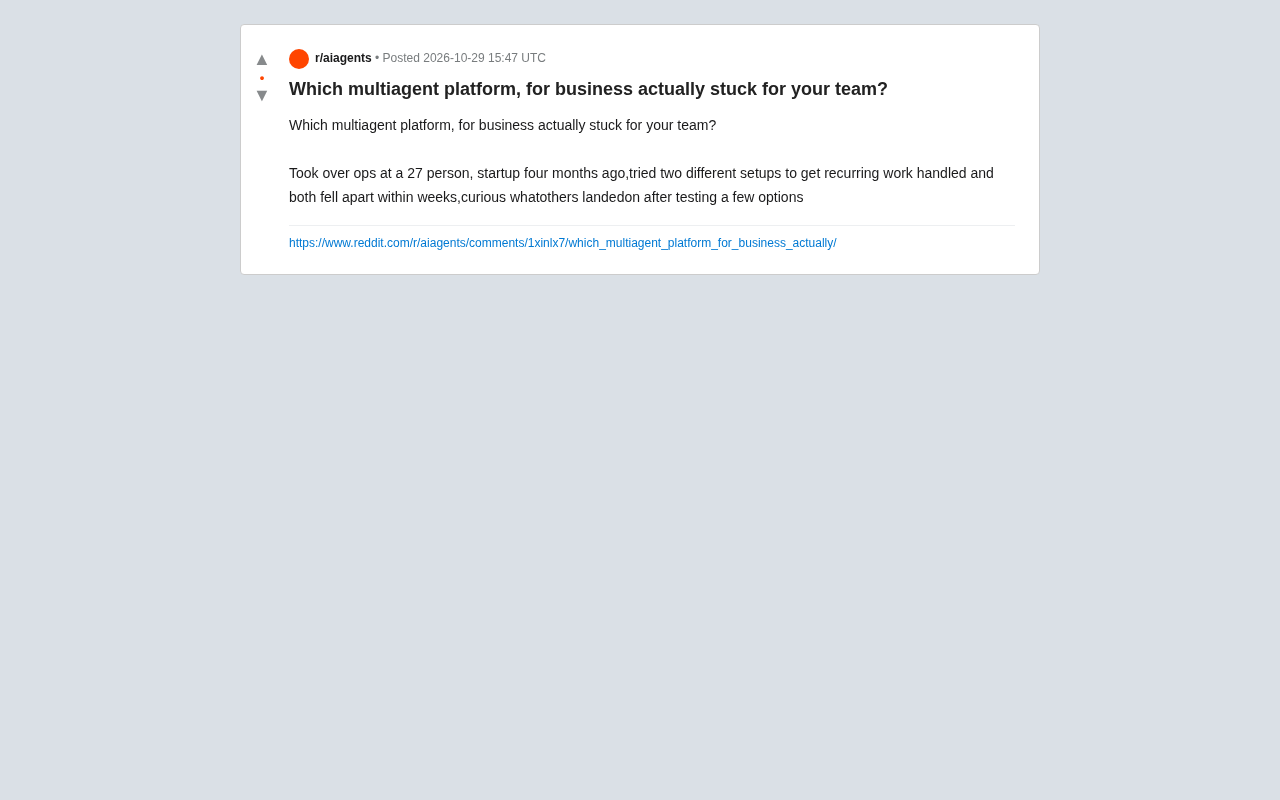
Which Multi-Agent Platform Wins? A Small Team's Battle Scars and Selection Considerations
A 27-person startup's ops lead tried two multi-agent platforms in four months and both failed. This article analyzes why small-team deployments break down, and offers selection guidance on integration depth, observability, and progressive rollout.

Thrive Holdings Takes ADT Private in $7.6 Billion Deal
Thrive Holdings acquires ADT for $7.6 billion in an all-cash take-private deal expected to close in Q1 2027. Analysis of the deal structure, ADT's asset value, and impact on the smart home security industry.