How Should Startups Navigate the ISO 27001 Compliance Dilemma?
Early-stage SaaS companies that honestly admit missing security certifications and replace empty promises with a transparent roadmap are more likely to win enterprise customer trust.
The article describes how a small startup building an AI operations SaaS tool for hardware teams chose to honestly admit it hasn't yet obtained certifications like ISO 27001 when facing enterprise customer security compliance inquiries, rather than making promises it couldn't keep. The author notes that missing certification doesn't mean missing trust—enterprise customer security teams focus more on the vendor's actual security practices and risk management level. The article proposes a phased compliance roadmap: first solidify basic security hygiene such as access control, encryption, and logging; then align with SOC 2 or ISO 27001 controls for documentation; and finally initiate formal certification audits. A transparent compliance roadmap can become an effective tool in sales conversations, helping customers understand the vendor's improvement plans and timeline expectations, thereby building long-term trust.
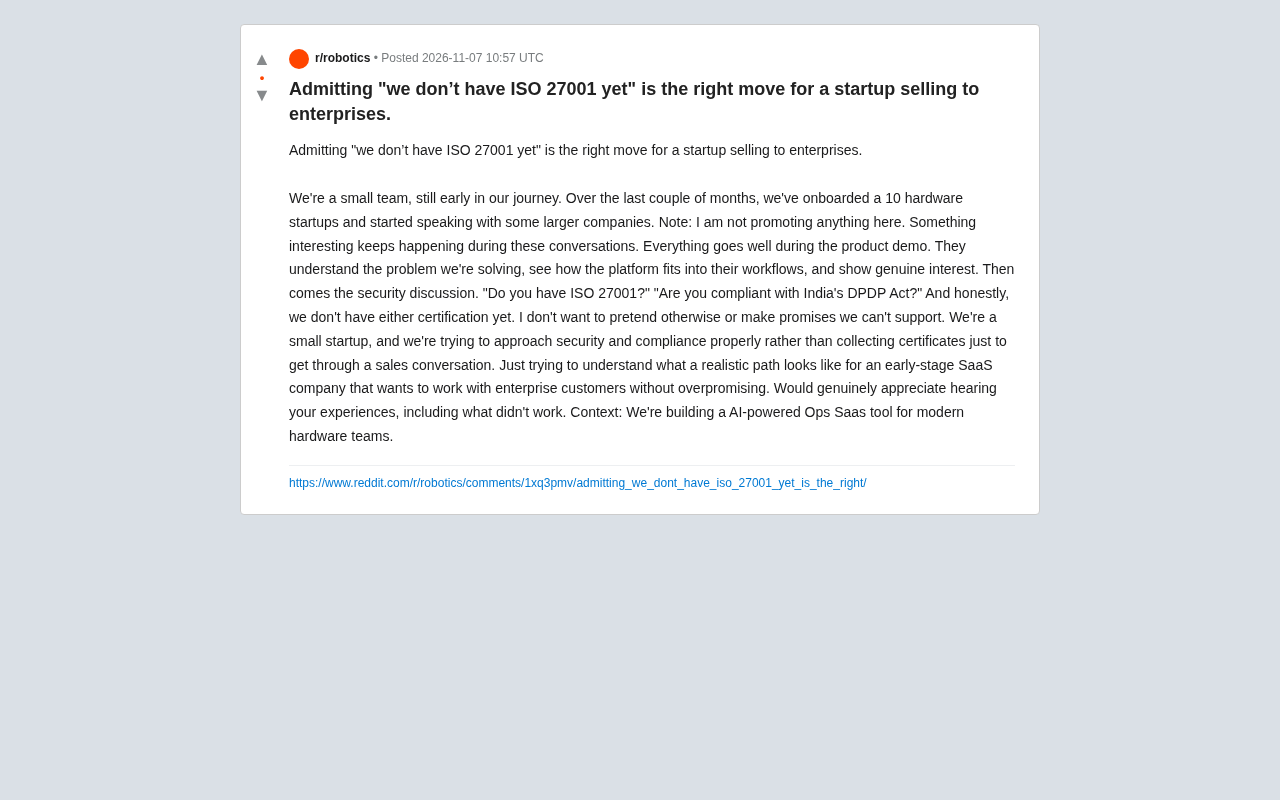
In sales cycles targeting enterprise customers, security compliance certifications are often an unavoidable hurdle. A small startup building an AI operations SaaS tool for hardware teams recently shared its experience on Reddit: demos went smoothly and customer interest was high, but once the conversation turned to security, questions like "Do you have ISO 27001 certification?" and "Are you compliant with India's DPDP Act?" brought discussions to a halt. Their choice was to honestly admit "we don't have these certifications yet" rather than make promises they couldn't keep. This seemingly simple decision sparked a deeper discussion about how early-stage SaaS companies can balance sales needs with compliance building.
Missing Certification Doesn't Mean Missing Trust
This startup has already served 10 hardware startups and is in talks with larger companies. The founder made it clear they didn't want to pretend to have certifications or make promises they couldn't deliver on. The team prefers to handle security and compliance "the right way" rather than collecting certificates just to get through sales conversations.
This attitude is actually a strategic choice at the early stage. ISO 27001 certification requires significant investment of time, manpower, and money, and for small teams, pursuing certification too early can divert resources away from product development. More importantly, if the security practices behind the certification aren't genuinely implemented, the certificate becomes a liability—once customers discover that reality doesn't match certification requirements, the cost of broken trust far exceeds the cost of honest acknowledgment of the current state.
ISO 27001 is an information security management system standard jointly published by the International Organization for Standardization (ISO) and the International Electrotechnical Commission (IEC), formally known as ISO/IEC 27001. The standard requires organizations to establish, implement, maintain, and continually improve an Information Security Management System (ISMS). Its core is not purely technical protection, but a systematic risk management framework covering three dimensions: people, processes, and technology. The certification process typically includes establishing system documentation, risk assessment, internal audit, management review, and finally a two-stage audit by an accredited external certification body. For startups, a complete certification cycle often takes 6 to 18 months, involving consulting fees, audit fees, and internal manpower investment, with total costs ranging from tens of thousands to hundreds of thousands of dollars. Certificates are valid for three years and require periodic surveillance audits. For this reason, starting certification prematurely can place a significant burden on resource-constrained teams.
What Enterprise Customers Really Care About
From the reality of sales conversations, enterprise customers asking for certifications doesn't necessarily mean "no certificate, no deal." More commonly, the security team needs to assess the vendor's risk level, and certification is just one dimension of the assessment framework. For early-stage vendors, customers often focus more on actual security practices: how data is stored and encrypted, whether access control mechanisms are sound, whether incident response processes exist, and whether basic vulnerability management measures are in place.
If a startup can clearly demonstrate these foundational practices, it may still pass the customer's internal risk assessment even without formal certification. The key is proactive communication rather than passively waiting for customers to discover problems.
SOC 2 (System and Organization Controls 2) is an attestation report standard developed by the American Institute of Certified Public Accountants (AICPA), focusing on a service organization's controls across five trust service principles: security, availability, processing integrity, confidentiality, and privacy. Unlike the certification nature of ISO 27001, SOC 2 issues an attestation report from an independent auditor on the effectiveness of controls, typically divided into Type I (control design at a point in time) and Type II (operating effectiveness of controls over a period). Enterprise customers, especially North American ones, often use SOC 2 as a baseline requirement for vendor security assessments. For startups, SOC 2 Type I has a relatively lower barrier to entry and can serve as an intermediate step toward formal certification, with its controls overlapping significantly with ISO 27001 for easy reuse later.
A Pragmatic Compliance Roadmap
For early-stage SaaS companies hoping to serve enterprise customers, an actionable path is to build compliance capabilities in phases. Phase one focuses on basic security hygiene: establishing access controls, data encryption, logging, and backup and recovery mechanisms. Phase two aligns with common requirements from target customers, such as SOC 2 or ISO 27001 controls, and begins documenting processes and collecting evidence. Phase three formally initiates certification audits.
This gradual approach allows startups to present a clear compliance roadmap during sales conversations, explaining to customers their current status, next steps, and timeline expectations. What customers see is a planned, verifiable commitment to improvement—not empty assurances.
The Sales Value of Honest Communication
Admitting "we don't have ISO 27001 yet" may slow down some deals in the short term, but it builds the foundation for long-term trust. Enterprise customer security teams are typically experienced and can distinguish between vendors that are "building compliance capabilities" and those that are "ignoring security issues." An honest attitude combined with a concrete improvement plan is often more persuasive than vague promises.
This startup's approach also reflects a broader trend: as AI tools rapidly penetrate enterprise workflows, security and compliance are becoming part of product competitiveness rather than merely a sales obstacle. Embedding compliance awareness into product design and operational processes early on is more efficient than remediating later.
For resource-constrained startup teams, the key isn't whether they have certificates, but whether they manage security risks in a professional and transparent manner. What customers ultimately buy is trust, and trust comes from consistent behavior and verifiable commitments.
One-line Summary
Early-stage SaaS companies that honestly admit missing security certifications and replace empty promises with a transparent roadmap are more likely to win enterprise customer trust.
Paragraph Summary
The article describes how a small startup building an AI operations SaaS tool for hardware teams chose to honestly admit it hasn't yet obtained certifications like ISO 27001 when facing enterprise customer security compliance inquiries, rather than making promises it couldn't keep. The author notes that missing certification doesn't mean missing trust—enterprise customer security teams focus more on the vendor's actual security practices and risk management level. The article proposes a phased compliance roadmap: first solidify basic security hygiene such as access control, encryption, and logging; then align with SOC 2 or ISO 27001 controls for documentation; and finally initiate formal certification audits. A transparent compliance roadmap can become an effective tool in sales conversations, helping customers understand the vendor's improvement plans and timeline expectations, thereby building long-term trust.
Related articles
 Tech Frontiers
MuJoCo: An Analysis of DeepMind's Open-Source General-Purpose Physics Simulator
An in-depth analysis of Google DeepMind's open-source physics simulator MuJoCo: high-performance C++ kernel, MJCF modeling format, contact solving principles, MJX GPU acceleration, and robot reinforcement learning use cases.
 Tech Frontiers
Claude API Quick Start: The Official Quickstarts Project Collection
Anthropic's official claude-quickstarts project collection helps developers quickly build deployable apps with the Claude API. Nearly 20k stars, Python-based, great for beginners and prototyping.
 Tech Frontiers
AI Agents Connecting Directly to APIs: Which Calls Can Be Safely Allowed?
AI agents can call any API, but the real challenge is deciding which calls can be safely allowed. This article analyzes allowance decisions from three dimensions—intent matching, least privilege, and controllable impact—and argues that the control layer should sit outside the agent, combined with audit traceability to build a trustworthy API call governance mechanism.