How to Choose a PhD Research Direction in RL? A Deep Dive into Six Frontier Areas

Breaking down the potential and risks of six major RL PhD research directions, with a selection framework based on interest, industry, advisor, and transferability.
Aiming at the common dilemma of choosing an RL PhD direction, this article systematically reviews six main research directions: RL for LLMs and agents, offline RL, safe RL, world models and model-based RL, multi-agent RL, and robot RL. Each direction is analyzed from four dimensions: core question, open problems, advantages, and risks. It points out that RL for LLMs has the highest industrial heat but is fiercely competitive and fast-changing; offline RL and safe RL have strong theoretical depth but need to be combined with practice to enhance practicality; world models and robot RL are irreplaceable in sample efficiency and real-world applications; and multi-agent RL suits researchers of complex systems. Finally, it proposes four selection frameworks: the intersection of interest and skills, the balance between academia and industry, advisor fit, and method transferability, emphasizing that the value of a PhD lies in cultivating research taste and problem-solving ability.
Why the Direction Choice for an RL PhD Matters So Much
A Reddit user about to start a PhD in reinforcement learning (RL) posted for help: with so many directions to choose from—offline RL, safe RL, world models, multi-agent RL, robotics, RL for LLMs—how should they decide? They specifically emphasized three criteria: enough open research questions, PhD-level depth, and ideally value outside academia. This actually captures the common predicament of RL PhD students—the field is developing rapidly with clear divergence between directions, and choosing wrong could mean that a few years later the research topic has cooled down or become disconnected from industry needs.
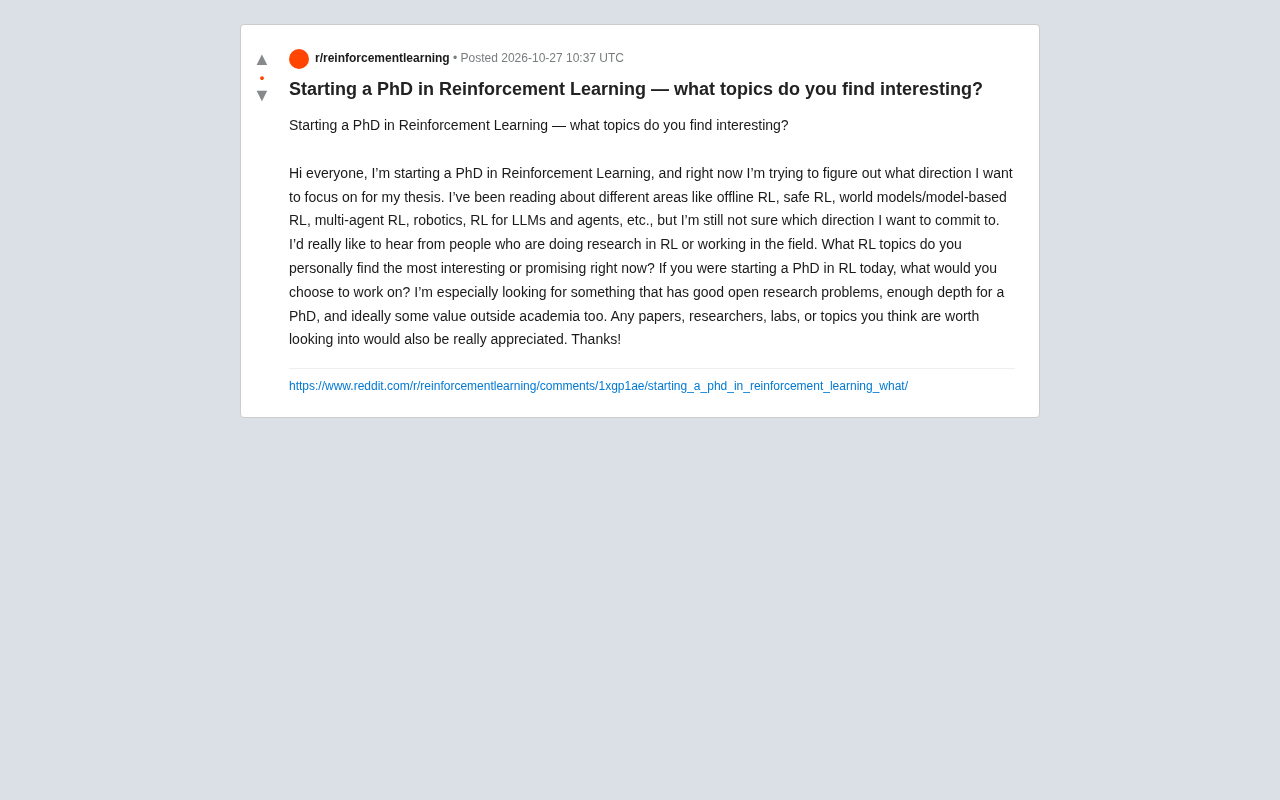
Drawing on community discussion and current research trends, we break down the potential and risks of each direction from several dimensions and offer a selection framework.
Direction 1: RL for LLMs and Agents—Hottest Right Now, but Fiercely Competitive
Core question: How can reinforcement learning be used to improve the reasoning ability, alignment, and tool-use capability of large language models?
This is one of the most closely watched directions in RL today. From RLHF (reinforcement learning from human feedback) to reinforcement learning with verifiable rewards (RLVR), and on to multi-turn tool calling and agent decision-making, industry demand for talent in this area is very strong. Open problems include: how to design better reward models, how to solve credit assignment under sparse rewards, and how to keep agents stable on long-horizon tasks.
Advantages: Clear industrial value, fast paper output, and close integration with the LLM ecosystem.
Risks: The direction changes extremely quickly—today's hotspot may be replaced by a new paradigm in two years; at the same time, competition is exceptionally fierce, with a large number of labs and industry teams rushing in. If you choose this direction, it is advisable to focus on a specific sub-problem and build depth rather than doing “RL + LLM” in a broad, generic way.
The difference between RLHF and RLVR: RLHF (reinforcement learning from human feedback) relies on human-annotated preference data to train a reward model, and then optimizes the policy through algorithms such as PPO. Its bottleneck is that the reward model may be “reward hacked,” and annotation costs are high. RLVR (reinforcement learning with verifiable rewards), by contrast, uses reward signals that can be automatically verified (such as the correct answer to a math problem or whether code passes unit tests), avoiding reward model bias, but its scope is limited to tasks with clear verifiers. The core difference between the two lies in the source and reliability of the reward signal; understanding this helps determine which category a specific research question belongs to and where the innovation space lies.
Direction 2: Offline RL—The Cornerstone of Data Efficiency
Core question: How can a policy be learned solely from a static dataset without requiring online interaction?
Offline RL addresses learning problems in scenarios where interaction is costly or dangerous, such as healthcare, autonomous driving, and robotics. Open problems include: the overestimation problem for out-of-distribution actions, generalization when offline data coverage is insufficient, and offline-to-online fine-tuning. This direction is theoretically strong and suits PhD students who enjoy mathematical derivation and algorithm analysis.
Advantages: Clearly defined problems, close connection to real scenarios, and mature theoretical tools.
Risks: Industrial deployment cases for purely offline RL are relatively limited, and it is more often a supplement to online RL. It is advisable to combine it with online fine-tuning or world models to enhance practicality.
The overestimation problem for out-of-distribution actions: In offline RL, during training the policy tends to select actions that never appeared in the dataset but are overestimated by the value function, leading to performance collapse at deployment. This phenomenon is called “out-of-distribution action overestimation” and is a core challenge in offline RL. Common mitigation methods include: conservative Q-learning (CQL), which suppresses overestimation by penalizing the value estimates of unseen actions; and implicit Q-learning (IQL), which completely avoids querying the values of out-of-distribution actions. Understanding the assumptions and limitations of these methods is the foundation for entering offline RL research.
Direction 3: Safe RL—From Constraints to Trustworthiness
Core question: How can rewards be maximized while guaranteeing safety constraints?
Safe RL focuses on constraint satisfaction, risk-sensitive decision-making, and robustness. As RL systems enter the real world (robotics, autonomous driving, healthcare), safety becomes an unavoidable issue. Open problems include: how to define and verify safety constraints, how to avoid catastrophic behavior during exploration, and how to provide formal guarantees of safety.
Advantages: High social value, aligned with policy and regulatory trends, and research questions with depth.
Risks: Formal guarantees of safety often require a strong mathematical background, and experimental validation costs are relatively high. Suitable for students with a background in control theory or formal methods.
Direction 4: World Models and Model-Based RL—A Breakthrough for Sample Efficiency
Core question: How can we learn a dynamics model of the environment and plan or learn policies within that model?
Model-based RL (MBRL) improves sample efficiency through world models and is a key technology for scenarios where interaction is expensive, such as robotics and autonomous driving. Open problems include: the long-term prediction accuracy of world models, policy optimization under model bias, and unified modeling of discrete and continuous action spaces. In recent years, integration with video generation models has also brought new ideas.
Advantages: Obvious sample efficiency advantages, intersection with cognitive science, and sufficient research depth.
Risks: Training and evaluating world models is highly complex, and tuning costs are high. A solid foundation in generative models and optimization is recommended.
Model bias and compounding error: World models produce compounding error in long-term prediction—small deviations at each step rapidly accumulate after multi-step rollout, distorting the imagined trajectories on which planning relies. This is a major obstacle for MBRL in practical applications. Countermeasures include: shortening the planning horizon of model rollout, falling back to real environment interaction when model uncertainty is high, and using ensemble models to estimate predictive uncertainty. The introduction of video generation models in recent years (such as Diffusion World Models) has improved prediction quality under high-dimensional observations, but the compounding error problem has not been fundamentally solved, making it a research point worth exploring in depth.
Direction 5: Multi-Agent RL—The Complexity of Cooperation and Games
Core question: How can multiple agents learn to cooperate or compete in a shared environment?
Multi-agent RL (MARL) involves game theory, credit assignment, communication learning, and other issues. Application scenarios include robot swarms, traffic signal control, game AI, and economic simulation. Open problems include: learning stability in non-stationary environments, credit assignment among agents, and scalable communication protocols.
Advantages: Abundant problems, intersection with game theory and social science, and easy to produce interesting stories.
Risks: Complex experimental environments, high reproducibility difficulty, and relatively early industrial deployment. Suitable for students who enjoy complex systems and game theory.
Non-stationarity and credit assignment: In multi-agent RL, each agent's policy is updated simultaneously, causing the environment faced by other agents (that is, the joint policy) to change constantly, which breaks the stationarity assumption of the Markov decision process in single-agent RL and makes learning stability a difficult problem. Credit assignment refers to how, when a team receives a shared reward, the reward can be reasonably attributed to each agent's actions. Common methods include counterfactual baselines (COMA) and value decomposition (VDN/QMIX). These two major problems constitute the core theoretical challenges of MARL research and are also key yardsticks for assessing the research depth of this direction.
Direction 6: Robot RL—From Simulation to Reality
Core question: How can RL policies run stably on real robots?
Robotics is one of the most classic application scenarios for RL. Sim-to-real transfer, dexterous manipulation, and locomotion control are core problems. Open problems include: bridging the simulation-reality gap, multi-task generalization, and safety and efficiency in human-robot interaction.
Advantages: Clear industrial demand (manufacturing, logistics, service robots) and concrete research problems.
Risks: High hardware costs and experimental cycles, with strong requirements for engineering ability. Suitable for students with a background in robotics or control.
How to Choose: Three Practical Frameworks
1. The intersection of interests and skills: List the questions you are genuinely curious about and the technical stack you already have, and choose the intersection of the two. A PhD is a long race; without interest it is hard to persist.
2. The balance between academic depth and industrial value: If you hope to enter industry after graduation, prioritize directions closely tied to LLMs, robotics, and autonomous driving; if you lean toward academia, choose directions with richer theoretical problems and a more active community.
3. The fit between advisor and lab: No matter how good the direction is, it is hard to produce results if your advisor is not familiar with it. Before settling on a direction, it is advisable to first investigate the paper topics and graduate destinations of your target lab over the past three years.
4. Pay attention to the transferability of methods: No matter which direction you choose, try to master general RL tools (optimization, probabilistic inference, experimental design), so that even if the hotspot shifts, you can adjust quickly.
Conclusion
There is no absolutely “correct” direction—only the one that best matches your interests, skills, and career goals. RL for LLMs and agents is currently the area with the highest industrial heat, offline RL and safe RL offer solid theoretical depth, and world models and robot RL are irreplaceable in terms of sample efficiency and real-world applications. Multi-agent RL suits researchers who enjoy complex systems. It is advisable to preserve some room for exploration in the early stage of the PhD and gradually converge on specific problems by reading top-conference papers, reproducing classic work, and discussing with your advisor. Ultimately, the value of a PhD lies not only in the direction itself but also in the research taste and problem-solving ability you develop along the way.
Related articles

14 Core Concepts of Reasoning Models: From Chain of Thought to GRPO Explained
A systematic breakdown of 14 core concepts of reasoning models: chain of thought, test-time compute, verifiers, RLVR and GRPO, distillation, and reward hacking, plus rules for controlling thinking-token costs to help you decide when reasoning is worth paying for.

OpenAI's Claimed Refutation of ETH Sparks Debate, Meta Bets Big on AI Infrastructure
OpenAI claims an AI-assisted discovery that challenges the Exponential Time Hypothesis (ETH) and launches the mid-tier GPT-6.1 Tera. Cloudflare discloses a cross-customer data leak postmortem, and Meta plans $95B in AI infrastructure financing.

Data Scraping, AI Proofs, and Open Source Contracts: This Week's Deep Dive into the Tech World
From the 3D model crawler controversy and OpenAI's Lean formal proofs to AI agents challenging Brooks' Law and Debian rejecting LLM review, this week's tech discussions center on openness and verifiability.