How to Choose an Agent Framework: A Comparison Guide to 10 Major Frameworks by Use Case
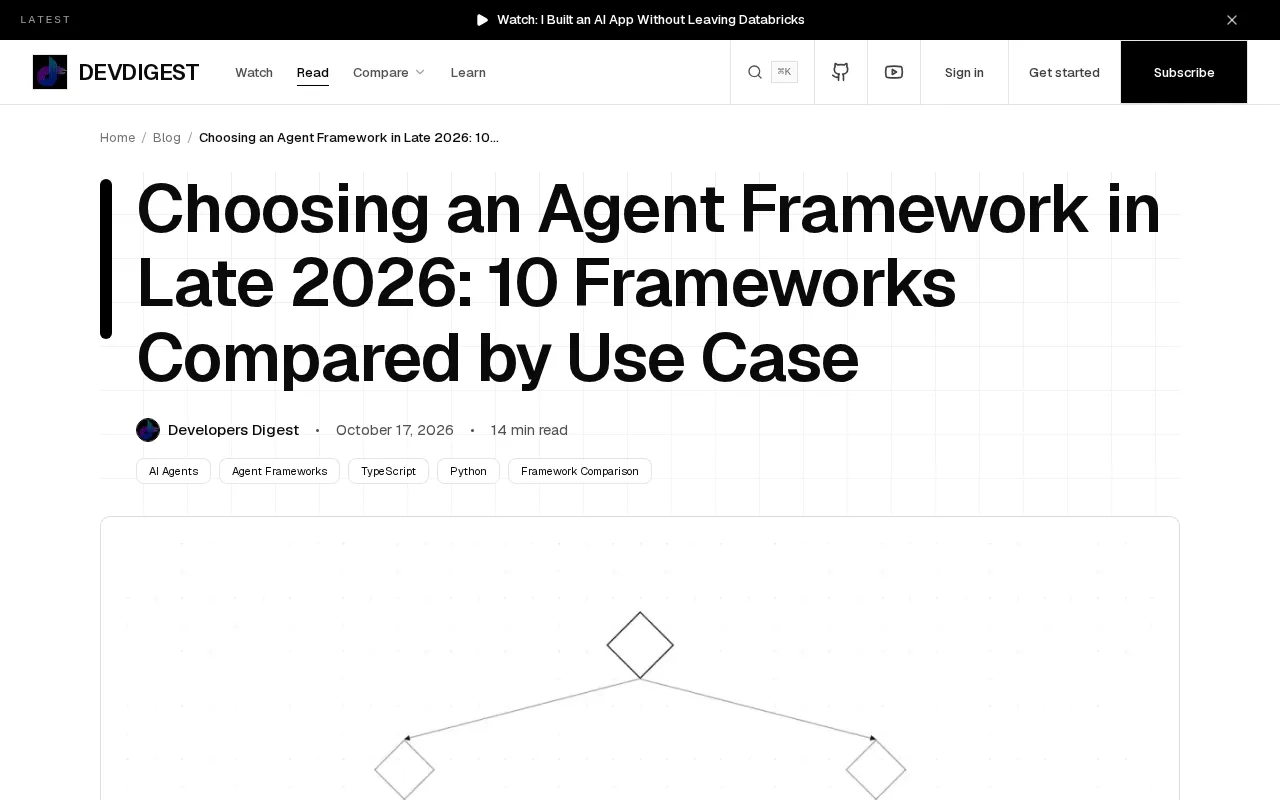
Use a capability matrix and decision flowchart to turn Agent framework selection into a structured process.
The article introduces an Agent framework selection guide from an RSS source, noting that the explosion in the number of frameworks has made selection difficult, rooted in teams often looking at demo results before considering engineering constraints. The original article proposes the reverse approach: first clarify programming language, durability requirements, and team structure, then work backward to the framework. The guide includes a capability matrix compiled from official documentation and a decision flowchart branching on language, durability, and team, emphasizing that durability is a key watershed for long-task Agents and that real team constraints determine implementation cost. The core argument is to choose by use case rather than by popularity, prioritizing orchestration models and execution reliability, with the real differences often showing up in how edge cases are handled.
Building an AI Agent often makes choosing a framework more agonizing than writing the code itself. There are more and more options on the market, official documentation tells a different story from each vendor, and a guide from an RSS source tries to condense this into an executable selection process using a capability matrix and a decision flowchart.
Why Framework Selection Has Become a Challenge
The explosive growth of Agent frameworks has brought a side effect: they all look similar, but their actual positioning differs enormously. Some focus on orchestrating multi-step tasks, some emphasize durable execution, and some are built around a specific programming language ecosystem. The original article points out that the capability matrix in this comparison guide was compiled from each framework's official documentation rather than secondhand reviews—this point is critical, because frameworks iterate quickly and blog posts often lag behind the docs.
The root of the selection difficulty is that teams usually look at demo results first and only then consider engineering constraints. The approach proposed in the original article is the reverse: first clarify your language stack, durability requirements, and team structure, then work backward to the framework.
Three Entry Points of the Decision Flowchart
The flowchart in the original article uses three dimensions as branch criteria: programming language, durability, and team situation.
Language Stack Determines the Candidate Set
Different frameworks support languages such as Python and TypeScript to different depths. Some frameworks are more mature in one language ecosystem, and cross-language use can reveal capability gaps. Once you settle on the language first, the number of candidate frameworks shrinks noticeably.
Orchestration model refers to how a framework organizes and drives the various steps of an Agent. Common forms include chain-based invocation, state machines, event-driven designs, and graph-based workflows. The chain model is simple to implement and intuitive to debug, but has weak support for branching and loops; state machines excel at expressing explicit state transitions and suit tasks with clear phases; graph workflows abstract nodes and edges, making parallel and conditional routing easier, but the abstraction layer is thicker and the learning curve steeper. Differences in orchestration models permeate all subsequent extensions—for example, when adding human intervention, retry strategies, or multi-Agent collaboration, the places that need changing and the difficulty of changing them differ completely across models. Therefore, when comparing frameworks, you should first confirm whether their core abstraction can naturally express your process, and then look at the feature list.
Durability Is the Watershed
Durability refers to whether an Agent can recover after an interruption during execution and whether long tasks can progress reliably. The original article treats this as a core branch: if the business requires long-running, recoverable Agent processes, then lightweight frameworks that only support short sessions are out of consideration. This judgment directly affects architectural complexity, and remedying it after the fact is very costly.
Durability in the Agent context means whether execution state can survive a process crash, a deployment update, or a long wait for an external response, and whether it can continue from the breakpoint. There are usually two implementation approaches: one is a persistence engine built into the framework that writes the state of each step to storage (such as a database or event log) and replays it after a failure; the other relies on an external workflow system to host the state, with the framework itself only responsible for orchestration logic. The former is more tightly coupled and has higher migration costs, while the latter is more flexible but requires additional operations and maintenance. When judging requirements, ask three questions: Is a single task likely to run for more than several hours? Does it involve long waits such as human approval? Would rerunning after a failure cause unacceptable side effects? If most answers are yes, durability is a hard constraint rather than a bonus.
Team Structure Affects Implementation Cost
Team size, existing engineering habits, and maintenance capacity determine whether a framework's learning curve is acceptable. The original article puts team factors into the flowchart, meaning it does not believe there is an absolutely optimal framework—the same framework can have very different practical results in different teams.
The premise for choosing by use case is to break the use case down to a comparable granularity. It is recommended to create a process table: for each stage, note the inputs and outputs, whether it can be interrupted, whether human intervention is needed, the expected duration, and the consequences of failure. This table can be used both to judge durability requirements and as an index for the capability matrix—directly look up framework entries in the matrix that cover similar process patterns rather than comparing feature counts item by item. In addition, for the same use case, you should distinguish between the needs of the prototype validation stage and the production operation stage: lightweight frameworks are tolerable during prototyping, but if production requires persistence and observability, binding to lightweight abstractions too early will instead increase migration costs.
How to Read the Capability Matrix
If the capability matrix of 10 frameworks only lists features, its value is limited. The original article's approach is to organize comparisons by use case so readers can map them directly to their own scenarios.
When reading this kind of matrix, there are several pitfalls worth noting:
- Checkmarks in a feature list do not equal production readiness; look at how mature the capability is described as being in the official documentation
- A framework's core abstraction determines the ease of subsequent extension, and differences in orchestration models are often more important than feature counts
- A matrix compiled from official documentation is relatively current, but you still need to confirm against the documentation for the specific version
Practical Advice for Choosing a Framework by Use Case
The core argument of the original article is to "choose by use case" rather than "choose by popularity." This approach can be broken down into several steps in practice:
First, write down the core process the Agent needs to complete, and mark which stages may be interrupted and which require human intervention. Then use the flowchart to filter out options that do not match on language or durability. For the remaining candidate frameworks, check the capability matrix for entries closest to your use case, prioritizing orchestration models and execution reliability rather than feature counts.
For most teams, the final decision is often made among two or three frameworks, and the real differences show up in how edge cases are handled—details that can only be confirmed by going back to the official documentation.
A Judgment Worth Remembering
The attitude conveyed by this guide is more valuable than any specific conclusion: there is no universal answer for Agent frameworks, and the selection process should be structured. Use a capability matrix to narrow the range, use a flowchart to eliminate hard mismatches, and use the realities of your team as constraints for the final trade-off. This method can reduce back-and-forth and rework in framework selection.
Frameworks will continue to evolve, but the order of "clarify constraints first, then choose tools" will not become outdated.
One-line Summary
Use a capability matrix and a decision flowchart to turn Agent framework selection into a structured process.
Paragraph Summary
The article introduces an Agent framework selection guide from an RSS source, noting that the explosion in the number of frameworks has made selection difficult, rooted in teams often looking at demo results before considering engineering constraints. The original article proposes the reverse approach: first clarify programming language, durability requirements, and team structure, then work backward to the framework. The guide includes a capability matrix compiled from official documentation and a decision flowchart branching on language, durability, and team, emphasizing that durability is a key watershed for long-task Agents and that real team constraints determine implementation cost. The core argument is to choose by use case rather than by popularity, prioritizing orchestration models and execution reliability, with the real differences often showing up in how edge cases are handled.
Related articles

Build a Reasoning Model from Scratch: An 11-Hour Open-Source Course Breakdown
Sebastian Raschka releases a free 8-episode, ~11-hour video course teaching you to build a reasoning model from scratch with Python and PyTorch—from a small Qwen3 model through Verifier, Inference Time Scaling, GRPO, and distillation, with open-source code on GitHub.

An 11-Hour Reasoning Model Course in Practice: How Small Models Learn to Think
Starting from Sebastian Raschka's 11-hour reasoning model course and HN buzz, this analyzes small-model training, legal text version control, Anthropic data policy, and product reliability reviews.

Lightpanda: A Headless Browser Built for AI and Automation
Lightpanda is a headless browser built from scratch in Zig for AI and automation, with 37,852 GitHub stars. This analysis covers its technical approach, design choices, and use cases.