How to Choose an LLM Inference Engine: A Full Breakdown of Seven Mainstream Options

A one-sentence positioning and scenario-based selection guide for seven mainstream LLM inference engines.
Centered on the judgment that "choosing an engine is more painful than choosing a model," the article summarizes the optimization focus and use cases of seven mainstream LLM inference engines in one sentence each. Llama CPP targets CPU and home single machines, MLXLM targets local inference on Apple silicon, and XLama V3 specializes in fitting large models into limited VRAM, while Hugging Face Transformers is not suited for service deployment but is irreplaceable for research, fine-tuning, and experimentation. For high-concurrency GPU scenarios, VLLM is the default choice, while SGLang is optimized for repeated context and agent workflows; LMDeploy focuses on Chinese vision models and 4-bit quantization, and TensorRT-LLM is tied to the NVIDIA data-center ecosystem. The article emphasizes that there is no universal engine, only engines that match the scenario, and provides a scenario-based decision checklist, suggesting you first use the one-sentence positioning to rule out unsuitable options, then benchmark two or three candidates.
Why Choosing an Inference Engine Is More Painful Than Choosing the Model Itself
When you decide to run a large language model locally or in production, the real question is often not "which model should I use" but "which engine should I run it on." The same model can differ by an order of magnitude in throughput, VRAM usage, and latency across different inference engines. In one video, a tech creator summed up the optimization focus and ideal use case of seven mainstream LLM inference engines in a single sentence each—exactly the decision map many developers need most.
His core judgment is simple: there is no universal engine, only engines that match the scenario. CPU inference, consumer-grade GPUs, multi-user concurrency, agent workflows, NVIDIA data centers—each need corresponds to a different technical choice.
Local Single-Machine and CPU Scenarios: Llama CPP and MLXLM
Llama CPP has a very clear positioning—CPU inference, and running a single model on home systems. If you use a tool like O-Llama, it's usually running on top of this. For users without a discrete GPU, or who just want to quickly run a quantized model on a laptop, Llama CPP is the most hassle-free starting point.
MLXLM is the Apple-ecosystem counterpart. It runs on Apple silicon, leveraging the unified memory architecture, and is suited for Mac users doing local inference. What these two engines share is "single machine, single model, lightweight"—neither pursues service-oriented capabilities.
GGUF and Quantization Formats
The common model file format in the Llama CPP ecosystem is GGUF (GPT-Generated Unified Format), which packs model weights, tokenizer configuration, and quantization information into a single file, with memory-mapped loading optimized for CPU and memory-constrained environments. GGUF supports a range of quantization schemes from 2-bit to 8-bit (such as Q4_K_M, Q5_K_S); the lower the bit count, the smaller and faster the model, but the more obvious the precision loss. This explains why the same model on Llama CPP can "pick a version based on your VRAM/memory budget," whereas GPU serving engines typically require a different weight format.
Unified Memory Architecture
On Apple silicon, the CPU and GPU share the same physical memory, so there is no copy bottleneck between discrete VRAM and host memory—this is the so-called Unified Memory Architecture. MLXLM exploits exactly this, so model weights are loaded only once and can be accessed directly by the GPU, enabling relatively large quantized models to run on a Mac with comparatively limited memory. The trade-off is that memory bandwidth and compute ceilings fall short of data-center GPUs, so it suits single-user local inference rather than high-concurrency serving.
What If You Don't Have Enough VRAM: XLama V3's Extreme Compression
If you have a large model but limited VRAM, XLama V3 is designed specifically for this. According to the video, its goal is to "fit huge models into as little VRAM as possible." Such engines typically combine quantization and memory optimization techniques to give models that otherwise wouldn't run a chance to be runnable on consumer-grade hardware.
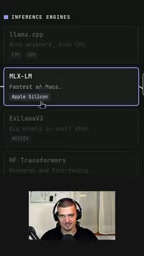
It should be noted that compression inevitably involves trade-offs in precision or speed. XLama V3 suits scenarios where "being able to run matters more than running fast," not high-concurrency production serving.
Hugging Face Transformers: Not a Serving Engine, But Unavoidable
The video author's assessment of Hugging Face Transformers is direct: it is not suited for service deployment, and its main value lies in research, experimentation, fine-tuning, and rapid validation.
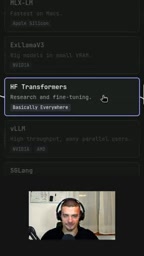
The reason for including it is its ecosystem status—a large number of model weights, fine-tuning scripts, and toolchains are centered on it. You may not use it for online inference, but it's hard to completely avoid it for model preparation and experimentation. For developers new to LLMs, starting with Transformers to understand model behavior and then migrating to a dedicated inference engine is a reasonable path.
High-Concurrency GPU Serving: VLLM and SGLang
When the scenario shifts to GPUs and multi-user concurrency, VLLM is basically the default answer. The video emphasizes that if you need parallel processing and want many users calling the model simultaneously, VLLM is what gives you high throughput. Through efficient memory management and batch scheduling, it pushes GPU utilization to a higher level.
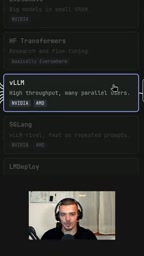
SGLang is positioned similarly to VLLM, but with a different optimization focus: it is specifically optimized for repeated prompts and workflows that repeatedly reuse the same context, such as agent scenarios. The author calls the two "competitors," and the key to choosing is whether your workload has high context reuse characteristics—for ordinary chat services, choose VLLM; for agent-intensive workflows, SGLang is worth evaluating.
PagedAttention and Continuous Batching
The key to VLLM's high throughput comes from PagedAttention: it divides the KV Cache (the key-value pairs cached during attention computation) into fixed-size blocks and allocates them on demand, much like an operating system manages virtual memory pages. This avoids reserving contiguous VRAM for the maximum length of every request, significantly reducing VRAM fragmentation and waste. Combined with Continuous Batching, the engine can dynamically add new requests to a batch and remove completed requests without waiting for the entire batch to finish, greatly improving GPU utilization. Understanding this makes it clear why VLLM's advantage truly shows only when "many users are calling simultaneously."
Prefix Caching
The core technology behind SGLang's optimization for repeated context is Prefix Caching and RadixAttention: when multiple requests share the same system prompt or long-context prefix, the engine directly reuses the already-computed KV Cache instead of recomputing from scratch. Agent workflows often repeatedly carry the same tool descriptions and history, so the gains are obvious; whereas ordinary chat requests differ greatly from each other with low prefix reuse rates, so SGLang's relative advantage is less pronounced. This is also the technical basis for the article's "choose based on whether the workload has high context reuse."
Special Hardware and Special Scenarios: LMDeploy and TensorRT-LLM
LMDeploy is described as a relatively "niche" option, which according to the video comes from a Chinese company, is optimized for Chinese vision models, and has specific optimizations for 4-bit quantized models. If your business involves Chinese multimodal models, it deserves separate consideration.
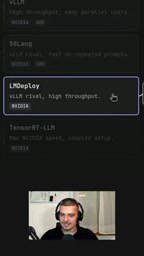
TensorRT-LLM, on the other hand, is tied to the NVIDIA ecosystem. As long as your deployment is on NVIDIA hardware, especially in data-center environments, it is usually the first choice. The performance gains from deep hardware optimization are hard to replace with other engines within the NVIDIA stack.
A Decision Checklist
Putting the seven engines back into their scenarios, the selection logic is actually quite clear:
- Pure CPU, home single machine, O-Llama-type tools: choose Llama CPP
- Local inference on Apple silicon: choose MLXLM
- Fitting large models into small VRAM: choose XLama V3
- Research, fine-tuning, rapid experimentation: use Hugging Face Transformers
- High-concurrency GPU serving: choose VLLM
- Agent and other repeated-context workflows: evaluate SGLang
- Chinese vision models and 4-bit quantization: look at LMDeploy
- NVIDIA data centers: choose TensorRT-LLM
It's worth emphasizing that these engines overlap, and actual selection should also take into account the team's tech stack, hardware inventory, and operational costs. The greatest value of the video's "one-sentence positioning" is to help you quickly rule out unsuitable options, narrow the evaluation scope to two or three candidates, and then run benchmarks.
One-line Summary
A one-sentence positioning and scenario-based selection guide for seven mainstream LLM inference engines.
Paragraph Summary
Centered on the judgment that "choosing an engine is more painful than choosing a model," the article summarizes the optimization focus and ideal use case of seven mainstream LLM inference engines in one sentence each. Llama CPP targets CPU and home single machines, MLXLM targets local inference on Apple silicon, and XLama V3 specializes in fitting large models into limited VRAM, while Hugging Face Transformers is not suited for service deployment but is irreplaceable for research, fine-tuning, and experimentation. For high-concurrency GPU scenarios, VLLM is the default choice, while SGLang is optimized for repeated context and agent workflows; LMDeploy focuses on Chinese vision models and 4-bit quantization, and TensorRT-LLM is tied to the NVIDIA data-center ecosystem. The article emphasizes that there is no universal engine, only engines that match the scenario, and provides a scenario-based decision checklist, suggesting you first use the one-sentence positioning to rule out unsuitable options, then benchmark two or three candidates.
Related articles
 Tech Frontiers
Coldframe: A Honeypot Disguised as a Supermarket Freezer Controller
Coldframe is a honeypot disguised as Danfoss AK-SM 800A and Dixell XWEB freezer controllers, built as a single Python file that detects CVE-2025-41450 attempts and is identified as real devices on Shodan.
 Tech Frontiers
GRFNet: A Lightweight PyTorch Model Designed for Multichannel Time-Series Classification
GRFNet is a lightweight PyTorch model for multichannel time-series classification, originating from EEG decoding research. With only 3,847 parameters, it is based on the ROCKET architecture, combining random convolution kernels with learnable spatial filters, supports arbitrary input lengths, and will soon be evaluated on the PhysioNet dataset.
 Tech Frontiers
CUDA-Accelerated Rocket League Simulator: A Player-Made Hardcore Experiment
A Reddit post shows a "100% Accurate" Rocket League simulator accelerated with CUDA. We analyze its technical context, CUDA's value in game physics simulation, and the significance and limitations of such community projects.