How to Reduce False Pass Rates in AI Testing Agents: Four Practical Strategies

AI testing agents' false passes are more dangerous than flaky tests, requiring combined approaches like explicit expectations and hard assertions to prevent.
The article discusses the risk of false passes in UI regression from AI testing agents: one developer's agent, after dismissing a modal, saw a residual confirmation screen and marked an incomplete checkout flow as passed—undetected for three days, leading to shipping with defects. The author notes false passes are more dangerous than flaky tests because green passes mask problems. Four approaches to reduce false passes include: explicit expected results at each step (most effective, lowest cost), a second model as judge (doubles cost but independence is questionable), hard assertions outside the agent (most reliable but depends on backend access), and built-in safeguards in specialized tools like step-by-step reports and watchdog agents. Community consensus is to prioritize explicit expectations, combine hard assertions with audit mechanisms, and establish false pass reporting mechanisms.
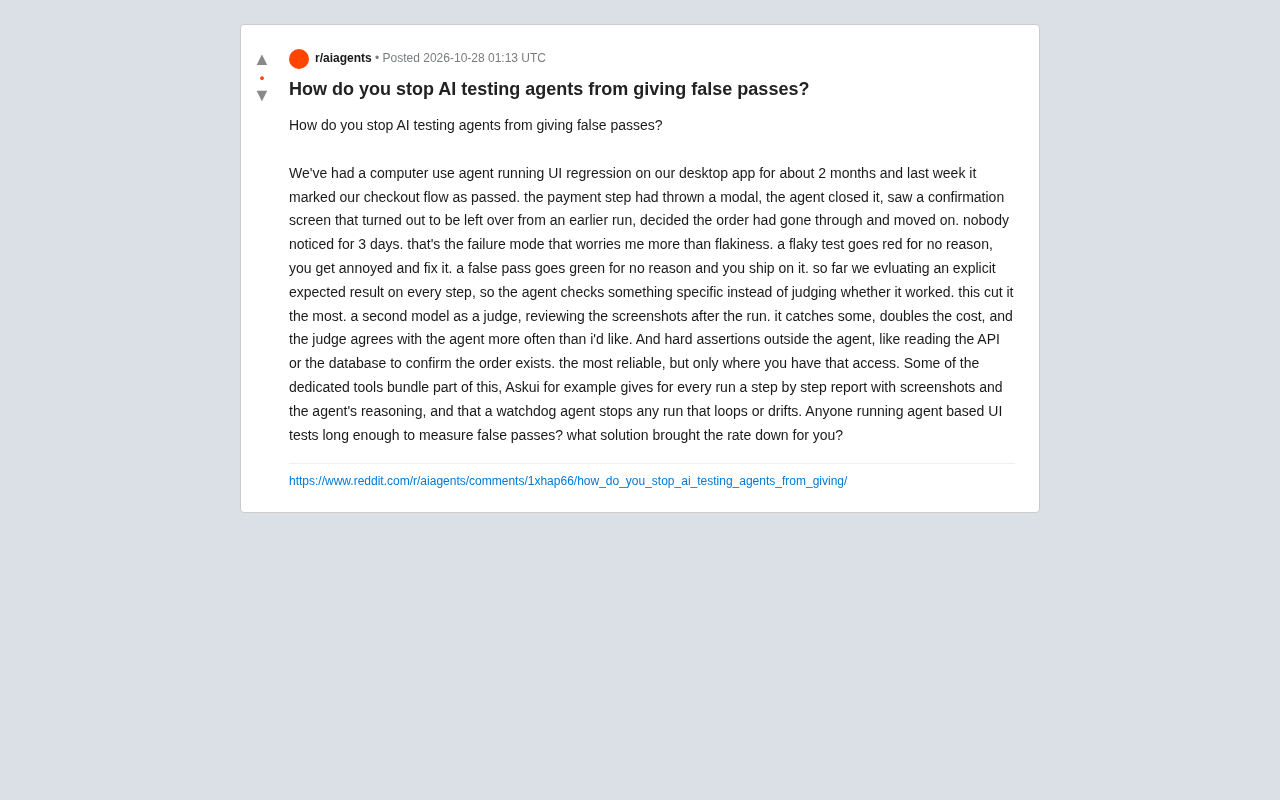
AI testing agents giving false passes in UI regression testing is more dangerous than test flakiness. A developer shared on Reddit: their computer-use agent had been running desktop application UI regression tests for two months, and last week it marked the checkout flow as passed. In reality, a modal appeared during the payment step; after the agent dismissed it, it saw a confirmation screen left over from an earlier run and concluded the order was complete. No one noticed for three days. This kind of silent failure—tests turning green without actually passing—directly led to shipping with defects.
Why False Passes Are More Terrifying Than Flaky Tests
A flaky test turns red for no reason, you get annoyed and fix it. A false pass turns green for no reason, and you ship software based on it. The difference is: red failures trigger action, green passes mask problems. The developer noted that false passes are the failure mode they worry about more.
In UI regression, the agent needs to judge whether each step succeeded. If the judgment is based on a vague "looks normal," it's susceptible to residual state, modal occlusion, and timing mismatches. In the above case, after dismissing the modal, the agent saw a leftover confirmation screen and mistakenly believed the order had succeeded. This error went undetected for three days.
UI regression testing refers to automatically re-executing a set of interface tests covering critical user flows after each code or configuration change, to ensure existing functionality hasn't been broken. It typically runs in continuous integration (CI) pipelines, where failures block merges or releases. Traditional UI regression relies on scripted locators and assertions, while AI testing agents replace hardcoded assertions with visual or natural language reasoning, making them more adaptable to interface changes but also introducing judgment uncertainty. A false pass means the test didn't actually verify success but reported a pass—a silent failure. In contrast, a flaky test produces inconsistent red/green results under the same code. The industry commonly uses escaped defect to describe defects that should have been caught by testing but reached production; false passes are one of the main sources of escaped defects.
Four Approaches to Reducing False Pass Rates
The developer tried multiple methods with varying effectiveness and cost.
1. Explicit Expected Results at Each Step (Most Effective)
Require the agent to check a specific thing at each step, rather than letting the agent judge "whether it succeeded" on its own. For example, instead of just checking "the page shows confirmation information," explicitly expect "the order ID appears in the confirmation area and the status is 'paid'." The developer said this measure "cut false passes the most."
Explicit expected results shift the judgment criterion from the agent's subjective assessment to verifiable conditions. The agent no longer needs to "understand" success or failure—it just compares expected vs. actual. This reduces misjudgments caused by residual state or timing issues.
Hard assertions stand in contrast to AI agents' "soft judgments": hard assertions are deterministic programmatic checks that throw a failure when conditions aren't met, without relying on model interpretation. In UI testing, hard assertions can be checking that an element's text equals an expected value, that an API returns 200 with an order ID in the response body, or directly querying the database to confirm a record exists. Their reliability comes from repeatability and non-bypassability, but maintenance costs are higher—any interface change can break them. Network interception is a middle ground between UI and backend: the agent or test framework captures HTTP requests made by the page and validates request parameters and response content, verifying whether business actions actually occurred without directly accessing the database. Such assertions push verification from "looks successful" down to "successful at the data or protocol level," effectively identifying illusions caused by residual screens and modal occlusion.
2. A Second Model as Judge (Doubles Cost, Limited Effectiveness)
Use another model to review screenshots after the run. The developer noted it catches some false passes, but costs double, and the judge agrees with the agent "more often than I'd like." This means the second model isn't independent and may share the same biases or blind spots.
The second model's advantage is post-hoc review, which can introduce different perspectives. But the developer didn't specify whether the judge model differs in architecture or training data from the execution model. If the two are similar, agreement may just be shared errors.
3. Hard Assertions Outside the Agent (Most Reliable, Depends on Access)
Use hard assertions outside the agent, such as reading the API or database to confirm the order exists. The developer called this the "most reliable" method, but it's limited to scenarios where you have the appropriate access. For desktop applications, you may not be able to directly access backend APIs or databases, so applicability is limited.
Hard assertions don't depend on UI state—they directly verify system state. If the order truly exists in the database, the confirmation screen on the UI can be trusted. This approach pushes verification from the presentation layer down to the data layer, greatly reducing false passes.
4. Built-in Safeguards in Specialized Tools (Partial Automation)
Some specialized tools integrate some of the above capabilities. The developer cited Askui, which provides step-by-step reports for each run, including screenshots and the agent's reasoning process. Additionally, a watchdog agent stops any looping or deviating runs.
A watchdog agent can prevent the agent from getting stuck in infinite loops or deviating from the expected path. Step-by-step reports provide an audit trail for post-hoc analysis of false pass causes. But whether these built-in safeguards are sufficient to eliminate false passes depends on the tool's implementation details.
Multi-Source Perspectives: Community Consensus and Divergence
According to the Reddit post and comment discussions (single source, but reflecting frontline practice), explicit expected results are considered by multiple developers to be the most cost-effective measure. Some commenters mentioned that writing expected results as executable assertions (such as checking specific element text or API responses) is more reliable than letting the agent judge freely.
There's disagreement about the second-model judge. Some developers believe the judge model should use a model from a different vendor to avoid shared bias, while others think doubling the cost isn't worth it and it's better to invest in hard assertions.
Hard assertions are widely recognized as the most reliable, but implementation difficulty depends on system architecture. For scenarios without backend access, developers suggest at least using network interception or filesystem checks as a compromise.
Watchdog features in specialized tools are considered useful supplements but cannot replace explicit expected results. Some users pointed out that watchdogs can only stop obvious anomalies and cannot judge whether business logic is correct.
Practical Recommendations: Combine Approaches, Prioritize Explicit Expectations
Based on the developer's experience and community discussion, reducing false pass rates requires a combination of approaches. Prioritize implementing explicit expected results at each step—this is the lowest-cost, most effective measure. Next, add hard assertions at stages where the backend is accessible. The second-model judge can serve as a supplement, but pay attention to model independence and cost. Watchdog and reporting features in specialized tools can serve as audit and safeguard layers.
The developer finally asked: has anyone run agent-based UI tests long enough to measure false pass rates? What approaches reduced your false pass rate? This reflects the field's ongoing lack of publicly available quantitative data, with practitioners relying on experience sharing.
For teams adopting AI testing agents, it's recommended to start with explicit expected results, gradually introduce hard assertions, and establish a reporting mechanism for false passes to avoid silent failures.
One-line Summary
False passes from AI testing agents are more dangerous than flaky tests, requiring combined approaches like explicit expectations and hard assertions to prevent.
Paragraph Summary
The article discusses the risk of false passes in UI regression from AI testing agents: one developer's agent, after dismissing a modal, saw a residual confirmation screen and marked an incomplete checkout flow as passed—undetected for three days, leading to shipping with defects. The author notes false passes are more dangerous than flaky tests because green passes mask problems. Four approaches to reduce false passes include: explicit expected results at each step (most effective, lowest cost), a second model as judge (doubles cost but independence is questionable), hard assertions outside the agent (most reliable but depends on backend access), and built-in safeguards in specialized tools like step-by-step reports and watchdog agents. Community consensus is to prioritize explicit expectations, combine hard assertions with audit mechanisms, and establish false pass reporting mechanisms.
Related articles

Why Does Self-Play AI Always Get Crushed by Cheap Units? An RTS Developer's Account of the Dilemma
An independent developer trained an RTS commander AI with pure self-play, only to find it dominated historical versions but was crushed by human players using cheap tier-1 units. This article analyzes the causes of self-play strategy collapse, explores solutions such as exploiters, diversity rewards, and reward design, and introduces the open Bot Kit and AI league plan.
Which Multi-Agent Platform Wins? A Small Team's Battle Scars and Selection Considerations
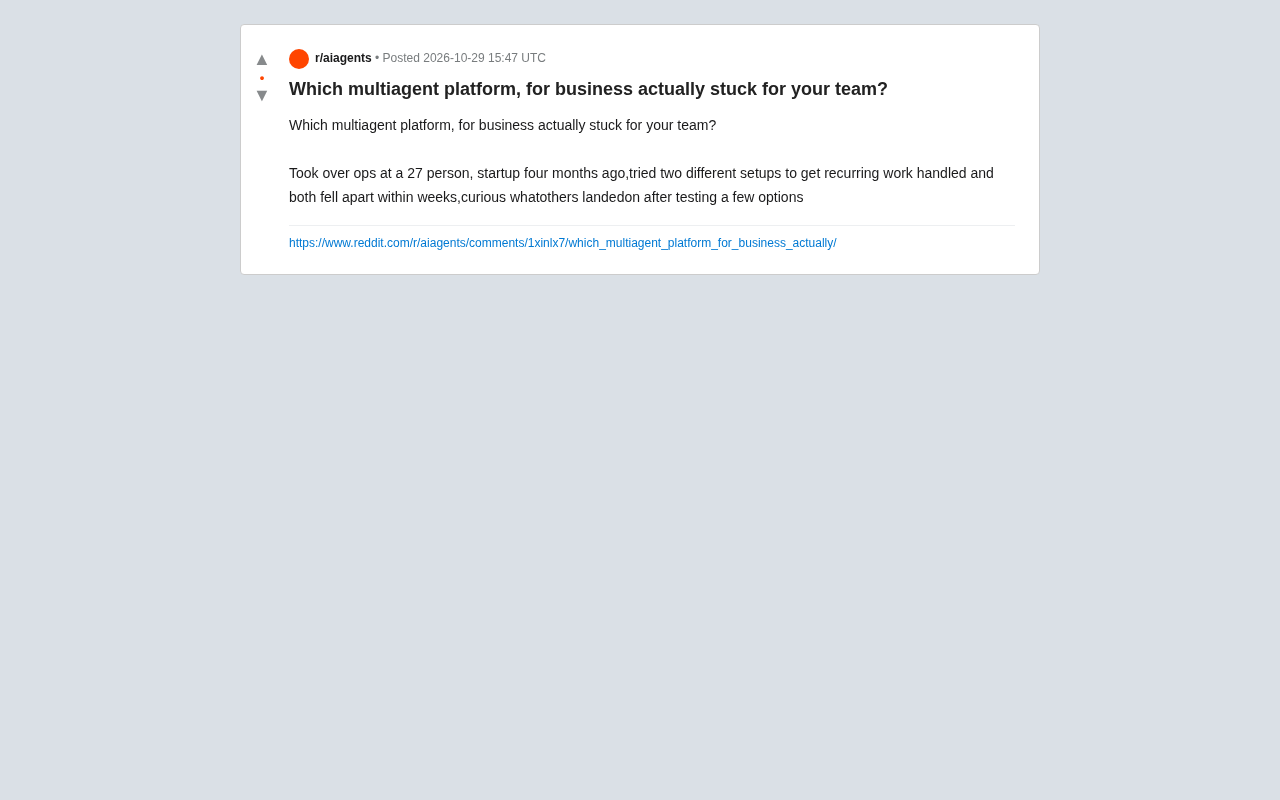
A 27-person startup's ops lead tried two multi-agent platforms in four months and both failed. This article analyzes why small-team deployments break down, and offers selection guidance on integration depth, observability, and progressive rollout.

Thrive Holdings Takes ADT Private in $7.6 Billion Deal
Thrive Holdings acquires ADT for $7.6 billion in an all-cash take-private deal expected to close in Q1 2027. Analysis of the deal structure, ADT's asset value, and impact on the smart home security industry.