Hugging Face Models Vanish en Masse: What's Behind the Takedowns?

Multiple abliterated models vanished from Hugging Face, sparking debate on platform moderation and supply chain risk.
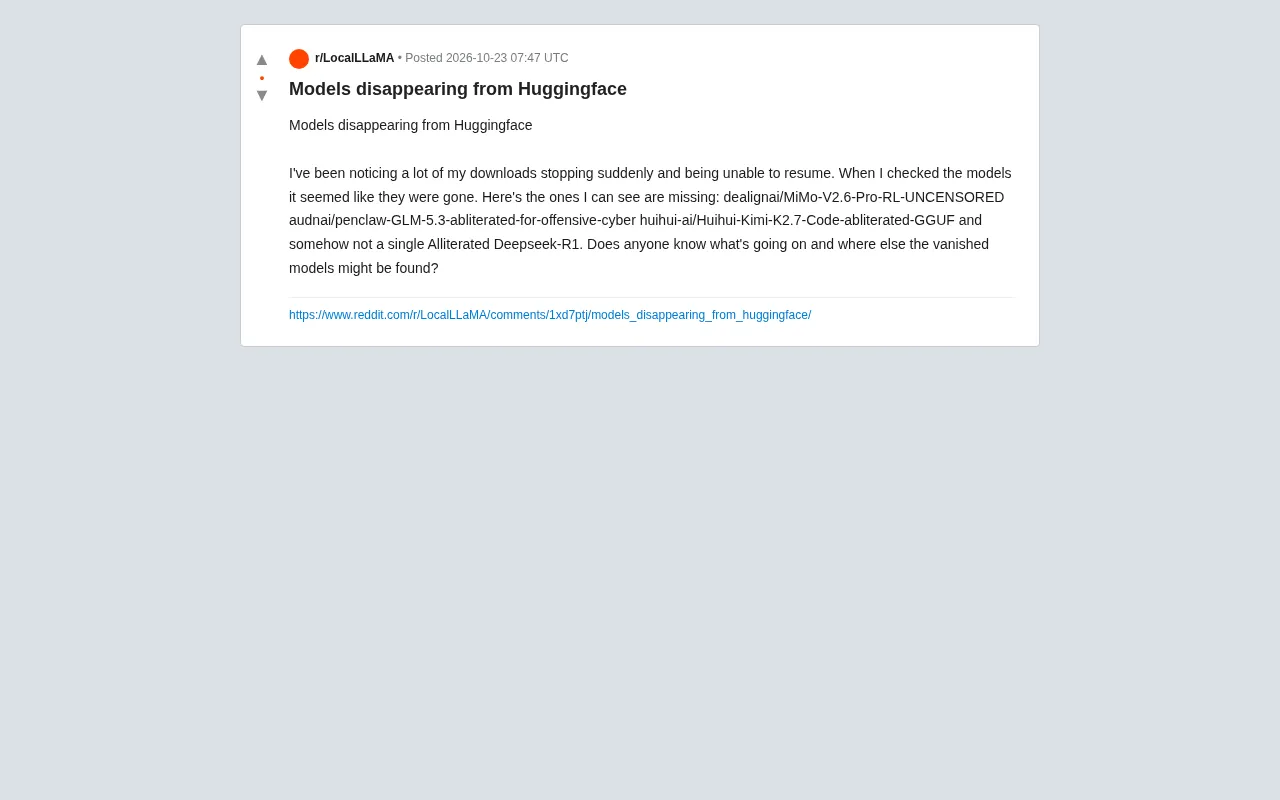
Reddit users found that multiple models suddenly disappeared from Hugging Face and downloads could not be resumed; the listed models generally carried tags like uncensored, abliterated, and for-offensive-cyber. The article argues these models tread the gray area of platform content policy, and their disappearance is more likely a proactive takedown under community guidelines than a technical failure or author deletion; the stalled, unrecoverable downloads also point to platform-side removal. Lacking official statements, both platform cleanup and author self-deletion remain possible. The article advises developers to back up key models locally, watch for compliant mirror sources, and assess content policy risk during project planning, while noting the incident reflects insufficient transparency in platform content governance and the inherent risk of single-platform dependence.
Recently, users in the Reddit community discovered that several models they were downloading suddenly stalled and could not be resumed. Upon checking, they confirmed these models had disappeared from Hugging Face. The user listed the missing models, including dealignai/MiMo-V2.6-Pro-RL-UNCENSORED, audnai/penclaw-GLM-5.3-abliterated-for-offensive-cyber, and huihui-ai/Huihui-Kimi-K2.7-Code-abliterated-GGUF, and noted that "not a single abliterated version of DeepSeek-R1 survived." The user posted to ask why, and wanted to know where these vanished models could still be found.
What Do the Vanished Models Have in Common?
Judging from the model names the user listed, almost all of them carry tags like UNCENSORED, abliterated, or for-offensive-cyber. abliterated refers to a technique that removes a model's refusal behavior through weight orthogonalization, typically used to produce variants free of content restrictions. Such models often tread the gray area of platform content policies.
As the world's largest model hosting platform, Hugging Face's community guidelines explicitly prohibit models used for malicious attacks, illegal content generation, and similar purposes. The platform regularly cleans up violating content, but usually without advance notice. The disappearance of these models is very likely related to the platform's content moderation actions rather than a technical failure.
Abliteration technology: The term abliterated derives from identifying and removing a model's "refusal direction." Research shows that safety-aligned language models often have a one-dimensional direction in activation space associated with refusing harmful requests; researchers compute this direction and orthogonalize it out of (or project it away from) the model weights, so the model no longer produces refusals while preserving its original capabilities as much as possible. This process requires no retraining and is low-cost, which is why many community members use it to generate "decensored" variants. It should be emphasized that abliteration produces models that bypass safety alignment, and their outputs may contain harmful, illegal, or high-risk content; under most platforms' content policies, these are high-risk assets.
Platform Moderation or Voluntary Deletion by Authors?
There is currently no official statement explaining the specific reason these models disappeared. There are two possibilities: first, Hugging Face proactively took them down, cleaning up models with obvious abuse risk under its content policy; second, the model authors deleted them themselves out of concern about account bans or legal risk.
Judging from the phenomenon users observed—"downloads suddenly stalled and could not be resumed"—platform-side deletion is more likely. If authors deleted the models themselves, downloads already in progress would typically not be affected (unless storage was cleared immediately).
Hugging Face content governance mechanisms: As a model hosting platform, Hugging Face manages content through community guidelines, Model Card review, and user reports. The platform can take measures such as restricting visibility, disabling downloads, deleting repositories, or even banning accounts. In practice, the platform may directly take down repositories clearly intended for malicious use (such as offensive cybersecurity tools or models that bypass safety restrictions), and for anti-abuse reasons it typically does not publicly explain case by case. In addition, the platform is subject to export controls and local laws, and some models may be removed for compliance reasons. Therefore, models "suddenly disappearing" often involves both platform policy enforcement and legal compliance, and it is difficult for outsiders to distinguish the specific cause from the phenomenon alone.
Impact on Developers and How to Respond
Developers who rely on such models face a direct impact. Ongoing projects may be interrupted because the model is unavailable, especially workflows that fine-tune or run inference on specific abliterated variants.
Developers are advised to take the following measures:
- Local backups: Store key model weights locally or in private cloud storage to avoid dependence on a single platform.
- Watch for mirror sources: Some models may be re-uploaded by community members to other platforms, but be mindful of copyright and compliance risks.
- Choose models carefully: Assess the content policy risk of models during project planning, and avoid binding core workflows to variants that may be taken down.
Single-platform risk in the model supply chain: Currently, a large number of open-source models and their derivative variants are hosted on a few platforms (such as Hugging Face), creating a de facto single point of dependency. Once a repository is taken down, download links, CI pipelines, container builds, and fine-tuning scripts that depend on that model's repo id may all fail immediately. Mitigating this risk usually requires multiple measures: fully mirroring weights to self-hosted object storage using git-lfs or huggingface-cli; pinning the hash values of weight files in deployment configurations for auditing; and keeping offline copies of key models along with license information. It should be noted that backups themselves do not change a model's compliance status; using models deemed violating by the platform may still bring legal and reputational risks.
Community Reaction and Information Gaps
Users in the Reddit thread mainly expressed confusion and a need to find alternative sources, but as of the time of posting, no official or authoritative community figure had given a clear explanation. This information vacuum also reflects the lack of transparency in content governance on model hosting platforms—users often can only infer changes in platform policy from models suddenly disappearing.
For researchers, this incident reminds us that relying on third-party platforms to host key assets carries inherent risks, and building an independent, controllable model management strategy is the safer choice.
(This article is based on Reddit community discussions; the specific reasons for the takedowns are subject to official Hugging Face information.)
Related articles

Why Does Self-Play AI Always Get Crushed by Cheap Units? An RTS Developer's Account of the Dilemma
An independent developer trained an RTS commander AI with pure self-play, only to find it dominated historical versions but was crushed by human players using cheap tier-1 units. This article analyzes the causes of self-play strategy collapse, explores solutions such as exploiters, diversity rewards, and reward design, and introduces the open Bot Kit and AI league plan.
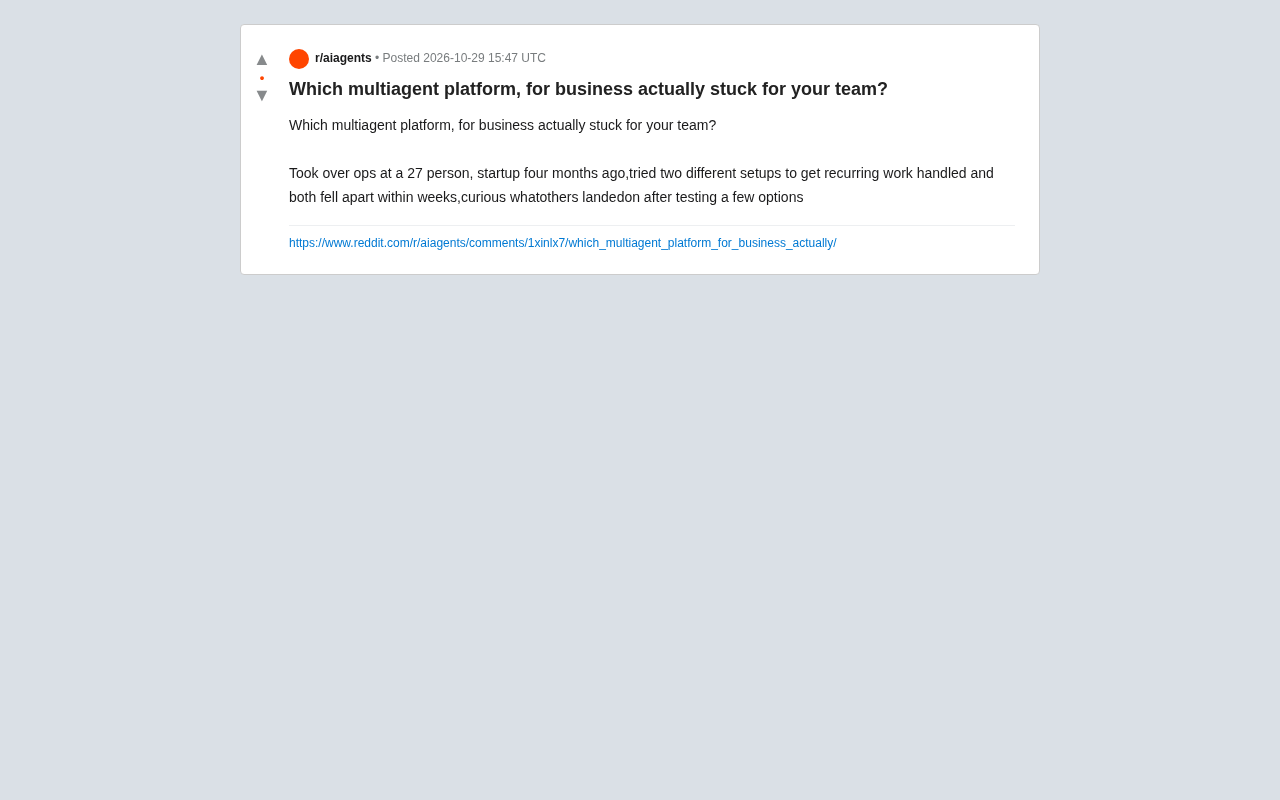
Which Multi-Agent Platform Wins? A Small Team's Battle Scars and Selection Considerations
A 27-person startup's ops lead tried two multi-agent platforms in four months and both failed. This article analyzes why small-team deployments break down, and offers selection guidance on integration depth, observability, and progressive rollout.

Thrive Holdings Takes ADT Private in $7.6 Billion Deal
Thrive Holdings acquires ADT for $7.6 billion in an all-cash take-private deal expected to close in Q1 2027. Analysis of the deal structure, ADT's asset value, and impact on the smart home security industry.