Hundreds of Artex AI Hacking Tools Found Exposed to the Public Web, Security Alarm Sounded

Hundreds of Artex AI penetration testing tool instances exposed to the public internet without authentication, highlighting deployment risks of AI security tools.
Security researchers discovered hundreds of servers hosting Artex directly exposed to the internet, allowing anyone to access and use this AI-driven penetration testing tool without authentication. Artex assists with vulnerability scanning and automated attack simulation, and its dual-use nature means malicious exploitation could become a springboard for infiltrating corporate networks. The cause remains unclear—possibly users failing to modify default configurations or the tool lacking security hardening guidance—but both point to an imbalance between usability and security. The article argues developers should incorporate access control, default authentication, and deployment checklists into core product design, users must verify network isolation and permissions before deployment, and governance of AI security tools cannot focus solely on powerful functionality.

Security researchers have discovered that hundreds of servers hosting the penetration testing tool Artex are directly exposed to the internet, allowing anyone to access and use this AI-driven hacking tool without authentication. This finding once again sounds the alarm for the governance of AI security tools.
What Is Artex and Why Is Exposure So Dangerous
Artex is an AI tool designed for penetration testing that can assist security professionals in tasks such as vulnerability scanning and automated attack simulation. By design, such tools should be deployed in controlled environments and restricted to authorized personnel only. However, researchers' scans revealed that a large number of Artex instances lack basic access controls and are directly open to the public internet.
This means that anyone with basic networking knowledge can find and operate these tools for unauthorized attack activities. Penetration testing tools have an inherent dual-use nature; once they fall into the hands of malicious actors, they can become a springboard for infiltrating corporate networks and probing system vulnerabilities.
The dual-use nature of penetration testing tools refers to the fact that the same tool can be used by authorized security personnel for legitimate vulnerability assessment and by attackers for unauthorized intrusion activities. Such tools typically possess capabilities including port scanning, vulnerability probing, and exploit chain orchestration; once obtained by malicious parties, they can be directly used to reconnaissance target networks and find entry points. Historically, tools like Metasploit and Cobalt Strike have triggered security incidents due to leaks or misuse, with cracked versions of Cobalt Strike being widely used by numerous ransomware gangs for post-exploitation phases. Therefore, the distribution and deployment of penetration testing tools typically require strict licensing management and network isolation; public internet exposure means the barrier to attack is significantly lowered.
Root Cause of Exposure: Deployment Oversight or Default Configuration Flaws
It remains unclear what specifically caused these instances to be exposed. One possibility is that users did not modify default configurations or set up authentication when deploying Artex; another is that the tool itself provides insufficient guidance on security hardening. Either way, both point to the same problem: an imbalance between usability and security in AI security tools.
As tools increasingly emphasize out-of-the-box readiness, the barrier to deployment decreases while the importance of secure defaults rises. If public internet access is allowed by default and authentication is not enforced, large-scale exposure is almost inevitable.
Secure by Default is a principle in product design requiring systems to have a reasonable security baseline without additional user configuration—for example, authentication enabled by default, listening only on the local loopback address by default, and denying public internet access by default. The opposite is "open by default" design, which disables authentication or opens network ports to lower the onboarding barrier, shifting security responsibility entirely to the deployer. Extensive empirical research shows that default configurations have a decisive impact on final deployment states: when authentication is not required by default, the vast majority of instances remain unauthenticated. The proliferation of internet-connected device search engines like Shodan and Censys further enables misconfigured instances to be easily discovered in bulk, rapidly amplifying the consequences of default configuration flaws.
Implications for the AI Security Tool Ecosystem
This incident is not an isolated case. As AI capabilities permeate the security tool landscape, similar risks are accumulating. Developers of security tools need to incorporate access control, default authentication, and deployment checklists into core considerations during the product design phase, rather than treating them as optional.
For users, before deploying any tool with attack capabilities, they should confirm that network isolation and access permission configurations are in place. Penetration testing tools exposed to the public internet are essentially equivalent to placing attack weapons on an open shelf.
The researchers' findings remind the entire industry: governance of AI security tools cannot focus solely on powerful functionality—deployment security is equally part of product responsibility.
One-line Summary
Hundreds of Artex AI penetration testing tool instances exposed to the public internet without authentication, highlighting deployment risks of AI security tools.
Paragraph Summary
Security researchers discovered that hundreds of servers hosting Artex are directly exposed to the internet, allowing anyone to access and use this AI-driven penetration testing tool without authentication. Artex can assist with vulnerability scanning and automated attack simulation, and its dual-use nature means that if exploited by malicious actors, it could become a springboard for infiltrating corporate networks. The cause of the exposure remains unclear—possibly users failing to modify default configurations or the tool lacking security hardening guidance—but both point to an imbalance between usability and security in AI security tools. The article notes that developers should incorporate access control, default authentication, and deployment checklists into core product design, users must confirm network isolation and permission configurations before deployment, and governance of AI security tools cannot focus solely on powerful functionality.
Related articles
 Tech Frontiers
Coldframe: A Honeypot Disguised as a Supermarket Freezer Controller
Coldframe is a honeypot disguised as Danfoss AK-SM 800A and Dixell XWEB freezer controllers, built as a single Python file that detects CVE-2025-41450 attempts and is identified as real devices on Shodan.
 Tech Frontiers
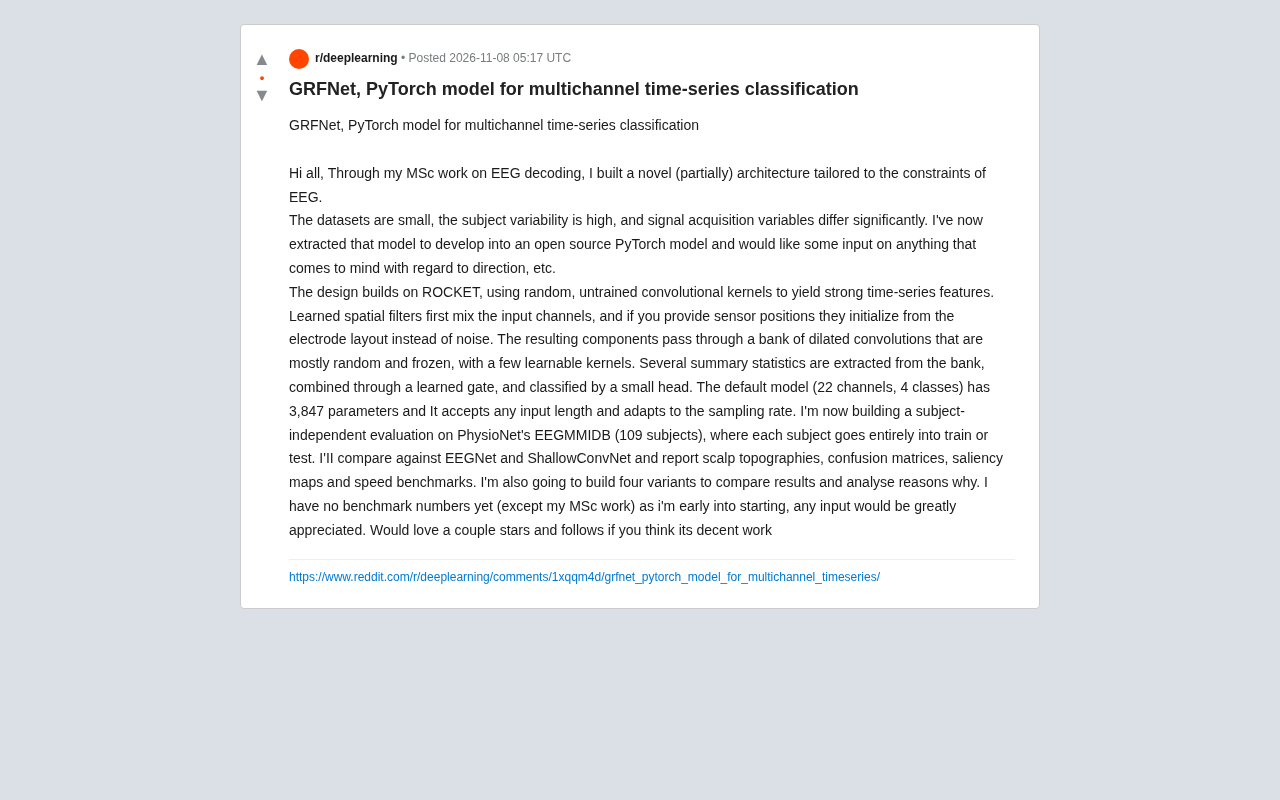
GRFNet: A Lightweight PyTorch Model Designed for Multichannel Time-Series Classification
GRFNet is a lightweight PyTorch model for multichannel time-series classification, originating from EEG decoding research. With only 3,847 parameters, it is based on the ROCKET architecture, combining random convolution kernels with learnable spatial filters, supports arbitrary input lengths, and will soon be evaluated on the PhysioNet dataset.
 Tech Frontiers
CUDA-Accelerated Rocket League Simulator: A Player-Made Hardcore Experiment
A Reddit post shows a "100% Accurate" Rocket League simulator accelerated with CUDA. We analyze its technical context, CUDA's value in game physics simulation, and the significance and limitations of such community projects.