Hungary Opens Communist-Era Archives: Up to 60,000 Informant Identities May Be Revealed

Hungary opens communist-era secret police archives, potentially revealing 60,000 informant identities, sparking privacy and historical justice debate.
Hungary has released communist-era secret police archives, potentially revealing up to 60,000 informant identities, drawing limited attention on Hacker News. The figure requires careful interpretation, as Eastern European secret police informant networks were vast and ambiguously classified, involving both active collaborators and those forced to sign. The tech community focuses more on how large-scale archive digitization affects privacy boundaries and how unannotated raw documents may create new injustices. The article also compares experiences in Poland, the Czech Republic, and eastern Germany, stressing that archive disclosure is the starting point, not the end, of social dialogue. Due to limited source information, the specific form of release, legal framework, and access mechanisms remain unclear.
Another Unboxing of Iron Curtain Archives
According to a discussion thread on Hacker News, Hungary has released secret police archives from the communist era, potentially revealing the identities of up to 60,000 former informants. The news drew attention in the tech community, though not much heat—the post received 19 points and no comments.
From the standpoint of the information itself, this is a classic "historical data unlock" story: a nation's security agency archives released on a large scale, with a scope large enough to affect tens of thousands of families and the reputations of public figures. Its appearance on Hacker News is likely tied to issues like "data transparency," "privacy versus the right to know," and "digitization of historical archives," but the source material does not elaborate on specifics.
What 60,000 Informants Means
"Up to 60,000 former agents/informants" is a figure that requires careful interpretation. In Cold War-era Eastern European states, secret police systems often built vast informant networks covering journalists, scholars, clergy, ordinary workers, and even students. Once archives are opened, those affected include not only the individuals recorded at the time but also their descendants, colleagues, and the entire society's structure of trust.
This scale also implies archival management challenges: how to verify identities, how to distinguish "active collaborators" from "those forced to sign documents," and how to handle reputational harm to the innocent who were implicated. The original reporting does not provide these details, but based on the experience of other Eastern European countries, archive releases are often accompanied by lengthy legal and ethical debates.
The secret police informant networks of communist-era Eastern Europe are commonly referred to as the "informer system" or "collaborator network." In Hungary, for example, the State Security Directorate (ÁVH, reorganized after 1956 into bodies such as the Third Department of the Ministry of the Interior) developed informants through threats, inducements, ideological mobilization, and other means. Categories of "secret collaborators" commonly found in the archives include active denouncers, those coerced into signing cooperation statements, and those merely registered as "contacts" who never formally cooperated. The ambiguity of these classifications is precisely the core of the controversy after archives are opened: a file may only record that someone "agreed to provide information," without reflecting whether they actually provided substantive content or signed under pressure. Therefore, inferring the actual scale of "60,000 informants" simply from the number of names in the archives requires extremely careful historical and legal scrutiny.
Why the Tech Community Cares About Old Archives
Hacker News users' interest in such stories usually lies not in political history itself but in the mechanisms of information disclosure. A common angle of discussion is: how does the digitization and retrieval of large-scale archives affect privacy boundaries? When the names, code names, addresses, and communication records of tens of thousands of people are compiled into searchable databases, technology becomes simultaneously a tool for transparency and a potential weapon for doxxing.
Another angle is data credibility. Security archives from the communist period often contain large numbers of unverified denunciations, exaggerated reports, and even deliberately fabricated materials. Releasing raw documents without annotation may create new injustices. This is why "disclosure" and "interpretation" must proceed in tandem in archive opening.
The Stasi Records are the vast intelligence archive left by the Cold War-era East German Ministry for State Security (Stasi), comprising approximately 6 million individual files, nearly 2 million photographs, and a large number of audio tapes. After German reunification, Germany passed the Stasi Records Act in 1991 and established the Federal Commissioner for the Stasi Records (BStU) to organize, preserve, and open records to individuals. The agency not only provides archive access but also explains document context, distinguishes different forms of cooperation, and supports academic research. The Stasi archive disclosure model is regarded as a reference case for handling large-scale secret police archives; its experience shows that digitization and searchability significantly improve efficiency of use but also bring risks of privacy leakage, misidentification, and secondary harm, requiring accompanying legal and ethical frameworks.
Comparison With Other Eastern European Countries
Poland, the Czech Republic, and eastern Germany all went through similar processes after transition. Germany's Stasi archives are enormous, and a dedicated federal agency was established for access and interpretation after disclosure; the Czech Republic passed legislation imposing restrictions on public office for certain individuals. The specific legal framework for Hungary's release, access methods, and whether complete originals are included are all unaddressed in the source material.
This comparison also reminds readers: archive disclosure is not an endpoint but the starting point of social dialogue. Which content should be fully public, which should be redacted, and which should wait until the individuals concerned have died—different countries have given different answers. Hungary's choice will join this comparative sample.
Questions Still Unanswered
The confirmed information is quite limited: archives have been released, potentially involving up to 60,000 informants. As for the form of disclosure (paper, scans, or database), whether online search is available, and whether any agency is responsible for review and appeals—none of this has been further explained.
For readers concerned with the balance between information freedom and privacy, the value of this news lies more in the reminder: the release of historical data always redraws the boundary between public memory and individual rights, and the role of the tech community in this is far more than just relaying news.
Related articles
 Tech Frontiers
AI Agents Connecting Directly to APIs: Which Calls Can Be Safely Allowed?
AI agents can call any API, but the real challenge is deciding which calls can be safely allowed. This article analyzes allowance decisions from three dimensions—intent matching, least privilege, and controllable impact—and argues that the control layer should sit outside the agent, combined with audit traceability to build a trustworthy API call governance mechanism.
 Tech Frontiers
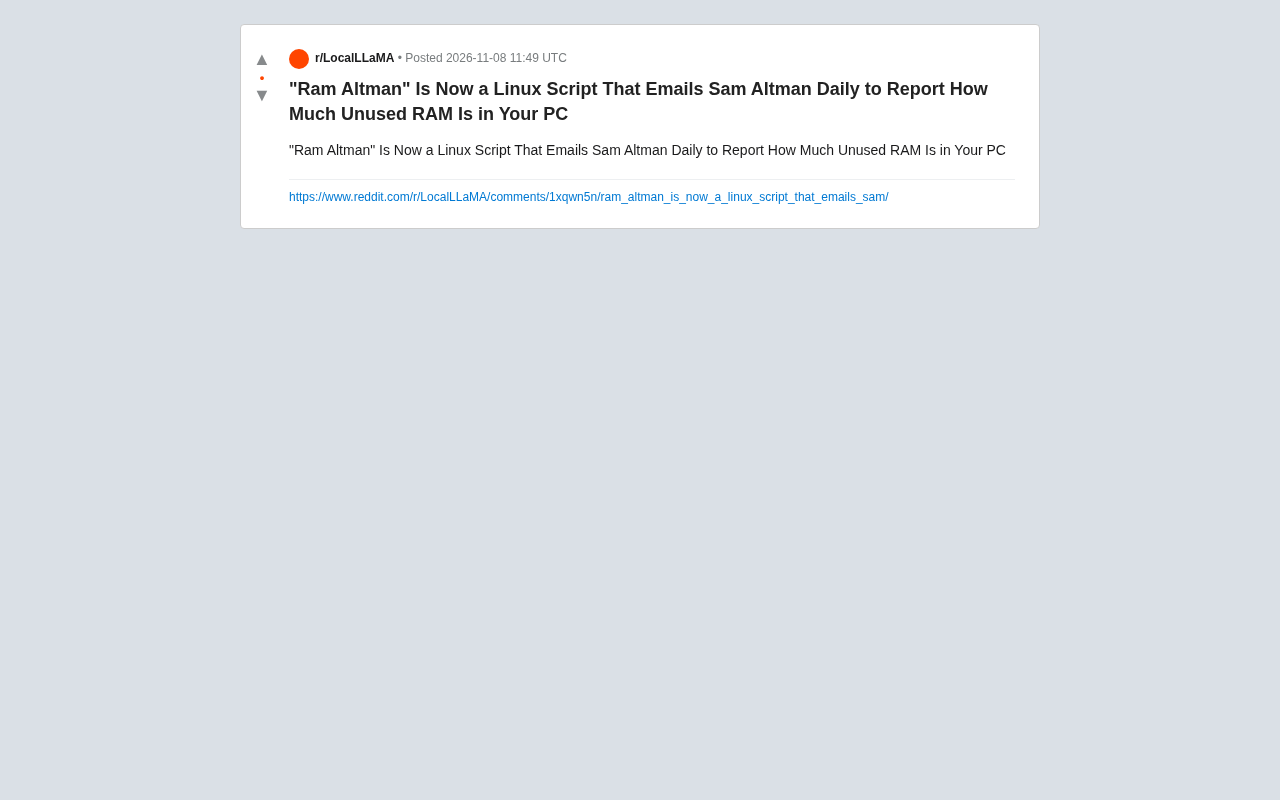
Prank Script 'Ram Altman' Emails Sam Altman Daily to Report Idle RAM
The viral Linux script "Ram Altman" emails OpenAI CEO Sam Altman daily to report idle RAM. We break down its technical implementation, the community prank culture, and the AI compute anxiety behind it.
 Tech Frontiers
Google Releases Elephant-Goldfish Plugin: Write the Spec Before the Code
Google releases the Elephant-Goldfish Model plugin, which has coding agents draft a spec and pass 5 zero-context review stages before generating code. We analyze the spec-first workflow's impact and limits.