Hy ASR 3.0 Technical Report: A New Breakthrough in LLM-Driven Multi-Dialect Speech Recognition

Hy ASR 3.0 uses an LLM as its recognition backbone to boost multilingual and multi-dialect recognition via multi-form context injection.
Hy ASR 3.0 is a speech recognition system built on a large language model backbone, covering Mandarin, English, and 13 Chinese dialect groups. It breaks the disconnected acoustic-language model pipeline so the LLM's world knowledge and context modeling directly inform recognition. It supports hotword lists, Q&A dialogue, and summaries as external context, and uses intra-sentence context to disambiguate homophones, adapting to diverse tasks without retraining. The report claims lowest overall error rates on public and internal benchmarks and robustness to long, child/elderly, low-volume, and noisy speech, but omits model scale, inference cost, and latency, and lacks third-party verification.
From Speech Recognition to Context Understanding: The Core Idea Behind Hy ASR 3.0
Traditional ASR systems have long been constrained by "hearing clearly" rather than "understanding"—the acoustic model handles transcription, the language model handles error correction, and the two are disconnected. The starting point of Hy ASR 3.0 is to unify this process with a large language model, so that the recognition process itself possesses contextual reasoning capability. According to its technical report, the system achieves the lowest overall error rate on public Mandarin, English, and Cantonese benchmarks, and also leads on corresponding internal test sets, with dialect recognition capability in the top tier.

The system covers Mandarin, English, and 13 Chinese dialect groups (including Cantonese). It is positioned not as a transcription tool for a single scenario, but as a general-purpose recognition foundation for multilingual, multi-accent environments.
ASR (Automatic Speech Recognition) is the technology that transcribes speech signals into text; its classic architecture consists of three parts: an acoustic model, a pronunciation dictionary, and a language model. The acoustic model maps audio frames to phonemes or subword units, while the language model scores candidate word sequences to select the most likely sentence. The limitation of this pipeline design is that the acoustic model only cares about "what it sounds like" and the language model only cares about "whether the text is fluent," with no joint reasoning about the specific conversational context between them. Therefore, when facing homophones, proper nouns, and accent variants, traditional systems often require additional error-correction modules or manual hotword lists as remedies. The "LLM-based ASR" advocated by Hy ASR 3.0 is precisely an attempt to use a single large model to simultaneously handle acoustic mapping and language reasoning, merging the two disconnected stages into end-to-end contextualized recognition.
Architecture and Training: LLM as the Recognition Backbone
The model design disclosed in the report centers on "LLM-based ASR": using a large language model as the backbone, mapping acoustic features into the language model's semantic space for decoding. The advantage of this approach is that the language model's built-in world knowledge and context modeling capability can directly participate in recognition decisions without relying on external error-correction modules.
Regarding training methodology, the report emphasizes coverage of diverse speech conditions, including long speech, children's and elderly speech, low-volume speech, and noisy environments. These scenarios are precisely the boundaries where traditional ASR is most likely to fail; including them in training objectives indicates that Hy ASR 3.0 pursues robustness rather than scores on a single benchmark. Interestingly, the report does not disclose the specific number of model parameters or the scale of training data; the evaluation conclusions are mainly based on error rate comparisons.
Mapping acoustic features to semantic space is a key step in LLM-based ASR. A common approach is to first use an encoder (such as a Conformer or Whisper-style encoder) to compress raw audio into frame-level representations, then use a projection layer or adapter to align these acoustic vectors with the language model's word embedding space, after which the LLM decodes word by word in an autoregressive manner. The cost of this approach is that the model size is usually much larger than traditional ASR, and inference latency is higher; the benefit is that the vocabulary knowledge, grammatical constraints, and world knowledge accumulated during language model pretraining can directly act on recognition decisions. Understanding this makes it clear why the report emphasizes "no need for external error-correction modules"—the correction capability has been internalized into the backbone model rather than handled separately after recognition is complete.
Context Conditioning: Three Ways to Inject External Information
Hy ASR 3.0 supports multiple external context inputs, which is a notable feature that distinguishes it from conventional ASR:
- Hotword lists: Allow users to pre-inject domain vocabulary to improve recognition accuracy for proper nouns;
- Q&A dialogue: Provide task-related information in dialogue form to guide recognition toward a specific context;
- Summary: Use a summary to outline the topic of the content to be recognized, helping the model make more reasonable vocabulary choices during decoding.
This means the same model can adapt to vastly different tasks—such as meeting transcription, customer service quality inspection, and medical dictation—through different context inputs without retraining. The report claims strong context recognition capability under both external-context and intra-sentence-context settings.
Intra-sentence Context: Disambiguation Without External Inputs
A more ingenious design is to use context within an utterance to disambiguate homophones and phonetically similar keywords. For example, clues appearing later in the same sentence can help determine the correct word corresponding to an earlier pronunciation, and the entire process requires no additional context input. This effectively internalizes "context" from an external prompt into the model's own reasoning capability, improving accuracy even in bare scenarios without hotword lists or summaries.
Homophone disambiguation is a classic challenge in Chinese ASR. Chinese has a limited number of syllables but a vast number of characters; "公式/攻势/工事" (formula/offensive/fortification), "期中/期终" (midterm/end of term), and others are pronounced identically and cannot be distinguished by acoustic signals alone. Traditional approaches rely on local probabilities from n-gram language models and are prone to errors in long sentences or specialized contexts. The idea of intra-sentence context disambiguation is to let the model use semantic clues appearing later in the same sentence to constrain the word choice earlier in reverse—essentially a form of bidirectional contextual reasoning. This complements external hotword lists: hotword lists solve the problem of "not recognizing domain vocabulary," while intra-sentence disambiguation solves the problem of "recognizing it but choosing the wrong word." Together, they form the complete picture of what the report calls "context recognition capability."
Robustness Evaluation: Real-World Speech Is Not Standard
The report's evaluation dimensions fall into three parts: recognition accuracy, context utilization capability, and robustness. The robustness section covers long speech, children's and elderly speech, low-volume speech, and speech in noisy environments. What these conditions have in common is that they deviate from the distribution of read-aloud standard speech—children's and elderly pronunciation habits, signal-to-noise ratio degradation caused by low volume, and noise interference all significantly degrade the performance of conventional systems.
Hy ASR 3.0 claims robust recognition under all these conditions. From an engineering perspective, this kind of robustness is often more practically valuable than a few tenths of a percentage point difference in error rate on a benchmark, because speech input in real deployments is almost never as clean as a test set.
Positioning and Open Questions from Multiple Perspectives
Currently, public information about Hy ASR 3.0 mainly comes from its technical report itself, which is a single source. The conclusions given in the report—lowest overall error rate on public benchmarks, leading on internal test sets, top-tier dialect recognition—still lack cross-validation through independent third-party reproduction, and readers should keep this caveat in mind when citing these conclusions.
From a technical路线 perspective, LLM-based ASR is becoming one of the mainstream directions in speech recognition. Hy ASR 3.0's differentiation lies in combining multi-form context conditioning (hotwords, Q&A, summaries) with intra-sentence self-disambiguation. However, the report does not disclose deployment-critical metrics such as model scale, inference cost, and latency, which are precisely the core variables for assessing whether an ASR system can be deployed. For teams focused on multi-dialect recognition and context-enhanced recognition, this report offers technical ideas worth following, but it is still some distance from a complete engineering evaluation.
One-line Summary
Hy ASR 3.0 uses an LLM as its recognition backbone and improves multilingual and multi-dialect recognition through multi-form context injection.
Paragraph Summary
Hy ASR 3.0 is a speech recognition system with a large language model as its recognition backbone, covering Mandarin, English, and 13 Chinese dialect groups. Its core idea is to break the disconnected pipeline of traditional ASR's acoustic model and language model, allowing the language model's world knowledge and context modeling capability to directly participate in recognition decisions. The system supports three types of external context input—hotword lists, Q&A dialogue, and summaries—and uses intra-sentence context to disambiguate homophones, thereby adapting to vastly different tasks such as meeting transcription, customer service quality inspection, and medical dictation without retraining. The technical report claims it achieves the lowest overall error rate on public Mandarin, English, and Cantonese benchmarks and internal test sets, and remains robust in long speech, children's and elderly speech, low-volume, and noisy environments. However, the report does not disclose model scale, inference cost, or latency, and the conclusions lack independent third-party verification.
Related articles

AI Writes Your Code—Do You Still Need to Learn Git? Five Reasons
AI coding agents handle Git operations automatically—is it still necessary to learn Git? Five reasons: team communication, reviewing agent PRs, monitoring code changes, fallback when AI goes down, and the joy of learning—plus how the focus of learning Git is shifting in the agent era.

Anthropic Reportedly Prices IPO at $83 Per Share, Valuing Company at $1.5 Trillion
Anthropic reportedly prices IPO at $83 per share, above the expected range, with a fully diluted valuation of $1.5 trillion. This article analyzes the signal significance of the pricing and its impact on the AI industry's financing environment.
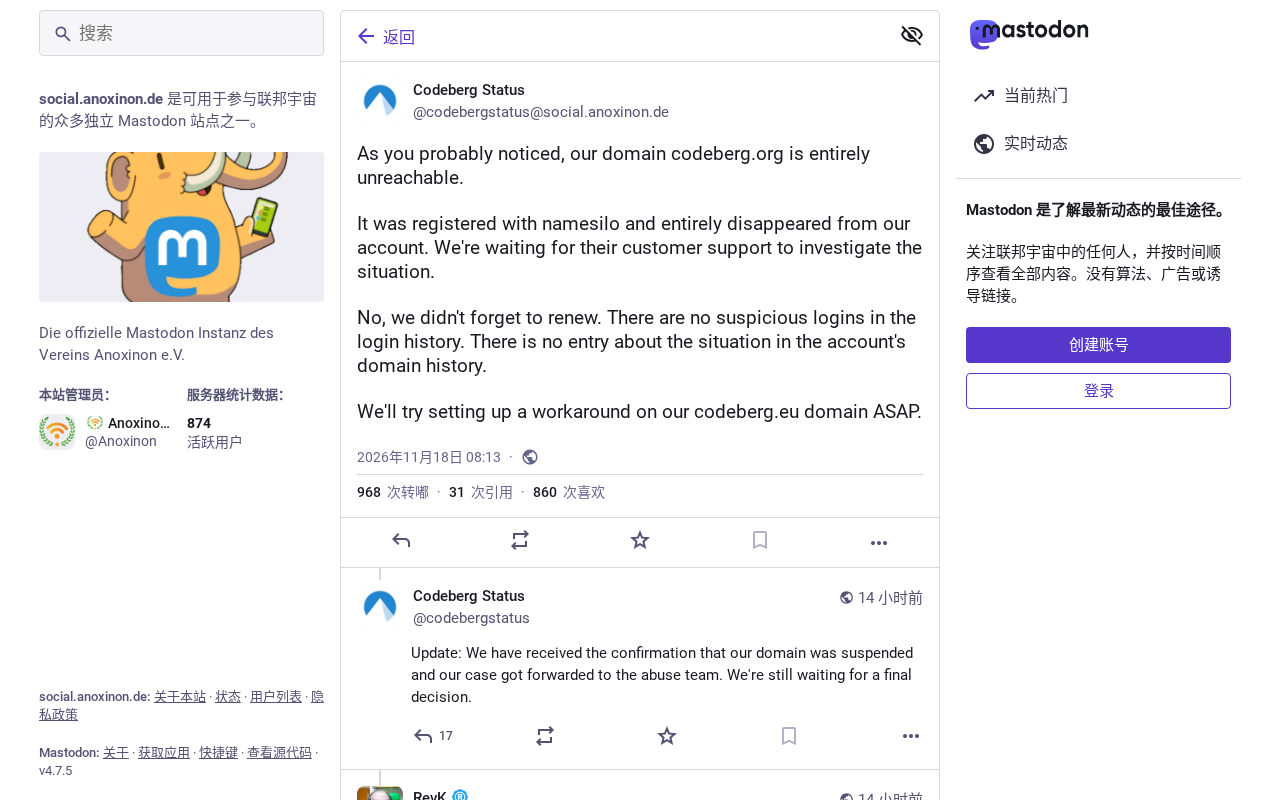
Open-Source Code Hosting Platform Codeberg Suffers Outage, Sparking Debate in Developer Community
Open-source code hosting platform Codeberg.org suffered an outage, sparking Hacker News debate over nonprofit platform stability and open-source infrastructure dependency risks.