IBM Open-Sources Granite Speech 5.0 2B, Multilingual Transcription and Translation Ranked Second on ASR Leaderboard

IBM open-sources Granite Speech 5.0 2B, ranking second on the leaderboard with 5.68% WER, handling both transcription and translation.
IBM has released Granite Speech 5.0 2B under the Apache 2.0 license. The model supports both multilingual speech transcription and speech translation, ranking second on the Open ASR Leaderboard with an average English word error rate of 5.68%, achieved with only a 2B parameter scale. Also updated are Turbo CTC, focused on low latency, and 4.1 2B Plus for smooth upgrades for 4.x users, covering accuracy, speed, and compatibility respectively. The article analyzes the meaning of the WER metric, the advantages of end-to-end speech translation over cascaded approaches, and the trend of open-source speech model competition shifting from "whether it exists" to "who is lighter, who is more accurate, and who has a more permissive license." It also reminds readers that leaderboard results do not equal business outcomes and that language coverage, translation direction, and long-audio stability should be tested before deployment.
IBM has made another move in the open-source speech model race. Granite Speech 5.0 2B is released under the Apache 2.0 license, offering both speech recognition and speech translation capabilities, and ranks second on the Open ASR Leaderboard with an average English word error rate (WER) of 5.68%. Alongside it, two other models—Turbo CTC and 4.1 2B Plus—have also been updated, forming a suite of speech models tailored for different latency and accuracy requirements.

What 5.68% WER Means
Word error rate is the core metric for measuring speech recognition quality—the lower the value, the more accurate the transcription. An average English WER of 5.68% puts it in the top tier among open-source models. For reference, most open-source ASR models still hover in the 7% to 10% range, and pushing below 6% typically requires larger parameter counts or a stronger training data pipeline.
Granite Speech 5.0 2B achieves this with only a 2B-scale parameter count, indicating that IBM made targeted optimizations in data curation, acoustic modeling, and decoding strategies rather than simply scaling up parameters. For teams looking to deploy speech capabilities locally, the 2B scale means lower VRAM usage and more controllable inference costs—this is its practical value for engineering deployment.
WER (Word Error Rate) is calculated by aligning the recognition output with the reference transcription at the word level, counting the total number of substitutions (S), deletions (D), and insertions (I), and then dividing by the total number of words in the reference transcription: WER = (S + D + I) / N. The value can exceed 100% (when there are many insertion errors), so it is not strictly a percentage accuracy. WER is sensitive to tokenization; English splits naturally on spaces, while languages like Chinese and Japanese lack natural word boundaries and typically require prior segmentation or the use of character error rate (CER) instead, so WER values across languages should not be directly compared. Moreover, WER treats all errors equally, but in real-world applications, errors in names, numbers, and technical terms often matter more than errors in function words. Therefore, the average WER on a leaderboard serves only as a horizontal reference; when deploying, targeted evaluation with domain-specific corpora is still necessary.
Transcription and Translation Combined in One Model
Granite Speech 5.0 2B is not positioned merely as a "dictation tool." It covers both multilingual transcription and speech translation—that is, converting speech in one language directly into text in another. Such capabilities are clearly needed in scenarios like meeting notes, cross-border customer service, and subtitle generation, which previously often required a two-stage pipeline of "ASR model + machine translation model," leading to longer chains and accumulated errors.
Combining both capabilities into a single model reduces the information loss from cascading and simplifies the deployment architecture. Combined with the Apache 2.0 license, which has few commercial restrictions, enterprises can embed it into their own products without worrying about licensing constraints.
The difference between speech translation (ST) and traditional cascaded approaches is worth explaining. A cascaded approach first uses ASR to convert speech into source-language text, then a machine translation model to convert it into target-language text. In this two-stage chain, ASR recognition errors are passed unchanged to the translation step and amplified, and the two inference passes also add latency. End-to-end speech translation, on the other hand, maps directly from audio to target-language text, avoiding the intermediate text information bottleneck and preserving paralinguistic information such as intonation and pauses. However, end-to-end approaches demand more training data—parallel speech-target text corpora—which are scarce for low-resource languages, so practical systems often use a hybrid of end-to-end and cascaded designs. Speech translation quality is typically evaluated using metrics like BLEU and COMET, which belong to a different evaluation system from ASR's WER.
The Division of Labor Among the Three Models
This release is not a single model but a synchronized update of three models covering different use cases:
- Granite Speech 5.0 2B: The flagship model, balancing recognition accuracy and translation capability, suitable for general scenarios with high accuracy requirements.
- Turbo CTC: Judging by the name, it follows a CTC decoding approach, focusing on low latency and high throughput, suitable for real-time subtitles, voice assistants, and other latency-sensitive applications.
- 4.1 2B Plus: An enhanced version based on 4.1, aimed at users already in the 4.x ecosystem who want a smooth upgrade.
This combination of "one flagship + one low-latency + one upgraded version" essentially covers three dimensions—accuracy, speed, and compatibility—allowing developers to choose according to their needs rather than being forced into a single option.
CTC (Connectionist Temporal Classification) is a classic speech recognition training and decoding method. Its core idea is to introduce a blank symbol, allowing the model to learn the mapping from input sequences to output label sequences directly without prior knowledge of the alignment between phonemes and audio frames. During decoding, the alignment paths are merged, deduplicated, and stripped of blanks to obtain the final text. Compared with attention-based autoregressive decoding, CTC features frame-level independent outputs and parallel computation, making it naturally suited for streaming recognition and low-latency scenarios—this is the underlying reason why Turbo CTC targets real-time subtitles and voice assistants. CTC's limitation is its strong conditional independence assumption, which usually requires pairing with a language model or joint training with other losses to improve accuracy. Therefore, pure CTC models often lag behind autoregressive large models in WER, and in engineering practice the two are more complementary than substitutive.
The Competitive Landscape of Open-Source Speech Models
Second place on the Open ASR Leaderboard is a significant position. The top of the leaderboard has long been dominated by the Whisper series and its derivatives. IBM squeezing into the top ranks with a 2B scale shows that competition in open-source speech models has moved from "whether it exists" to "who is lighter, who is more accurate, and who has a more permissive license."
For developers, the direct benefit of increased competition is a wider range of choices: those seeking ultimate accuracy can look at the top models on the leaderboard, those focused on deployment cost can look at smaller models, and those prioritizing commercial freedom should compare licenses carefully. Granite Speech 5.0 2B has found a relatively balanced position among accuracy, license, and parameter count—which is probably why it is worth watching.
It should be noted that 5.68% is the average English WER. Actual performance in multilingual scenarios and the quality of speech translation still need to be tested with specific languages and target languages; leaderboard results cannot be directly equated with business outcomes.
The Open ASR Leaderboard is a public speech recognition benchmark maintained by the Hugging Face community, primarily computing average WER across multiple English datasets and providing reference metrics such as inference speed. Its value lies in using unified evaluation scripts and data splits to lower the barrier to comparing models, allowing models released by different organizations to be compared under the same standard. But the leaderboard has its boundaries: the evaluation sets are mainly English read speech and meeting speech, with limited coverage of accents, noise, specialized domains, and multilingual scenarios, and submitters may tune their models specifically for the leaderboard data. Therefore, rankings should be understood as relative performance under specific conditions rather than a universal quality conclusion.
What to Watch for in Deployment
If you plan to introduce Granite Speech 5.0 2B into a real project, there are several points worth verifying in advance: first, whether the target language is within the model's coverage—multilingual capabilities usually vary in strength across languages; second, the directionality of speech translation—some models only support translation in specific directions; third, the stability of the 2B model on long audio—segmentation strategy affects final transcription quality.
The Apache 2.0 license lowers the legal barrier, but engineering adaptation still needs to be done yourself. Treating it as a high-quality starting point rather than an out-of-the-box final solution is a more pragmatic attitude.
One-line Summary
IBM open-sources Granite Speech 5.0 2B, ranking second on the leaderboard with 5.68% WER, handling both transcription and translation.
Paragraph Summary
IBM has released Granite Speech 5.0 2B under the Apache 2.0 license. The model supports both multilingual speech transcription and speech translation, ranking second on the Open ASR Leaderboard with an average English word error rate of 5.68%, achieved with only a 2B parameter scale. Also updated are Turbo CTC, focused on low latency, and 4.1 2B Plus for smooth upgrades for 4.x users, covering accuracy, speed, and compatibility respectively. The article analyzes the meaning of the WER metric, the advantages of end-to-end speech translation over cascaded approaches, and the trend of open-source speech model competition shifting from "whether it exists" to "who is lighter, who is more accurate, and who has a more permissive license." It also reminds readers that leaderboard results do not equal business outcomes and that language coverage, translation direction, and long-audio stability should be tested before deployment.
Related articles

Why Does Self-Play AI Always Get Crushed by Cheap Units? An RTS Developer's Account of the Dilemma
An independent developer trained an RTS commander AI with pure self-play, only to find it dominated historical versions but was crushed by human players using cheap tier-1 units. This article analyzes the causes of self-play strategy collapse, explores solutions such as exploiters, diversity rewards, and reward design, and introduces the open Bot Kit and AI league plan.
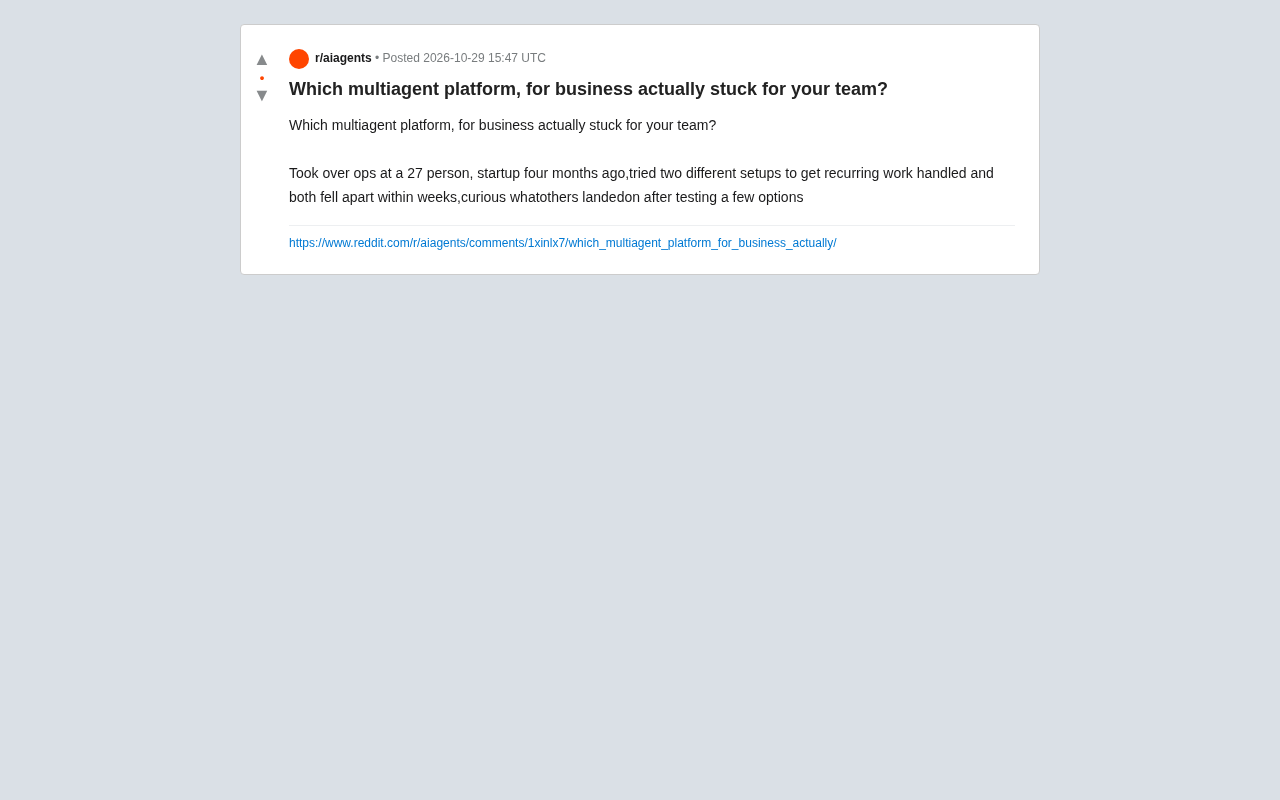
Which Multi-Agent Platform Wins? A Small Team's Battle Scars and Selection Considerations
A 27-person startup's ops lead tried two multi-agent platforms in four months and both failed. This article analyzes why small-team deployments break down, and offers selection guidance on integration depth, observability, and progressive rollout.

Thrive Holdings Takes ADT Private in $7.6 Billion Deal
Thrive Holdings acquires ADT for $7.6 billion in an all-cash take-private deal expected to close in Q1 2027. Analysis of the deal structure, ADT's asset value, and impact on the smart home security industry.