Innate: A 7-Person Team Building Robots for Everyday Life
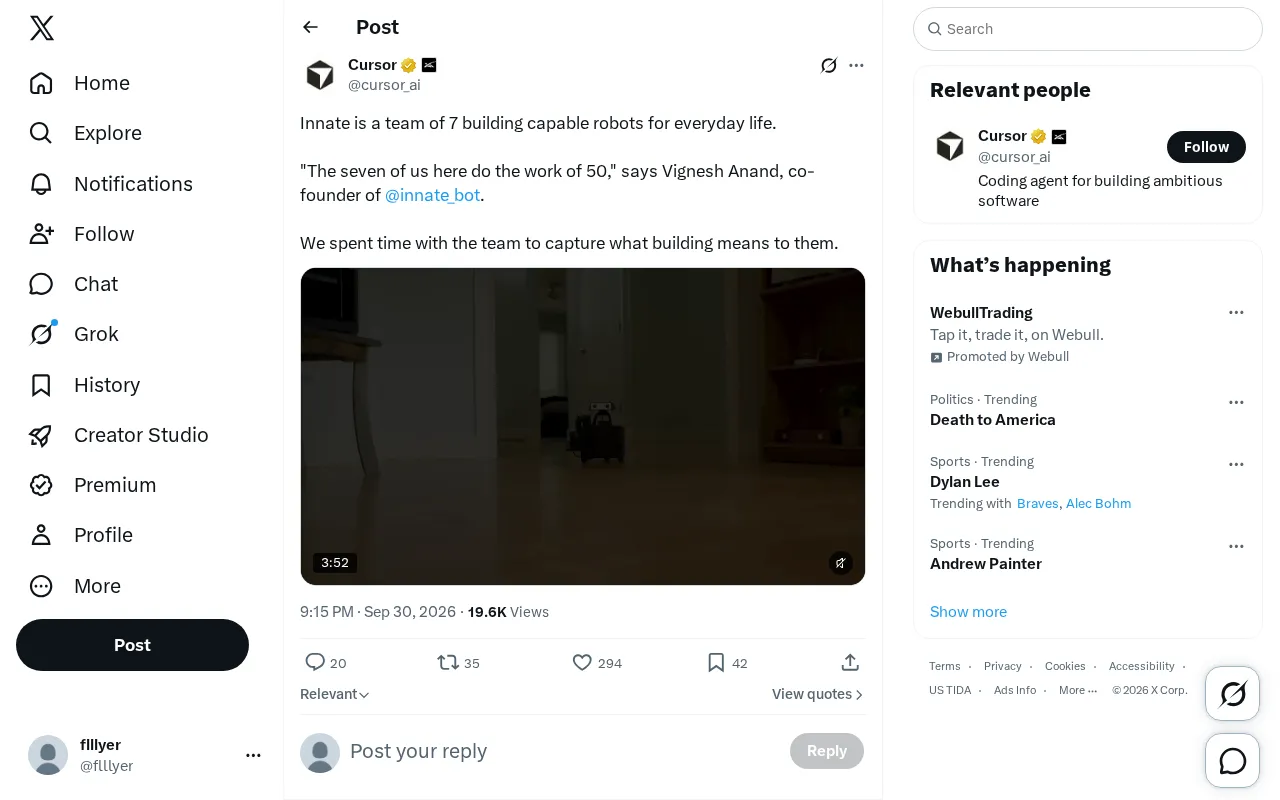
7-person startup Innate is using AI tools to build capable everyday-life robots with the output of a 50-person team.
Innate is a 7-person robotics startup aiming to build robots that can genuinely operate in the unstructured environments of everyday life. Co-founder Vignesh Anand summarizes their efficiency as "7 people doing the work of 50" — made possible by generative AI, automated simulation, and end-to-end learning frameworks that systematically lower R&D barriers. Short decision chains and full-stack collaboration amplify that advantage further, enabling rapid iteration without large-organization overhead. The company remains in its early stages with limited public detail, but it represents a broader "lean hardware startup" trend showing that small teams can realistically challenge larger players in the AI era.
A Robot Startup With Just Seven People
In the space where robotics hardware and AI converge, most startups rely on engineering teams of dozens or even hundreds to push their R&D forward. Innate has chosen a radically different path — getting seven people to do the work that would typically require fifty.
Co-founder Vignesh Anand put it plainly in an interview: "The seven of us here do the work of 50." That line isn't just a proud statement about team efficiency — it reflects a broader shift in what small hardware startups can realistically accomplish when equipped with modern AI tools.
The Goal: Building Capable Robots for Everyday Life
Innate's stated mission is to build capable robots for everyday life. That framing is worth unpacking:
- "Everyday life" signals that they're targeting ordinary home and living environments — not factory floors or research labs.
- "Capable" emphasizes that the robots need to actually work, not just impress in a demo.
This is an extraordinarily high bar to clear. Unstructured everyday environments — cluttered rooms, shifting lighting conditions, unpredictable human behavior — demand far more from a robot's perception, decision-making, and manipulation capabilities than any controlled industrial setting. That a 7-person team is taking this on is itself a statement about how seriously they take technical integration and operational efficiency.
Unstructured environments are one of the core unsolved challenges in robotics. Unlike a factory assembly line — where object positions, lighting, and workflows are tightly controlled and robots simply execute fixed routines — homes and offices are full of variability: objects placed at random, different context every time the same task runs, and unpredictable human interventions. This is precisely why companies like Boston Dynamics, Figure, and 1X, despite massive resources, haven't fully cracked it. For Innate to enter this space with seven people, they've almost certainly made deliberate, precise choices about which tasks and scenarios to focus on — rather than aiming for a general-purpose robot.
Why a Small Team Can Punch So Far Above Its Weight
While the available information doesn't reveal Innate's full technical stack, the claim of "7 people doing the work of 50" reflects a genuine structural shift in the robotics startup ecosystem.
AI Tools Are Reshaping R&D Efficiency
The maturation of generative AI, automated simulation, and end-to-end learning frameworks has dramatically compressed the timeline from prototype to deployment. Work that once required armies of engineers hand-tuning parameters and writing control logic can now be accelerated significantly through learning-based approaches and modern developer toolchains. Small teams can operate with much greater leverage as a result.
More specifically: the widespread availability of simulation platforms like Isaac Sim and MuJoCo lets robotics teams generate massive amounts of training data in virtual environments, without investing heavily in physical hardware or manual data collection. The combination of imitation learning and reinforcement learning has shifted control policy development from "write rules by hand" to "learn from demonstrations," dramatically reducing the need for large teams of low-level engineers. Meanwhile, the rise of large language models (LLMs) and vision-language-action models (VLAs, such as Google's RT-2) means robots can now benefit from pre-trained general capabilities at the task understanding and action planning layer. Small teams no longer need to build an entire perception-to-decision pipeline from scratch — they can fine-tune on top of mature foundation models, potentially cutting development timelines by months or even years.
Staying Small Means Staying Fast
There's another advantage to keeping the team lean: short decision chains and low communication overhead. Each member typically wears multiple hats, spanning hardware, software, and machine learning. This kind of full-stack collaboration is especially valuable in the early stages of a hardware startup — it enables rapid iteration and avoids the process friction that plagues larger organizations.
What "Building" Means to This Team
Those behind the release noted that they spent time documenting "what building means to them" — a detail that's emblematic of hardcore hardware startup culture.
For a team like Innate, "building" isn't just about shipping a product. It's a working philosophy: do more with less, get your hands dirty, validate fast. In a robotics landscape where capital and talent are highly concentrated, this lean-startup narrative is both a statement of team identity and a signal to like-minded collaborators and investors.
Closing Thoughts: The Robotics Opportunity for Small Teams
Innate's story is still in its early chapters. Public information is limited — the specific form of their robot, their technical approach, and their commercialization progress have yet to be fully disclosed. But the trend they represent is worth paying attention to: as AI tools continue to lower the barriers to development, small and focused teams are gaining a genuine shot at challenging much larger incumbents.
Whether they can truly deliver capable robots for everyday life will ultimately come down to how the product performs in the real world. For those tracking embodied AI and robotics startups, this 7-person team is a case worth following closely.
Related articles

Vibe Coding Full-Stack in Practice: AI Programming from Beginner to Enterprise Deployment
From Cursor to Claude Code, this Bilibili AI programming course uses four progressive projects to cover full-stack development, open-source secondary development, and team collaboration. The article analyzes the shock to frontend roles, the efficiency shift from 50 people to 5, and the methodology required for enterprise-grade projects.

David Blaine's Global Quest for Real Magic: From South Africa to Japan and India
David Blaine travels to South Africa, Japan, and India in his Do Not Attempt special, documenting Spinning drivers, black mamba rescuers, iaijutsu masters, and ascetics—exploring the boundary between magic and real human极限 challenges.

Is a Touchscreen MacBook Coming? Vergecast Reveals Apple Executive's Response
Vergecast podcast reveals a conversation between a reporter and Apple executive John Ternus about a touchscreen MacBook and Apple Pencil support. Ternus says iPad is the best device for a stylus, while the reporter bets MacBook will eventually support Apple Pencil.