Intelli Plugin: Manage WhatsApp and Instagram Inside ChatGPT and Claude

Intelli uses 89 tools to let ChatGPT and Claude directly operate WhatsApp and other social messaging platforms.
Intelli is a plugin that lets ChatGPT and Claude directly operate WhatsApp, Instagram, and website chat. It has entered the ChatGPT plugin directory and also supports Claude and other compatible tools as an MCP client. It offers 89 tools covering messaging, contacts, product management, and marketing flows, with users able to issue instructions in natural language. The product highlights OAuth login with no API key required and a "confirm before execution" human review mechanism to reduce the risk of AI errors. This update adds Instagram and Facebook comment and DM automation. The product received 70 votes and ranked #18 on Product Hunt—moderately popular but with a limited sample; data storage location, compliance details, and automation trigger conditions are not disclosed, making it more suitable as an object of observation than as mature customer service infrastructure.
There has always been an invisible wall between AI assistants and everyday communication tools: you can write copy in ChatGPT, but you can't get it to directly reply to the customer messages piling up in WhatsApp. Intelli, a new product ranked #18 on Product Hunt, is trying to tear down that wall with 89 tools.
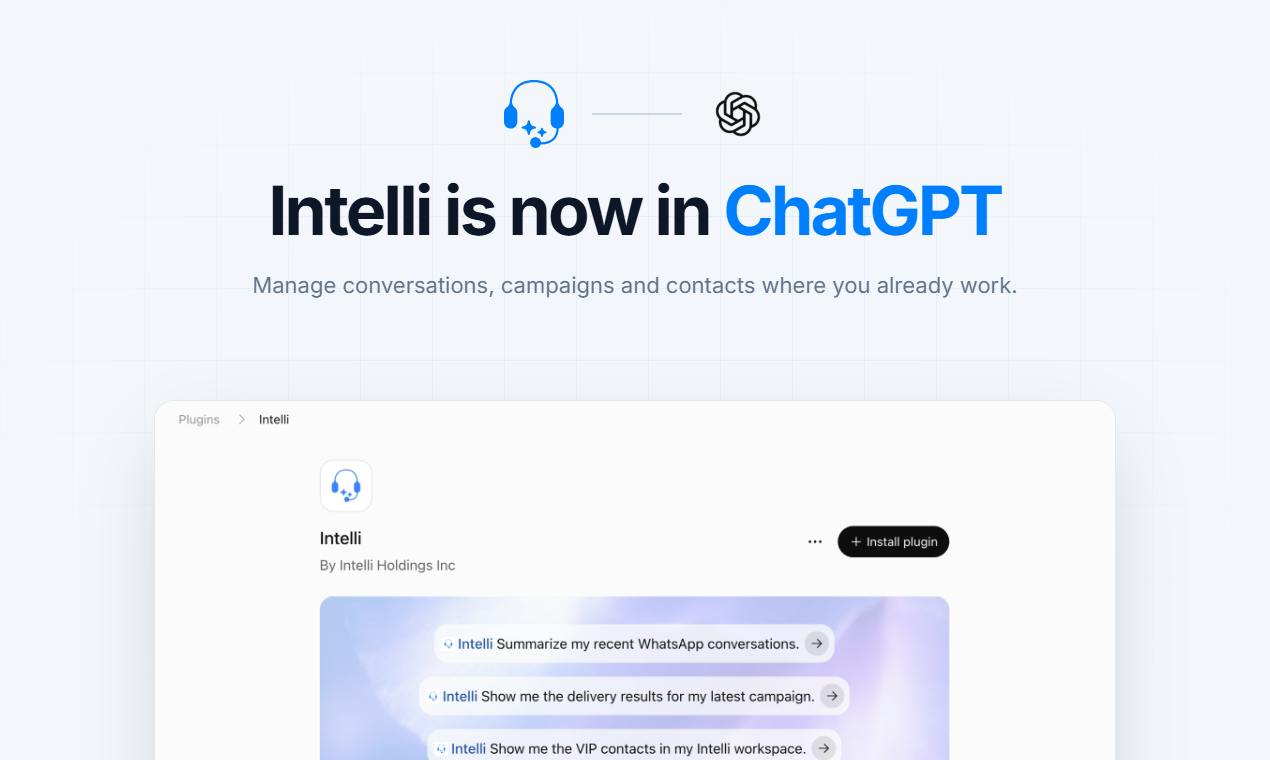
What Is Intelli: Stuffing a Social Inbox into the AI Chat Window
Intelli's positioning is straightforward: a plugin that lets ChatGPT and Claude directly operate WhatsApp, Instagram, and website chat. It has already entered ChatGPT's plugin directory and also supports Claude and other compatible tools as an MCP (Model Context Protocol) client.
Users issue instructions in natural language, and the AI assistant can handle conversations on these platforms—summarizing unanswered chats, launching marketing campaigns, building chatbot flows, updating contacts and product information. The vendor cites 89 tools, covering operational dimensions such as messaging, contacts, and product management.
From a product standpoint, Intelli is more like wrapping the APIs of multiple customer service and marketing backends into a set of functions callable by AI, then exposing them to large models via the MCP protocol. This technical approach has become common since the rise of the MCP ecosystem, but incorporating consumer-grade messaging platforms like WhatsApp and Instagram remains a relatively rare combination.
MCP (Model Context Protocol) is an open protocol proposed by Anthropic in late 2024 to standardize how large language models connect to external tools and data sources. Before this, connecting models to external capabilities typically relied on vendor-specific plugin specifications (such as OpenAI's function calling and ChatGPT plugin system), and tool providers had to adapt separately for each host. MCP abstracts tool discovery, parameter description, invocation, and result return into a unified interface: the model side acts as a "client" connecting to a "server," and the server exposes available tools declaratively. This allows a single development effort to be reused by Claude, Cursor, various IDEs, and self-built agents, and is regarded as an important step in the plugin ecosystem's migration toward open protocols.
89 Tools and Zero API Keys: The Trade-offs of Lowering the Barrier to Entry
Two features Intelli emphasizes deserve separate scrutiny.
The first is OAuth login with no API key required. For non-technical users, this means they don't need to apply for permissions in the Meta developer console or generate tokens—they can simply authorize with their account. This lowers configuration costs, at the price of users needing to trust Intelli as an intermediary holding access credentials.
The second is the "execute only after confirmation" mechanism. The product description explicitly states: nothing will be sent, edited, or deleted until you confirm. This is a defensive design against the risk of AI agent errors—letting the model generate an operation draft first, with a human providing the final review. In customer service scenarios, a single mis-sent message can cause real customer churn, so this human gate has practical justification, but it also means the process cannot be fully automated.
According to the Product Hunt page, the product received 70 votes and 4 comments, ranking #18 for the day. This level of interest is moderately above average among plugin products, but the sample size is limited and insufficient to judge market acceptance.
OAuth (Open Authorization) is an authorization framework that allows third-party applications to obtain limited access to specific resources without obtaining the user's account password. Users are directed to the platform's official page to complete login authorization, and the platform then issues an access token to the third party; the token can be scoped, has an expiration period, and can be revoked at any time. Compared with having users manually apply for API keys in the developer console, OAuth greatly lowers the configuration barrier and avoids plaintext key transmission. The cost is that the third-party application becomes the token holder and intermediary, and users must trust it to safeguard credentials and data—which echoes the trust trade-off mentioned in this article.
Instagram and Facebook Comments and DMs Automation: A New Battleground
In this update, Intelli added automation capabilities for Instagram and Facebook comments and direct messages.
The demand in this market is real: brand comment sections under social media posts often turn into customer service scenes, with user questions, complaints, and price inquiries mixed together. Automatically replying to comments and directing users to DMs is a routine need in social media operations. Intelli connects this flow to the AI assistant side, letting operators configure rules through conversation rather than switching between multiple backends.
That said, the original material does not explain the automation trigger conditions, the granularity of reply template customization, or the strategy for responding to changes in platform official API policies. Meta has historically been strict about interface controls for third-party automation tools, and the long-term stability of such products depends on grasping the compliance boundary.
Platform official API policies: Meta has historically set strict thresholds for third-party access to Instagram and Facebook messages and comments, involving app review, permission requests (such as pages_messaging), rate limits, and the 24-hour customer service window, with explicit constraints on automated behavior. This means whether such tools can operate long-term depends largely on whether they strictly stay within the range permitted by official interfaces; once the platform tightens permissions or adjusts review policies, implementations relying on unofficial channels may face feature failure or even bans.
The Opportunities and Concerns of Multi-Platform Coverage
Intelli supports both the ChatGPT plugin directory and MCP clients. This "dual-track" strategy makes sense today: ChatGPT has the largest user base, while MCP represents the direction of open protocols, with tools like Claude and Cursor all connecting to it. Developing once to cover both types of entry points keeps marginal costs low.
The potential problem lies in experience consistency. ChatGPT plugins and MCP clients differ in invocation methods and context management mechanisms, and the discoverability and availability of the 89 tools may vary across hosts. The material does not provide comparative information on cross-platform experience.
Another observation point is data flow. The product description only emphasizes "no execution before confirmation" but does not disclose where conversation data is stored or how long it is retained. For enterprise users handling customer DMs, this is a key factor in purchasing decisions and a current information gap.
Who Should Use It, and Who Should Wait
Judging from the feature combination, Intelli's target users are small and medium-sized e-commerce and social media operations teams—they maintain multiple messaging channels simultaneously, have limited staff, and want to use AI to reduce repetitive work. For those already using ChatGPT or Claude workflows, the migration cost of the plugin format is relatively low.
If what you need is fully unattended, fully automated customer service, Intelli's confirmation mechanism is actually a hindrance; if you have strict data compliance requirements, the available public information is insufficient to support an evaluation. The product is still at an early stage, and the market feedback of 70 votes also shows it has yet to undergo large-scale testing. Treating it as an efficiency tool worth watching is more prudent than treating it as mature customer service infrastructure.
One-line Summary
Intelli uses 89 tools to let ChatGPT and Claude directly operate WhatsApp and other social messaging platforms.
Paragraph Summary
Intelli is a plugin that lets ChatGPT and Claude directly operate WhatsApp, Instagram, and website chat. It has entered the ChatGPT plugin directory and also supports Claude and other compatible tools as an MCP client. It offers 89 tools covering messaging, contacts, product management, and marketing flows, with users able to issue instructions in natural language. The product highlights OAuth login with no API key required and a "confirm before execution" human review mechanism to reduce the risk of AI errors. This update adds Instagram and Facebook comment and DM automation. The product received 70 votes and ranked #18 on Product Hunt—moderately popular but with a limited sample; data storage location, compliance details, and automation trigger conditions are not disclosed, making it more suitable as an object of observation than as mature customer service infrastructure.
Related articles

Mistral Large 4 Open-Sources a Trillion Parameters, Microsoft Offers Voluntary Severance to 60,000 Employees
Mistral Large 4 open-sources a trillion-parameter multimodal model with a coding agent score of 48; SanDisk earnings show AI inference reshaping NAND demand; Google Gemini adds in-app file editing, OpenAI raises Codex quotas, and Microsoft offers voluntary severance to 60,000 employees.
Mistral Large 4 Opens Its Weights: AI Morning Brief Roundup of Models and Ecosystem Trends
Mistral Large 4 opens its weights, a 1-trillion-parameter MoE architecture that can run locally on MacStudio; Meta's test-generation technology enters production; top tax benchmark pass rate only 10.8%; Canadian government takes a stake in Cohere; Doubao Work opens third-party model calls. This AI Morning Brief rounds up model, ecosystem, capital, and policy developments.

Mistral Large 4 Goes Open Source: A 1T-Parameter European Qwen Challenging DeepSeek
Mistral Large 4 is now open source: 1T total parameters, 52B activated, focused on coding and cybersecurity, with ~610G NVFP4 weights. We analyze its comparison with DeepSeek V4 Flash, API pricing, demo realism, and local deployment value.