IRS Fully Embraces Claude AI, Accelerating Federal Government's AI Adoption

The IRS is adopting Claude AI enterprise-wide, signaling a major federal government AI push.
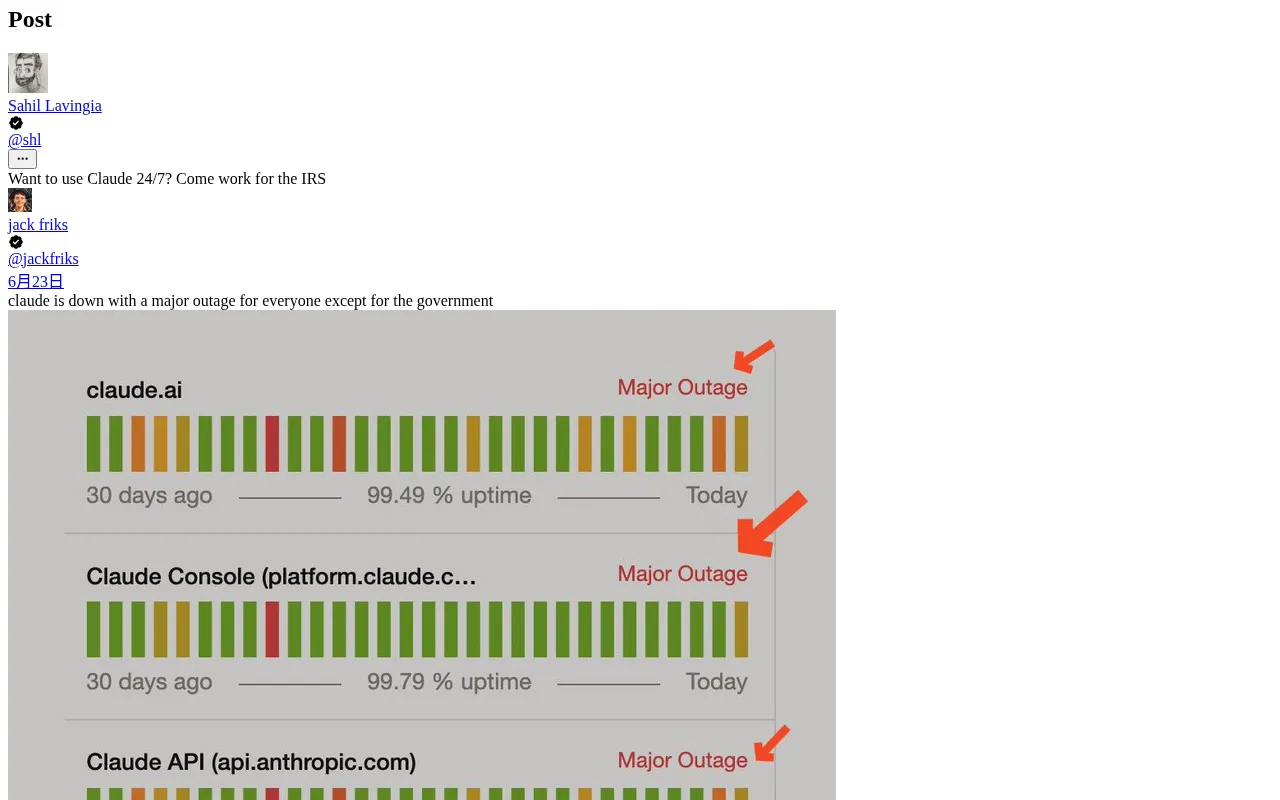
The U.S. IRS is recruiting staff with round-the-clock Claude AI access, marking Anthropic's successful entry into a core federal agency. The move highlights AI's shift from optional to essential in government work, with tax administration's rule-driven, text-heavy nature making it a natural fit for LLMs. It also underscores how AI tool access is becoming a new talent recruitment lever for agencies constrained by rigid pay scales.
Background
A job posting on social media recently caught the tech world's attention: the U.S. Internal Revenue Service (IRS) is recruiting staff with around-the-clock access to Claude AI. What reads as a lighthearted tweet actually reflects a significant trend — U.S. federal agencies are accelerating their adoption of AI technology.
The IRS's AI Transformation Journey
From Traditional Bureaucracy to Technology Pioneer
The IRS has long been seen as a symbol of inefficient government bureaucracy, drawing complaints from taxpayers every tax season due to its limited processing capacity. Yet the agency's adoption of Claude AI signals that even the most conservative government departments are actively seeking AI solutions to improve operational efficiency.
Offering employees "24/7 access to Claude" suggests the IRS has likely signed an enterprise-level service agreement with Anthropic, granting its workforce unrestricted AI access. For an agency that must process massive volumes of tax documents, answer taxpayer inquiries, and review filings, this represents a major productivity upgrade.
It's worth noting that federal AI procurement must pass FedRAMP (Federal Risk and Authorization Management Program) certification. Formally established in 2011 by the Office of Management and Budget (OMB), FedRAMP is a federal-level security certification framework specifically for cloud service providers, built on the principle of "authorize once, use many times" — a cloud vendor passes one rigorous review and can then serve all federal agencies. Certification comes in three impact levels: Low, Moderate, and High. The taxpayer financial data handled by the IRS falls under the highest level (High), which requires over 400 security controls covering multi-factor authentication, data encryption at rest, real-time intrusion detection, and disaster recovery planning. The full certification process typically takes 12 to 18 months and costs millions of dollars — a high barrier that effectively shuts out most small and mid-sized AI companies. Clearing this bar is itself a meaningful endorsement of Anthropic's security posture, and it means Claude underwent a far more rigorous compliance vetting process before entering the IRS than a typical enterprise procurement would require.
What Government AI Procurement Signals
This development carries several layers of significance:
- Anthropic's breakthrough into the government market: Claude's entry into a core federal agency demonstrates that it has met the stringent security and compliance standards required by government reviewers.
- AI tools shifting from optional to essential: When a government agency highlights AI access as a recruiting perk, it signals that AI has moved from a "nice-to-have" to a "must-have" productivity tool.
- A new dimension in talent competition: As tech companies and government agencies compete for talent, access to advanced AI tools is emerging as a new form of employee benefit.
The talent imbalance between the federal government and the private tech sector is a longstanding problem. According to the Government Accountability Office (GAO), average federal IT salaries are only 60–70% of comparable private-sector roles, and top Silicon Valley engineers can earn three to five times their federal counterparts. The structural barriers run deeper: federal employee compensation is tightly constrained by the General Schedule (GS) pay system, promotions depend on seniority rather than performance, and the average hiring process takes over six months. The creation of DOGE (the Department of Government Efficiency) and the broad rollout of AI tools signal that the federal government is attempting to rebuild its appeal to technical talent through technology empowerment. Offering AI access as a benefit is, at its core, a pragmatic workaround — compensating for a lack of salary competitiveness with productivity tools, given that the pay structure itself cannot be quickly reformed.
The Outlook for AI in Government Tax Administration
Why Tax Work Is a Natural Fit for Large Language Models
Tax work is inherently rule-driven and text-intensive — precisely the domain where large language models (LLMs) excel. The U.S. Internal Revenue Code (IRC) is one of the most complex tax systems in the world. Since the federal income tax was established in 1913, over a century of legislative amendments, judicial rulings, and administrative guidance has produced an IRC exceeding 4 million words. Add in the accompanying Treasury Regulations and tens of thousands of Tax Court decisions, and the total body of text surpasses 70 million words. Critically, tax questions often require synthesizing multiple code sections simultaneously — a multinational corporation's transfer pricing issue, for example, might involve IRC Section 482 (related-party transactions), Section 367 (outbound transfers), and bilateral tax treaty provisions all at once. Traditional keyword search tools are nearly powerless against these compound, context-dependent questions, while an LLM's long-context understanding and multi-step reasoning capabilities fill exactly that gap.
Specific use cases include:
- Tax law interpretation and consultation: Claude can help staff quickly retrieve and interpret relevant provisions, perform cross-section reasoning, and handle complex compound tax questions that traditional tools struggle with.
- Document review and analysis: Automated processing of large volumes of tax filings, flagging anomalies and potential issues.
- Internal knowledge management: Converting institutional procedures and case experience into a queryable AI knowledge base. In enterprise deployments, this is typically implemented via a RAG (Retrieval-Augmented Generation) architecture — vectorizing IRS internal documents so Claude can retrieve proprietary institutional knowledge in real time when answering questions, improving accuracy while avoiding the security risks of injecting sensitive data directly into model weights.
- Taxpayer service optimization: Helping customer service staff respond to taxpayer inquiries faster and more accurately.
Balancing Data Security and Privacy Compliance
Notably, the IRS handles the most sensitive financial information of American citizens. Choosing Claude over other AI products may be closely tied to Anthropic's longstanding emphasis on AI safety. Anthropic's Constitutional AI (CAI) is a training methodology that constrains AI behavior through a predefined set of value principles. Compared to traditional Reinforcement Learning from Human Feedback (RLHF), CAI introduces an explicit set of "constitutional principles" (such as harmlessness, honesty, and helpfulness), training the model to internalize these principles through self-critique and revision during training rather than relying solely on human scoring. The process unfolds in two stages: first, supervised learning teaches the model to revise its own outputs according to constitutional principles (SL-CAI); then reinforcement learning further refines this behavior (RL-CAI). This approach transforms safety constraints from "external guardrails" into "intrinsic capabilities" — when handling sensitive government data, the model can proactively identify and avoid privacy risks rather than passively waiting for a filter layer to catch them. This architectural design gives Claude a meaningful competitive edge over other AI products in government compliance scenarios.
It's also worth noting that when government agencies deploy LLMs like Claude, they typically use enterprise-grade dedicated architectures rather than public APIs: data is deployed in VPC-isolated environments, deeply integrated with existing identity and authentication systems, and full operational audit logs are maintained. In Anthropic's enterprise offerings, customer input data is not used to train the model — a critical assurance for high-security institutions like the IRS.
Industry Implications and Future Outlook
This development offers several takeaways:
For AI companies, the government market — especially the U.S. federal government — is enormous and highly lucrative. AI companies that are first to clear government security reviews and secure large-scale deployment opportunities will hold a significant competitive advantage. The high barrier of FedRAMP certification creates a structural moat, and first-mover advantages will compound as government agencies develop path dependencies on their chosen platforms.
For job seekers, proficiency with AI tools is becoming a baseline requirement for a growing number of roles — even in traditionally conservative government departments.
For the industry as a whole, when an institution like the IRS is fully embracing AI, the penetration rate of AI across enterprises and government may be advancing far faster than we imagine. We are at a critical inflection point as AI moves from the experimental phase into large-scale deployment.
Key Takeaways
- The IRS is fully adopting Claude AI, providing employees with unrestricted 24/7 access.
- This marks Anthropic's successful entry into the federal government market, having cleared rigorous security and compliance reviews including FedRAMP (a 12–18 month certification process with over 400 security controls).
- The rule-driven, text-intensive nature of tax work makes it a natural application domain for LLMs, with cross-provision reasoning being a particularly critical capability.
- Constitutional AI's architectural design gives Claude an inherent compliance advantage when handling sensitive government data, with safety constraints embedded in model training rather than relying on external filters.
- AI tool access is becoming a new form of benefit for government agencies seeking to offset their salary disadvantage (federal IT pay is only 60–70% of private-sector equivalents) and attract technical talent.
- The accelerating AI adoption by government agencies signals that 2025 will be a pivotal year for large-scale AI deployment.
Related articles
Meta Muse Hits 900K Downloads in Six D…
Meta Muse Hits 900K Downloads in Six Days: The AI Agent Era Has Officially Arrived
Meta's AI agent Muse hit 902K downloads in 6 days, topping US App Store and Google Play charts above ChatGPT and Claude. A deep dive into Muse's capabilities and the AI Agent race.
 Industry Insights
The IRS Mobile App Debate: A Trust Crisis in Government Digital Transformation
The IRS's proposed mobile app has sparked heated debate. This article analyzes the core arguments, exploring data security, privacy, and the trust crisis in government digital transformation.
 Industry Insights
OpenAI's Internal Codex Usage Surges 56x — AI Coding Is Eating Everything
OpenAI reveals internal Codex usage data: Research up 56x, Customer Support 32x, Engineering 27x, Legal 13x since Nov 2025. AI coding tools are penetrating every department faster than expected.