JIMMY: Control Your PC via WhatsApp Self-Chat, a New AI Agent Concept

JIMMY: an AI Agent that commands a Windows PC via WhatsApp self-chat to execute local tasks.
JIMMY is a local AI Agent residing on Windows. Users send natural language instructions through WhatsApp self-chat, and the computer executes operations such as sending files or taking screenshots, with results returned in the same conversation. The product builds safeguards through confirm-before-send, the /stop interrupt command, and an undo log, and supports scheduled tasks and custom commands, positioning itself as a PC automation tool rather than a general Q&A assistant. It received 81 votes and ranked 11th on Product Hunt—an early but clearly directed work. Its differentiation lies in keeping data local, remote desktop control from mobile, and reusing a messaging tool as the interface, but integration compliance, success rates for complex tasks, and permission transparency remain to be verified.
AI Agents are moving from the cloud to the local machine. A product called JIMMY on Product Hunt offers a rather unconventional interaction method: instead of opening a chat window in a browser or installing a standalone client, you directly command your computer through WhatsApp's "self-chat."
When WhatsApp's "File Transfer Assistant" Becomes an AI Assistant
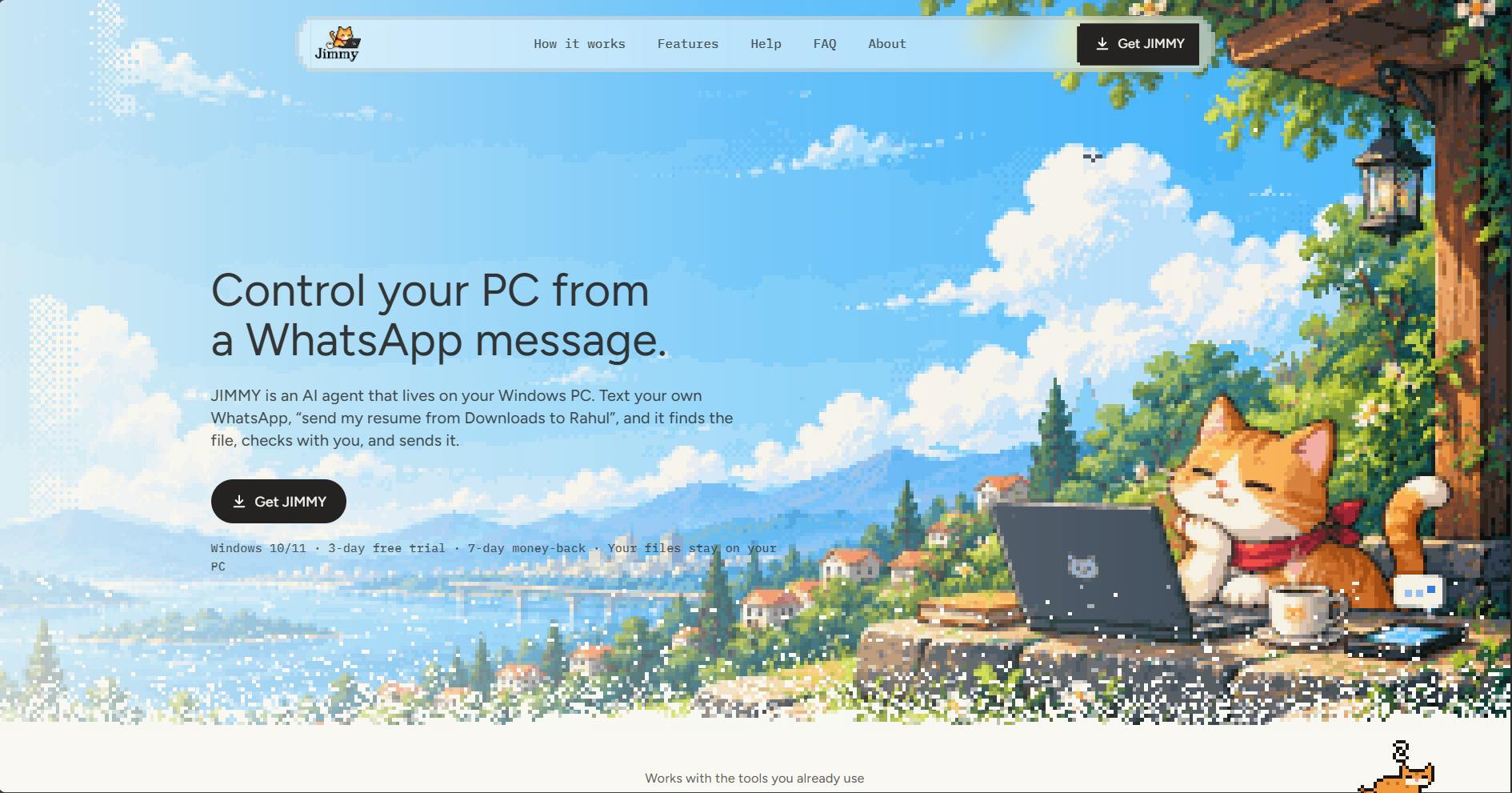
JIMMY's operating logic isn't complex: it resides on your Windows PC and monitors your WhatsApp conversation with yourself—that "File Transfer Assistant"-style chat window commonly used for sending yourself notes or forwarding links. You send a natural language instruction in the self-chat, and JIMMY executes the corresponding operation on your computer.
The official examples of typical commands fall into two categories: file operations, such as "send the resume in Downloads to Rahul"; and screen operations, such as typing "screenshot" to trigger a screen capture. After execution, JIMMY replies with the result in the same conversation, completing the loop.
The cleverest part of this design is that it eliminates the need for an "entry point." Users don't need to switch to another app or adapt to a new interface—WhatsApp is already a frequently opened communication tool, and placing the command channel here leverages the user's existing muscle memory.
WhatsApp's "self-chat" feature refers to a conversation window that a user establishes with their own account—essentially a chat session sent to oneself, visible only to the user. WeChat's "File Transfer Assistant," familiar to Chinese users, works similarly: sending yourself notes, saving links, and transferring files between devices. Technically, messages still pass through WhatsApp's servers, but since the sender and receiver are the same account, messages only flow between the user's own devices and don't involve third parties. For developers, this self-chat window is a ready-made, cross-device synchronized messaging channel: content sent from the user's phone syncs to the PC logged into the same account, and a local program only needs to connect to WhatsApp's corresponding interface to listen for new messages, enabling "phone sends command, PC executes." This is the key prerequisite that allows JIMMY to forgo a standalone app and a self-built server.
Safety Valve Design: Ask Before Acting, Keep a Way Back
Letting an AI directly operate your computer naturally raises concerns about it "slipping up." JIMMY has implemented several visible safeguards in this regard.
The core one is the "confirm before sending" mechanism. For actions involving outbound sending—such as sending a resume to someone—JIMMY doesn't execute directly but first asks the user for confirmation. This rule brings irreversible external operations into a human approval loop, a pragmatic approach among local Agent products.
Additionally, the product offers a /stop command to interrupt the current task and an undo log that lets users trace back and revert executed operations. For automation capabilities like scheduled tasks and custom commands that are easily forgotten in the background, these two features serve as a fallback.
Objectively, the available information doesn't specify JIMMY's permission boundaries, local data handling, or the specific technical path for WhatsApp integration. For local Agent tools, these are precisely the key items for security assessment and warrant further investigation before actual use.
Undo log is a mechanism that records operations a system has executed and retains the information needed for reverse operations, commonly found in database transactions and editor history. In the local Agent context, it means the program records the state before and after operations (such as original paths, file copies, or operation types) before executing file moves, deletions, or renames. When the user triggers an undo, the system rolls back in reverse order according to the log, restoring files to their original location and state. It's important to distinguish that undo logs work well for "reversible operations" (file moves, renames) but cannot help with irreversible actions like emails or messages already sent out—which is exactly why JIMMY separately implements a "confirm before sending" step. Together, they form a layered protection concept: "irreversible operations rely on human approval, reversible operations rely on log rollback."
Positioning This Type of Product Through Product Hunt Data
JIMMY received 81 votes and 4 comments on Product Hunt, ranking 11th on its launch day. This isn't a breakout performance, but it's enough to show that the "local PC Agent" direction has formed a stable audience.
Looking at the category tags, JIMMY is classified under Productivity, Task Management, and Messaging. This combination itself reveals its product ambition: not to be a general-purpose chatbot, but to treat the messaging channel as the task input layer and the local system as the execution layer. The addition of scheduled tasks and custom commands also confirms that it leans more toward being an "automation tool" than a "Q&A assistant."
The maker is Vedansh Danot, with the official website linked through Product Hunt. In terms of product maturity, JIMMY is more of an early work with a clear direction: the feature set is well-targeted and the interaction concept is distinctive, but information on the ecosystem and documentation is still limited.
Where Does the Differentiation of Local Agents Lie?
Placing JIMMY in the current AI Agent landscape, its value is mainly reflected at three levels.
First, data doesn't leave the local machine. Compared to workflows that upload files to the cloud for processing, locally executed Agents naturally avoid some concerns about data leakage. For scenarios involving sensitive files like resumes and contracts, this is a tangible advantage.
Second, remote control of the desktop from mobile. Sending commands through WhatsApp self-chat means you can have your home computer work while you're out. This "phone sends, PC executes" model has potential in remote work and fragmented task handling.
Third, the message is the interface. Instead of building a new UI, it reuses the user's existing communication tool, lowering the learning curve and avoiding yet another unused app icon. This approach has precedents in earlier personal automation tools; JIMMY combines it with LLM's natural language understanding to achieve a "say what you want and it does it" experience.
Of course, this path also faces obvious constraints: whether the WhatsApp integration is stable and compliant, how successful multi-step complex tasks are, and whether users are really willing to mix work commands into their private chat list—all these are questions that need time to verify.
For Windows users who want to try local Agents, JIMMY offers an extremely low-barrier starting point—just a WhatsApp account and a few natural language sentences. Whether it can move from small-scale attention on Product Hunt to daily use depends on subsequent refinement in reliability and security transparency.
The core difference between local Agents and cloud Agents lies in the execution environment and where data is processed. Cloud Agents (such as various web-based assistants) upload user input and files to the provider's servers, complete inference and processing remotely, and then return results. The advantages are ample compute, strong model capabilities, and no local deployment, but sensitive data must leave the local machine. Local Agents place the execution layer on the user's own computer, directly calling the local file system and operating system interfaces after parsing commands, so data can stay local. The trade-off is being limited by local compute, usually relying on external LLM APIs for semantic understanding, with model capability and response speed affected by network and cost. In addition, local Agents have real system permissions—able to read and write files and control the screen—with a capability boundary far greater than cloud assistants that can only operate in a browser sandbox, and correspondingly higher security risks. Therefore, least privilege, operation confirmation, and rollback design become essential for such products.
One-line Summary
JIMMY is an AI Agent that uses WhatsApp self-chat to command a Windows PC to execute local tasks.
Paragraph Summary
JIMMY is a local AI Agent that resides on Windows. Users send natural language instructions through self-chat on WhatsApp, and the computer executes operations such as sending files or taking screenshots, with results returned in the same conversation. The product builds safeguards through "confirm before sending," the /stop interrupt command, and an undo log, and supports scheduled tasks and custom commands, positioning itself as a PC automation tool rather than a general Q&A assistant. It received 81 votes and ranked 11th on Product Hunt—an early but clearly directed work. Its differentiation lies in keeping data local, remote desktop control from mobile, and reusing a messaging tool as the interface, but integration compliance, success rates for complex tasks, and permission transparency remain to be verified.
Related articles

The Truth Behind Titanic's Sinking: Key Decisions and Communication Failures in the National Geographic Documentary
National Geographic's The Unsinkable Ship uses survivor testimony to reconstruct Titanic's fatal decisions—from the missing MSG telegram prefix and the broken boiler-room-to-bridge link to how 'unsinkable' thinking delayed damage control and evacuation.

74M-Parameter Open-Source Model Partially Outperforms Jev AI in Testing
Fastino AI's Glider 2.5 models, with just 74M–300M parameters, reportedly outperform Jev AI in some guardrail benchmarks per YouTube testing, run on consumer hardware, and even play Doom. We analyze small models' competitiveness and deployment value on specific tasks.

Gemini 4 Argon Hands-On: Aggressive Pricing, 3D Capabilities Need Coaching
Gemini 4 Argon hands-on: limited-time $2/$10 pricing, million-token output, strong 3D and reverse-engineering work, but weak front-end aesthetics and zero-shot ability need coaching.