Junior Engineer Wants to Move into Agentic AI—What's Missing from This Skills List?

A junior engineer moving into Agentic AI roles needs to fill production capability gaps in observability, evaluation, and state management.
The article centers on a junior engineer hoping to move into an Agentic AI engineering role, noting that his existing skills lean toward Agent design while production practices are the key differentiator for junior candidates. Consensus says observability, kill switches, loop control, and SLOs come first; evaluation harnesses and failure mode analysis second; and expansion capabilities like RAG and multi-Agent orchestration last. State persistence, idempotency, and rate limiting are also underestimated, while cost modeling, prompt injection security boundaries, and stakeholder communication are blind spots outside the list.
A junior engineer posted on Reddit hoping to transition into an Agentic AI engineering role. His positioning is clear: focus on Agent system design—deciding which parts should be left to the model for autonomous decisions and which must retain deterministic logic, tool calls, or human approval. At the same time, he's also working on productionization practices. The post attracted many practitioners and hiring managers to the discussion, and the core question is really just one—beyond Agent design, which production capabilities can truly make a junior candidate stand out?
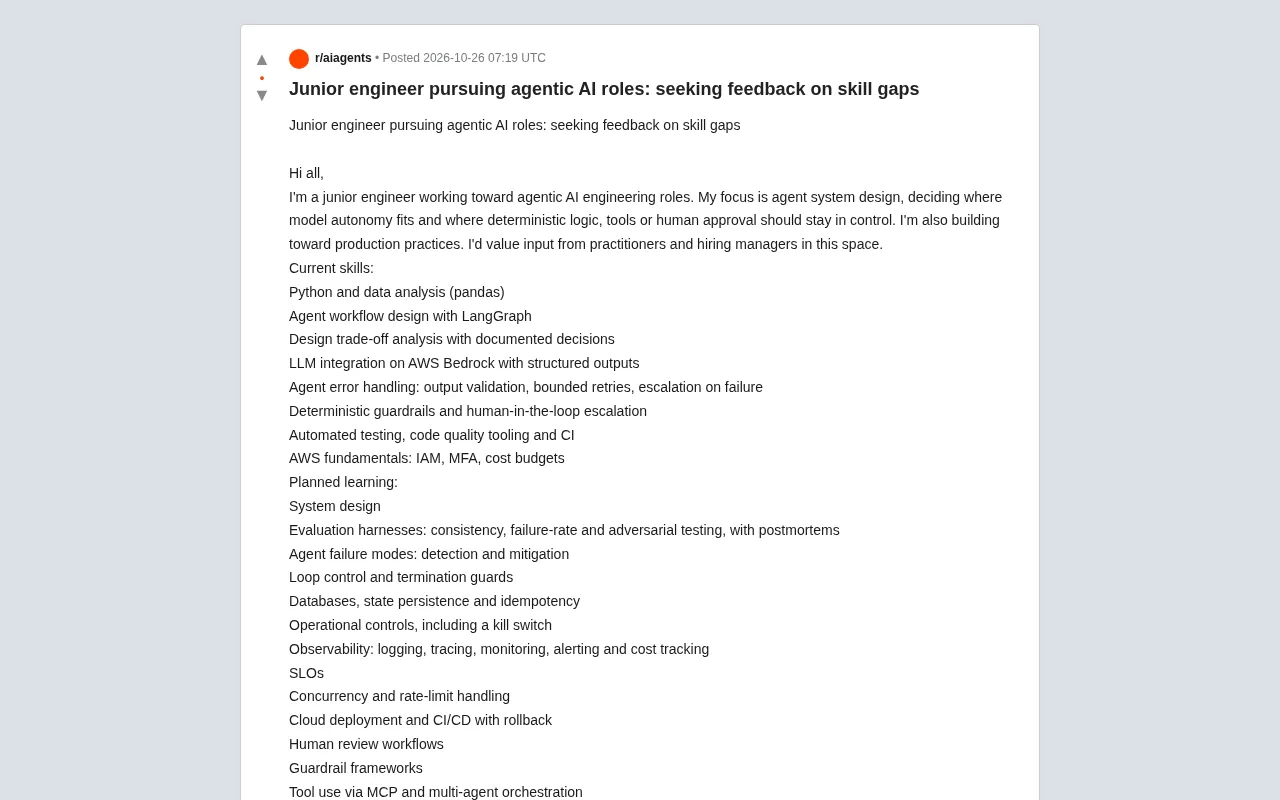
Existing Skills: The Direction Is Right, but Skewed Toward the "Design Layer"
From the list, this engineer's foundation is solid. He has Python and pandas data analysis skills as a base, can use LangGraph for Agent workflow design, can write analyses of design trade-offs, and has done LLM integration with structured outputs on AWS Bedrock. More importantly, he already realizes that Agent error handling can't rely on retries alone—output validation, bounded retries, and escalation on failure are all things he's practicing. Deterministic guardrails and human-in-the-loop escalation mechanisms are also within his practice scope, plus automated testing, code quality tools and CI, and AWS fundamentals like IAM, MFA, and cost budgets.
The direction of this combination is clear: he doesn't want to be "the person who calls APIs," but "the person who designs Agent boundaries." The problem is that most of these skills remain at the design and development stage, still some distance from the production environment.
Production Practices Are What Differentiate Junior Candidates
A recurring point in the replies is that the gap between an Agent demo and an Agent product lies almost entirely in operations. Many people can write LangGraph workflows, but few can clearly explain "how do you detect that this Agent has gone bad after it's deployed, and how do you shut it down before it causes damage." For junior candidates, this is exactly where an advantage can be built—senior engineers often assume you understand this, while hiring managers will specifically probe for it.
Specifically, observability (logging, tracing, monitoring, alerting, cost tracking) and operational controls (especially kill switches) are the two most frequently named items. Some practitioners mentioned that in interviews, if a candidate can proactively discuss "how the Agent's loop terminates and under what conditions human takeover is mandatory," the impression score clearly differs. This corresponds exactly to the loop control and termination guards in his planned learning list.
Kill switch (emergency stop switch) in Agent systems refers to a mechanism that can immediately interrupt Agent execution and prevent it from continuing to call tools or produce side effects. Unlike traditional service degradation, an Agent's kill switch needs to cover multiple stages including model inference, tool calls, and external API interactions, ensuring rapid containment when Agent behavior is abnormal (such as falling into an infinite loop, producing harmful output, or runaway costs). Common implementations include: setting a global flag at the orchestration layer, wrapping each tool call with timeout and circuit-breaker logic, and dynamically disabling high-risk tools via feature flags. For production-facing Agents, the kill switch should also be linked with alerting and human approval workflows, achieving a "automatic trigger + human confirmation" double safeguard.
Evaluation Systems: From "It Runs" to "It's Trustworthy"
The evaluation harnesses in his plan are considered by multiple practitioners to be one of the highest-priority directions. The reason is straightforward: Agent outputs are not deterministic, and traditional unit tests cannot cover "why did the model choose this tool this time." Consistency tests, failure rate statistics, adversarial testing, plus postmortems, together form a mechanism that makes Agent behavior measurable and regressible.
A hiring manager in the discussion said that junior engineers who can design evaluation plans and explain "why this metric reflects the Agent's reliability" are far scarcer than those who merely pile on features. This also addresses his first question: among production capabilities, evaluation capability is the one that best demonstrates engineering maturity.
Evaluation harnesses are frameworks for systematically testing and measuring LLM/Agent behavior, with the core challenge being non-deterministic outputs. Traditional unit tests rely on fixed inputs and outputs, whereas Agent evaluation requires building datasets with multiple samples, defining quantifiable scoring criteria (such as tool selection accuracy, task completion rate, hallucination rate), and supporting multiple runs to statistically assess consistency. Common open-source options include LangSmith, Braintrust, DeepEval, etc., which provide tracing, dataset management, and metric computation capabilities. For Agents, evaluation also needs to cover multi-turn interactions and tool call chains, and introduce adversarial testing (such as prompt injection) to verify robustness. Evaluation results should be fed back into the CI pipeline to prevent model or prompt changes from causing behavioral regressions.
State, Concurrency, and Idempotency: The Underestimated Hard Bones
The databases, state persistence, idempotency, concurrency, and rate limiting in his plan seem like traditional backend topics, but they carry special weight in Agent scenarios. Agents often need to maintain state across multiple turns, tool calls may be triggered repeatedly, and external APIs have rate limits—if these are not handled well, Agents will produce production incidents like duplicate orders, corrupted state, and timeout avalanches.
Some replies pointed out that many Agent projects fail not because the model isn't smart enough, but because state management wasn't done solidly. For junior engineers, explaining idempotency and rate limiting clearly proves you can touch production systems more than learning one more orchestration framework.
Idempotency means that performing the same operation multiple times has the same effect as performing it once, and it is especially critical in Agent scenarios. Because Agents may repeatedly call tools (such as payments or orders) due to retries, timeouts, or loops, if the tool is not idempotent, duplicate side effects will occur. Implementing idempotency usually requires generating a unique idempotency key for each operation, which the server uses for deduplication; for LLM calls, a cache or deduplication layer can avoid duplicate billing. In addition, rate limiting and concurrency control can prevent Agents from overwhelming external APIs or their own services during peak periods; common approaches include token bucket, leaky bucket algorithms, and queue-based asynchronous processing. Together, these mechanisms ensure the stability and cost controllability of Agents in production environments.
Priority Recommendations: Operations First, Then Evaluation, Then Expansion
Based on the consensus in the discussion, if we prioritize his plan list, it would roughly look like this:
- Tier 1: Observability, kill switch, loop control and termination guards, SLOs. These directly determine whether an Agent can be safely launched, and are also the key to distinguishing "has done a demo" from "has done a product" in interviews.
- Tier 2: Evaluation harnesses and failure mode analysis. They make Agent behavior verifiable and are a prerequisite for continuous iteration.
- Tier 3: RAG, vector databases, Agent memory, MCP tool calls, multi-Agent orchestration, graph databases. These expansion capabilities are important but build on the previous two layers; without observability and evaluation, the more complex the orchestration, the harder it is to troubleshoot.
One detail: items in his plan such as human review workflows and guardrail frameworks overlap heavily with Tier 1 and can be advanced together rather than listed separately.
What Else Is Missing from the List
The discussion also mentioned several directions he didn't list. First, cost modeling: an Agent's token consumption and tool call costs amplify with the number of loops, and being able to estimate per-task cost and set budget alerts is a basic production competency. Second, security boundaries: prompt injection, tool abuse, and least privilege require dedicated consideration beyond deterministic guardrails. Third, the ability to communicate trade-offs with business stakeholders: the balance between Agent autonomy and human approval is often not a technical decision but a product decision, and engineers who can articulate this layer are more likely to earn trust.
For this junior engineer, the skill direction is not off track; the real gap lies in moving from "designing Agents" to "operating Agents." Going deep on observability and evaluation is more valuable than continuing to expand the framework list.
Prompt injection is a security attack against LLM applications in which an attacker embeds malicious instructions in the input to induce the model to deviate from its original task or leak sensitive information. In Agent systems, the risk is amplified: the Agent may be manipulated into calling high-risk tools (such as executing code or accessing databases) or bypassing guardrails. Defenses include: isolating and escaping user input and tool return content, implementing least privilege (granting each tool only the necessary permissions), clarifying instruction priority in the system prompt, and deploying dedicated injection detection modules. In addition, tool abuse refers to an Agent being induced to use tools in unintended ways, which should be mitigated through tool whitelists, call frequency limits, and human approval for high-risk operations. These security boundaries should be designed in concert with deterministic guardrails, not as after-the-fact fixes.
One-line Summary
A junior engineer moving into Agentic AI roles needs to fill production capability gaps in observability, evaluation, and state management.
Paragraph Summary
The article centers on a case of a junior engineer hoping to move into an Agentic AI engineering role, pointing out that his existing skills lean toward the Agent design layer, while production practices are the key differentiator for junior candidates. The discussion consensus holds that observability, kill switches, loop control, and SLOs should be mastered first, followed by evaluation harnesses and failure mode analysis, and only then expansion capabilities such as RAG and multi-Agent orchestration. In addition, state persistence, idempotency, and rate limiting are easily underestimated in Agent scenarios, while cost modeling, security boundaries such as prompt injection, and the ability to communicate trade-offs with business stakeholders are also blind spots outside the list. The overall recommendation is to go deep on operations and evaluation first, then expand frameworks.
Related articles

Why Does Self-Play AI Always Get Crushed by Cheap Units? An RTS Developer's Account of the Dilemma
An independent developer trained an RTS commander AI with pure self-play, only to find it dominated historical versions but was crushed by human players using cheap tier-1 units. This article analyzes the causes of self-play strategy collapse, explores solutions such as exploiters, diversity rewards, and reward design, and introduces the open Bot Kit and AI league plan.
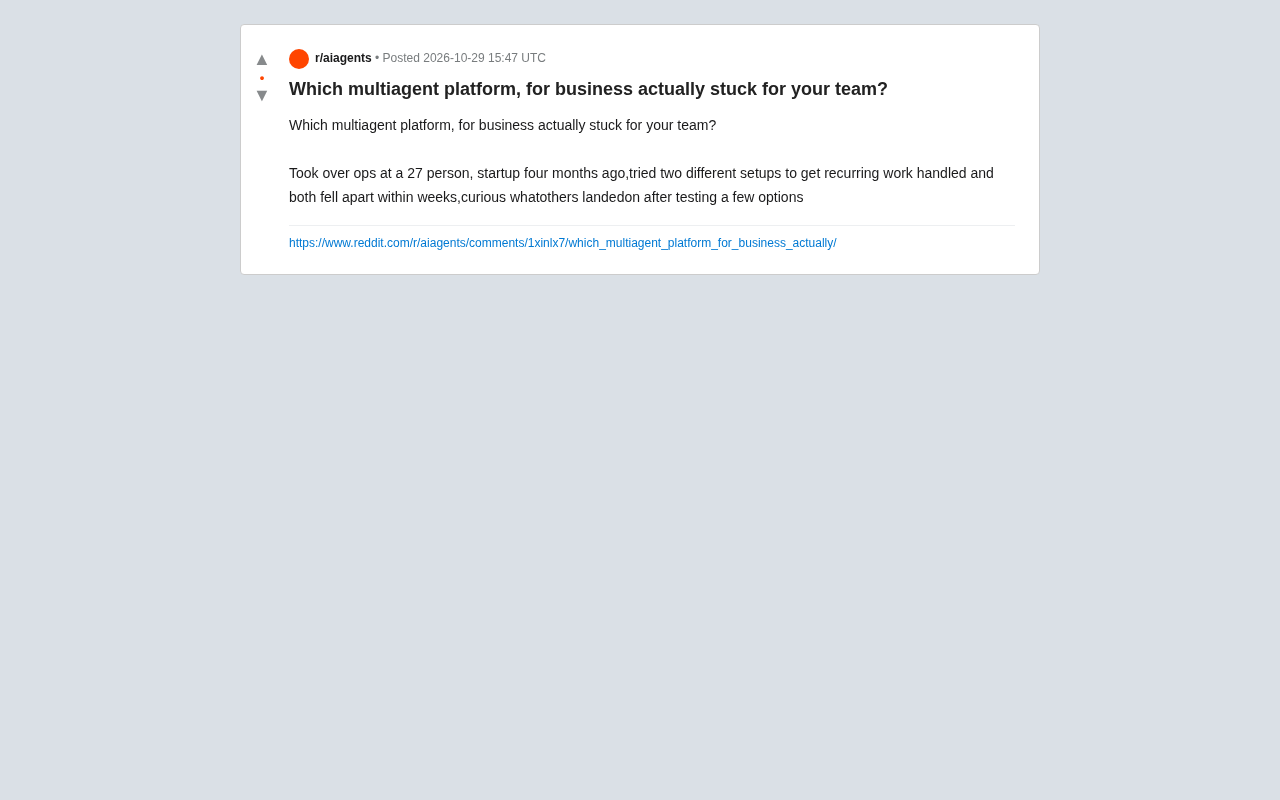
Which Multi-Agent Platform Wins? A Small Team's Battle Scars and Selection Considerations
A 27-person startup's ops lead tried two multi-agent platforms in four months and both failed. This article analyzes why small-team deployments break down, and offers selection guidance on integration depth, observability, and progressive rollout.

Thrive Holdings Takes ADT Private in $7.6 Billion Deal
Thrive Holdings acquires ADT for $7.6 billion in an all-cash take-private deal expected to close in Q1 2027. Analysis of the deal structure, ADT's asset value, and impact on the smart home security industry.