Kagi Launches "Search for everyone": A Bid to Democratize Paid Search

Kagi releases the "Search for everyone" update, sparking debate on whether paid search can reach the masses.
Paid search engine Kagi released a new feature called "Search for everyone," earning 427 points and 216 comments on Hacker News and sparking widespread discussion. Long known for being ad-free and subscription-based, Kagi's naming suggests it may be trying to lower the barrier to entry and find a new balance between the paywall and user growth. The article notes that the core contradiction of paid search is the extremely high operating cost—without ads, costs must be borne by users or subsidies. The community is divided: supporters value the alignment of interests from no ads, while opponents doubt the paid model can serve the masses. This attempt offers an observable industry sample of whether search can survive without ads.
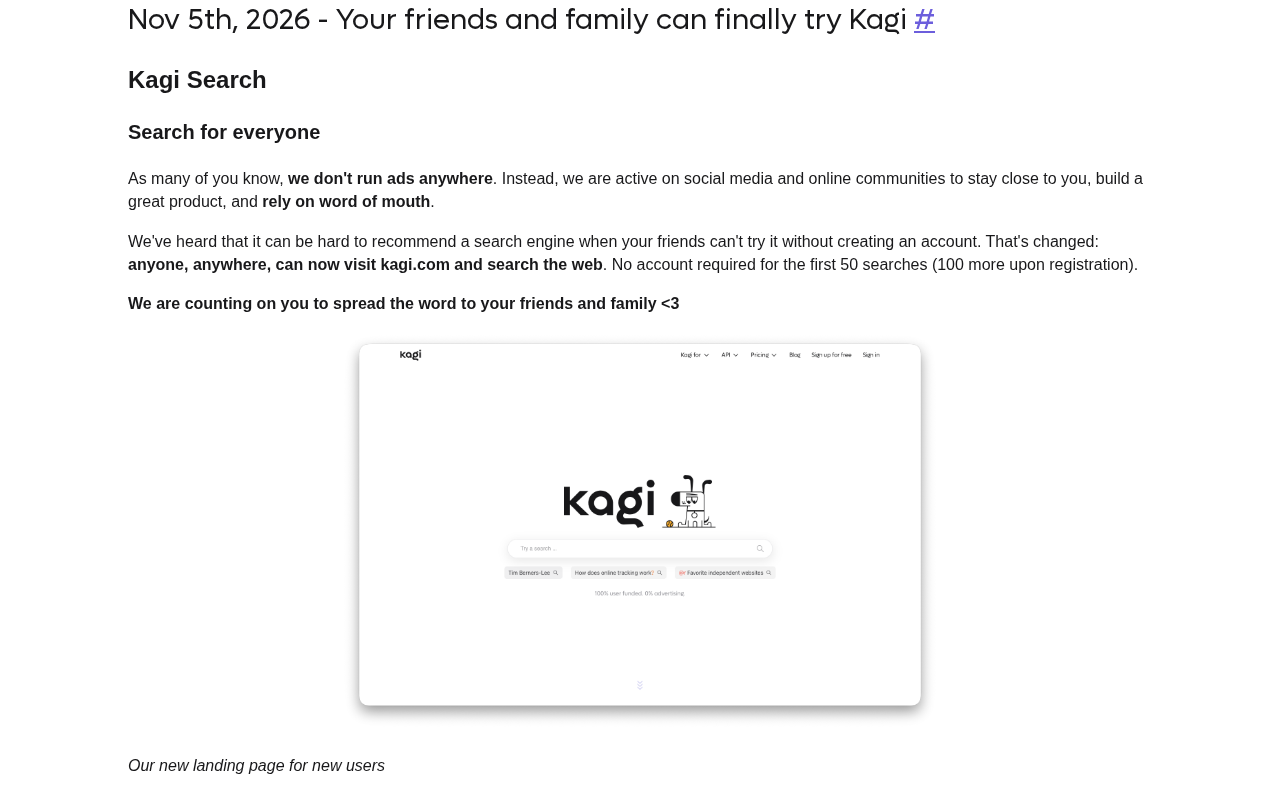
Paid search engine Kagi has released a new feature called "Search for everyone" in its changelog, quickly sparking heated discussion on Hacker News—the post garnered 427 points and 216 comments. For a search product long branded as "ad-free, user-paid," this update signals something intriguing: Kagi is rethinking the question of "who deserves access to good search."
The boundaries of paid search are being redrawn
Kagi has long taken a path diametrically opposed to mainstream search engines: no ad-based monetization, users pay by subscription, and search results contain no commercial promotions. This model has attracted a cohort of users extremely sensitive to search quality, but it has also quietly erected a barrier—you must pay first to experience so-called "better search."
The name "Search for everyone" itself carries a certain democratizing implication. Although the original source only provides the feature release link without disclosing implementation details or pricing changes, inferring from the product naming logic, Kagi is likely attempting to lower the barrier to entry, letting more people access its search capabilities rather than serving only the few willing to pay continuously.
Whether this path is viable depends on a fundamental contradiction: operating a search engine is extremely costly, and without ads, those costs must be borne by users or some subsidy mechanism. Kagi's move is essentially about finding a new balance between the "paywall" and "user growth."
Kagi was founded in 2018 and is headquartered in the United States. Founder Vladimir Prelovac had previously launched multiple software products. Kagi's core positioning is a "user-first" search engine, with a pure subscription business model: users pay monthly for search quotas, no ads are inserted into search results, and user behavior is not tracked to optimize ad delivery. Unlike free search engines such as Google and Bing, Kagi's revenue comes entirely from subscriptions, so its product design logic leans toward serving paying users' search quality rather than advertisers' exposure needs. This model is a minority in the search industry; a previous attempt, Neeva, shut down its consumer search business in 2023 and pivoted to the enterprise market, making Kagi's continued operation itself an important case for observing the viability of paid search.
What 216 comments on Hacker News tell us
A product update earning 427 points and 216 comments on Hacker News shows it touched on topics the community genuinely cares about. HN's user base has always been highly sensitive to search quality, privacy protection, and business models, and such discussions rarely stay focused on the feature itself.
Around paid search, two camps have long existed in the community. Supporters argue that ad-driven search inherently has conflicts of interest, and only user payment can make a search engine truly stand on the user's side; opponents point out that the paid model is destined to serve only a niche and cannot solve the real-world problem that "most people can't access good search."
"Search for everyone" lands precisely at the intersection of these two viewpoints. If Kagi can expand its user base without sacrificing the core experience, it may open a middle path for paid search; if not, the feature's name will instead become a target for criticism.
The specific leanings of the HN comment section on these two possibilities cannot be confirmed from the source material, but the sheer number of 216 comments already indicates the intensity of the debate.
Hacker News is a tech community operated by Y Combinator, with users primarily engineers, founders, and tech professionals, and its content ranking is based on votes and comment activity. A post earning 427 points means it entered the day's hot discussions, while 216 comments indicate the topic is contentious—HN's comment culture tends toward deep dissection of product design, business models, and technical implementation rather than simple emotional expression. In this community, search quality, privacy protection, and advertising ethics are long-standing high-frequency topics, and Kagi has been discussed multiple times before for its paid search model. Therefore, the comment volume on this update not only reflects attention but also shows that the community has substantive disagreements over whether paid search can break through its niche boundaries.
The third possibility for the search industry
Zooming out, Kagi's update reflects a structural change in the search industry. Mainstream search engines' business models are highly dependent on advertising, and the tension between advertising and search quality has always existed. In recent years, with the emergence of AI search products, users' sensitivity to "whether search results are trustworthy" has further increased.
Against this backdrop, paid search is no longer just a geeky niche choice but is beginning to be discussed as an institutional alternative. If Kagi's "Search for everyone" can truly lower the barrier, its significance is not just an additional feature but an observable sample of "whether search can survive without ads."
It is worth noting that the success of such attempts often depends not on technology but on whether the cost structure can be restructured. Search indexing, crawler infrastructure, and computing overhead are hard costs, and any democratization attempt must first answer "where the money comes from."
Search indexing and crawler infrastructure are among the heaviest fixed costs of a search engine. A general-purpose search engine needs to continuously crawl billions of web pages, maintain inverted indexes, handle query ranking, and invest substantial computing power in spam detection and ranking model inference. Google and Bing amortize these costs through ad revenue, while paid search engines must pass costs directly to users or find subsidies. Kagi早期曾使用 Google 和 Bing 的搜索结果作为部分数据源,再通过自有排序和过滤层进行二次加工,这种「依赖上游索引+自建排序」的混合架构可以在一定程度上降低基础设施成本,但也意味着其对上游搜索 API 的依赖和议价能力是一个结构性变量。任何普惠化尝试都必须在这种成本结构下重新计算单位用户的经济模型。
Conclusion
"Search for everyone" currently discloses limited information; whether it is a free tier, an open trial, or some kind of partnership distribution mechanism is not explained in the source material. But judging merely from the name and community reaction, Kagi is actively challenging the boundaries it previously drew for itself.
For those following the search industry and AI products, how this feature is implemented will be more worth tracking than the feature itself. Whether paid search can truly reach the masses—the answer won't appear in a changelog but in users' actual choices.
One-line Summary
Kagi releases the "Search for everyone" update, sparking discussion on whether paid search can reach the masses.
Paragraph Summary
Paid search engine Kagi has released a new feature called "Search for everyone," earning 427 points and 216 comments on Hacker News and sparking widespread discussion. Kagi has long been known for being ad-free and purely subscription-based; this naming suggests it may be trying to lower the barrier to entry and find a new balance between the paywall and user growth. The article points out that the core contradiction of paid search lies in the extremely high operating costs of search—without ads, costs must be borne by users or subsidy mechanisms. The community is divided: supporters value the alignment of interests that comes with no ads, while opponents question whether the paid model can serve the masses. This attempt provides an observable industry sample of "whether search can survive without relying on ads."
Related articles
 Tech Frontiers
Coldframe: A Honeypot Disguised as a Supermarket Freezer Controller
Coldframe is a honeypot disguised as Danfoss AK-SM 800A and Dixell XWEB freezer controllers, built as a single Python file that detects CVE-2025-41450 attempts and is identified as real devices on Shodan.
 Tech Frontiers
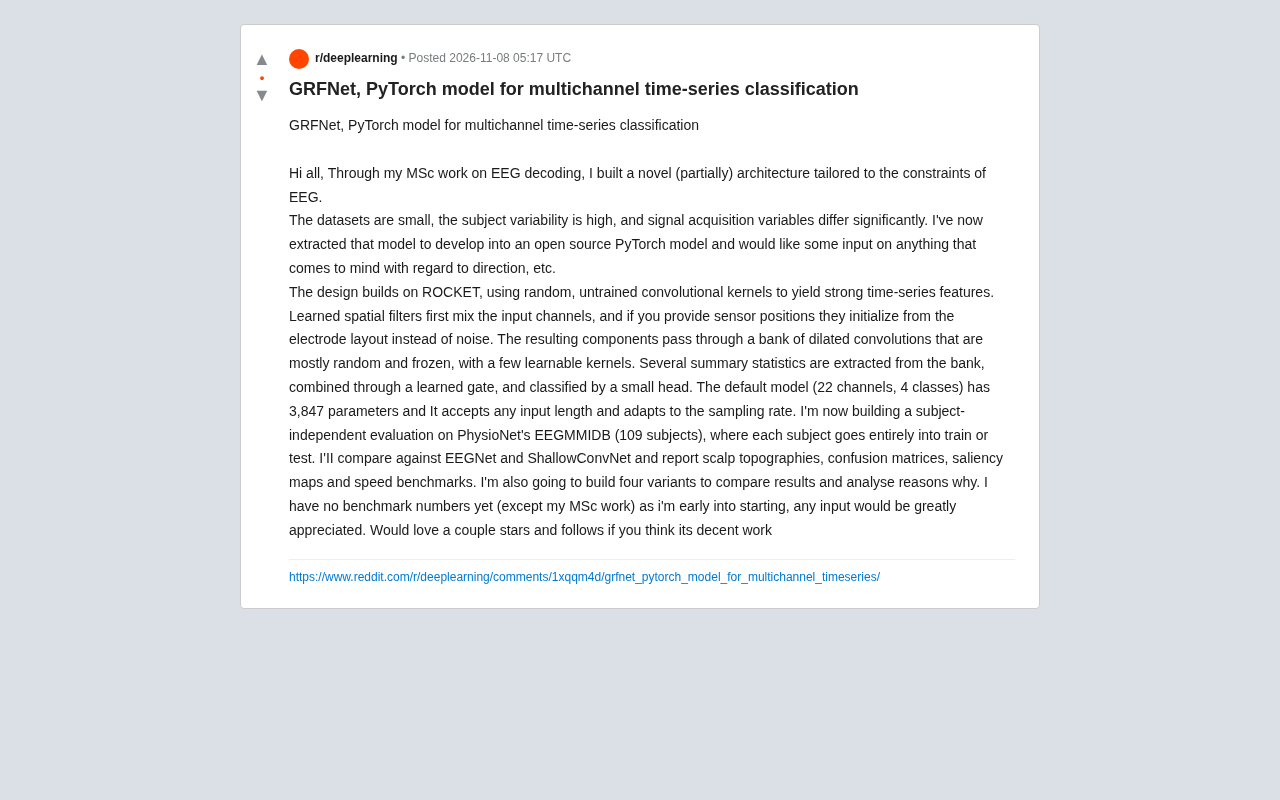
GRFNet: A Lightweight PyTorch Model Designed for Multichannel Time-Series Classification
GRFNet is a lightweight PyTorch model for multichannel time-series classification, originating from EEG decoding research. With only 3,847 parameters, it is based on the ROCKET architecture, combining random convolution kernels with learnable spatial filters, supports arbitrary input lengths, and will soon be evaluated on the PhysioNet dataset.
 Tech Frontiers
CUDA-Accelerated Rocket League Simulator: A Player-Made Hardcore Experiment
A Reddit post shows a "100% Accurate" Rocket League simulator accelerated with CUDA. We analyze its technical context, CUDA's value in game physics simulation, and the significance and limitations of such community projects.