Keepace.ai: A Technical Analysis of a Fine-Tuned LLM Specialized in Sports & Health

Keepace.ai is post-trained on Qwen3.5-27B for Chinese sports & health guidance, surpassing general models via safety-first evaluation.
Keepace.ai is a domain-specific LLM for Chinese sports and health scenarios, post-trained on Qwen3.5-27B and covering training plan generation, sports and health knowledge Q&A, and personal exercise data analysis. It aims to address the shortcoming of general-purpose models—broad coverage but insufficient professional depth—by injecting domain knowledge through a data pipeline. Its expert-designed rubric evaluation prioritizes exercise safety and boundary compliance; internal tests show it outperforms the base model and larger general models in safety, compliance, structured output completeness, and scientific accuracy. However, the report does not disclose data scale, fine-tuning methods, or quantitative scores, and it currently supports only Chinese, so external reproducibility and generalization remain to be verified.
General-purpose LLMs often come across as "knowing a bit of everything but not being truly professional" in fitness coaching scenarios—the training plans they produce may ignore safety boundaries, and their health Q&A lacks scientific grounding. Keepace.ai attempts to solve this problem: it is post-trained on Qwen3.5-27B, focuses on Chinese-language sports guidance, and outperforms its base model and larger general-purpose models in evaluations designed by internal experts.
Why Sports & Health Needs a Specialized LLM
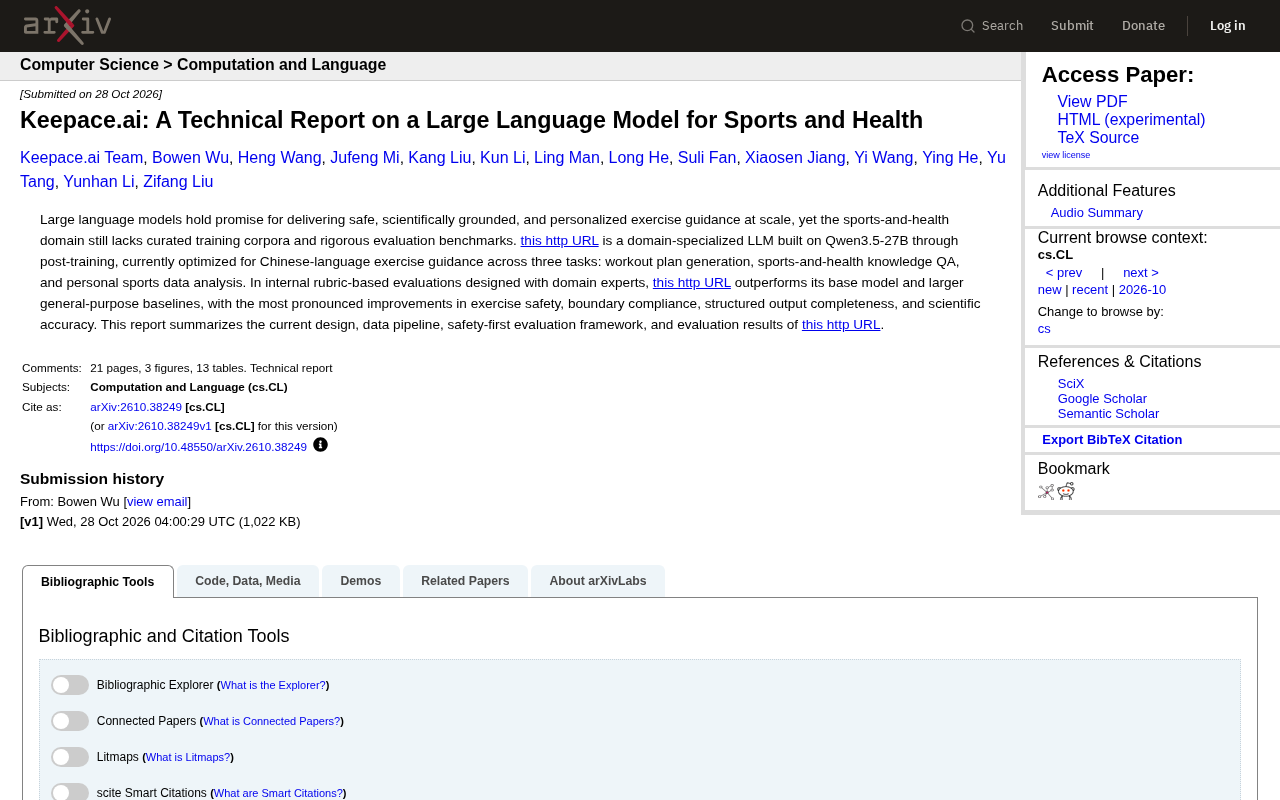
Large language models are capable of delivering safe, science-backed, and personalized exercise guidance at scale, but the sports and health domain has long lacked curated high-quality training corpora and rigorous evaluation benchmarks. Although general-purpose models are broad in coverage, they have clear shortcomings in professional depth. Keepace.ai's starting point is precisely to fill this gap: through domain post-training, it makes the model more reliable on three types of tasks—exercise plan generation, sports and health knowledge Q&A, and personal exercise data analysis.
According to the technical report, Keepace.ai is currently optimized for Chinese-language scenarios and covers three core tasks: generating training plans, answering sports and health knowledge questions, and analyzing personal exercise data. This task-focused strategy enables the model to deliver outputs that better fit real-world needs in specific scenarios rather than speaking in generalities.
Technical Approach: Post-training on Qwen3.5-27B
Keepace.ai does not train a foundation model from scratch; instead, it chooses Qwen3.5-27B as the base and injects domain capabilities through post-training. This choice strikes a balance between cost and effectiveness: a 27B parameter scale can carry sufficient domain knowledge without incurring excessive inference overhead. The technical report emphasizes that the post-training process relies on a carefully designed data pipeline, but it does not disclose details of the specific fine-tuning methods (such as SFT, RLHF, etc.).
From a results-oriented perspective, the post-trained Keepace.ai outperforms the base model on multiple metrics, indicating that the quality of the domain data pipeline plays a key role in the final performance.
Post-training refers to injecting specific capabilities or aligning with human preferences through additional training stages on top of an already pretrained foundation model. Common methods include supervised fine-tuning (SFT), reinforcement learning from human feedback (RLHF), direct preference optimization (DPO), and others. Compared with pretraining from scratch, post-training requires only a small amount of high-quality domain data to significantly change model behavior; it is low-cost and fast to iterate, and is the mainstream approach for vertical-domain models. Keepace.ai does not disclose which specific post-training method it adopts, so outsiders cannot distinguish whether its performance gains come from data quality or algorithm choice.
A Safety-First Evaluation Framework
Keepace.ai's evaluation system was designed with the participation of domain experts and uses rubric-based internal assessment. What is distinctive is that "exercise safety" and "boundary compliance" are placed at the core—this means the model must not only give seemingly reasonable answers but also avoid recommending dangerous movements, excessive training loads, and other content that could cause harm.
In the evaluation, compared with the base model and larger general-purpose models, Keepace.ai shows the most obvious improvements in the following dimensions: exercise safety, boundary compliance, completeness of structured output, and scientific accuracy. This indicates that domain post-training not only improves knowledge density but also strengthens the model's control over output boundaries.
Rubric-based evaluation is a structured assessment method: evaluators predefine scoring criteria and levels for each dimension (e.g., 1–5 points), then score each item against the criteria. Compared with vague judgments of "whether it feels good overall," rubric scoring can break results down into independent dimensions such as safety and accuracy, reducing subjective bias and making it easier to identify model weaknesses. Its limitation is that scoring still relies on expert judgment; consistency among different raters requires additional testing, and the rubric design itself may implicitly reflect the designer's preferences.
Targeted Optimization for Three Types of Tasks
Training plan generation: The model needs to output a structurally complete, progressive plan based on the user's physical condition, goals, and available equipment. Improvements in the completeness of structured output directly affect the plan's executability.
Sports and health knowledge Q&A: Answers are required to be scientifically grounded and to avoid spreading pseudoscience or overly absolute recommendations. Improvements in scientific accuracy are most directly reflected in this task.
Personal exercise data analysis: Provide interpretation and recommendations based on exercise data supplied by the user. Boundary compliance is especially important here—the model should not overstep to make medical diagnoses.
Boundary compliance in health-related AI specifically means that the model should be clear about the scope of its capabilities: it can give exercise advice, but it should not make medical diagnoses, recommend prescription drugs, or replace a doctor's judgment. This requirement is in tension with "usefulness"—being too conservative reduces practicality, while being too aggressive may cause harm. The risks in sports and health scenarios are especially concrete; for example, recommending squats to a user with a knee injury or suggesting high-intensity interval training to a user with cardiovascular disease may cause actual harm, which is why boundary control becomes one of the core dimensions of evaluation.
Limitations and Points Yet to Be Verified
The technical report does not disclose the specific scale of training data, its source composition, or quantitative evaluation scores, so external researchers find it difficult to reproduce or compare horizontally. In addition, the current optimization is limited to Chinese-language scenarios, and multilingual capabilities have not yet been addressed. The evaluation consists of internal expert scoring and lacks third-party verification on public benchmarks. These information gaps mean that Keepace.ai's actual generalization ability remains to be observed.
Conclusion
Keepace.ai demonstrates a feasible path for domain-specific LLMs in sports and health scenarios: starting from a medium-scale base model, and through post-training and an expert evaluation framework, achieving perceptible improvements in safety, compliance, and scientific accuracy. For practitioners concerned with the real-world deployment of AI in vertical domains, its "safety-first" evaluation approach is more worth learning from than the model itself.
One-line Summary
Keepace.ai is post-trained on Qwen3.5-27B and focuses on Chinese sports and health guidance, surpassing general-purpose models through safety-first evaluation.
Paragraph Summary
Keepace.ai is a domain-specific LLM for Chinese sports and health scenarios, post-trained on Qwen3.5-27B and covering three types of tasks: training plan generation, sports and health knowledge Q&A, and personal exercise data analysis. Its core idea is to address the shortcoming of general-purpose models—"broad coverage but insufficient professional depth"—by injecting professional knowledge through a domain data pipeline. The evaluation system was designed by domain experts and uses rubrics, prioritizing exercise safety and boundary compliance. Internal evaluation shows that the model outperforms the base model and larger general-purpose models in safety, compliance, completeness of structured output, and scientific accuracy. However, the technical report does not disclose data scale, fine-tuning methods, or quantitative scores, and it currently supports only Chinese; external reproducibility and generalization ability remain to be verified.
Related articles

The Touchscreen MacBook and Apple's Delightful Mess: A Deliberate Gamble
The Vergecast unpacks the touchscreen MacBook Pro's launch logic, the ProLed naming controversy, the iPad squeezed between iPhone and Mac, and how Apple stays competitive with premium hardware in the AI era.

Fifty Years Studying Power: Robert Caro's Writing and Insights on Power
Robert Caro reflects on 50 years studying power: Lyndon Johnson's persuasion and leverage, Robert Moses's transformation from idealist to ruthless builder, the dilemmas of large-scale construction, and his methods of compressing themes and solitary focus in biography writing.

Can a $20,000 Robot Do Your Chores? The Test Results Are Surprising
A YouTube test video shows how a $20,000 robot responds to commands like washing dishes, turning off lights, taking out trash, and feeding the dog. This article analyzes its real capability boundaries, the state of voice interaction technology, and how far household robots are from mainstream adoption.