Kept: Turn Ideas into Action with AI — The All-in-One Planner for the Apple Ecosystem

Kept centers on goal tracking, combining Apple Intelligence on-device categorization with calendar, tasks, and notes.
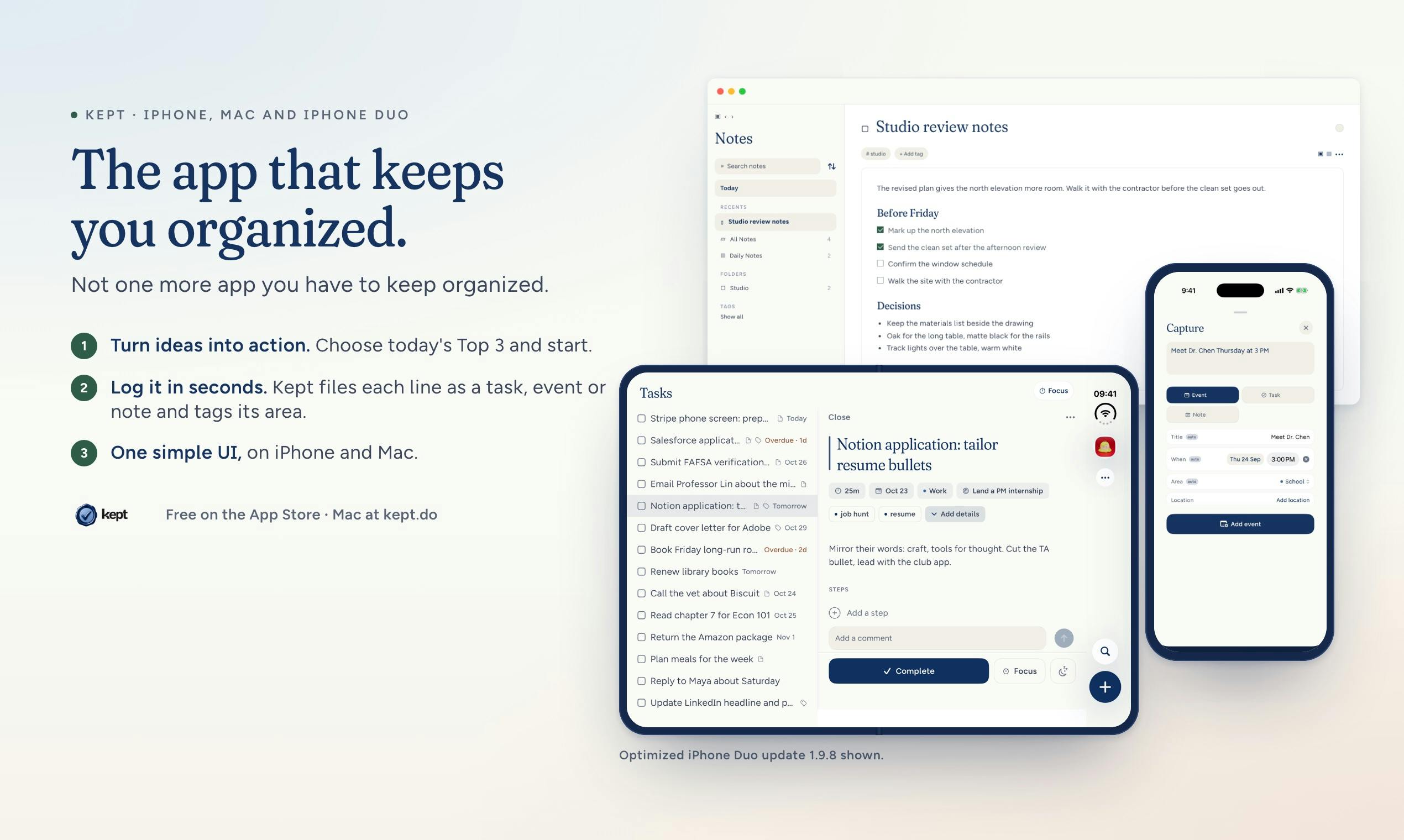
Kept is a to-do app by developer Jessie Salas launched on Product Hunt, aiming to fuse Notion's flexibility, Craft Notes' writing experience, and Things 3's task management. Its core difference is goal-centered tracking that makes tasks serve goals instead of piling up lists, plus Apple Intelligence on-device categorization into user-defined areas for privacy and easy retrieval. It also integrates calendar, tasks, and notes with iPhone and Mac sync. Still very early with limited votes and comments, and AI accuracy, sync quality, and data export undisclosed—better for a watchlist than replacing your workflow now.
In today's endless stream of productivity tools, most to-do apps just make "capturing" prettier—they rarely actually help users "complete" their goals. Kept, newly launched on Product Hunt, tries to change that: it bundles goal tracking, AI-powered auto-categorization, and cross-device sync together, claiming to create the ideal blend of Notion, Craft Notes, and Things 3.
Why is another to-do app worth paying attention to?
According to the Product Hunt page, Kept is built by developer Jessie Salas and currently has 14 votes, ranking 17th on the day's leaderboard. That's not a standout result, but its product thinking is worth noting for productivity tool enthusiasts.
In his introduction, Salas says outright that he wanted a fusion of Notion's flexibility, Craft Notes' writing experience, and Things 3's elegant task management. The biggest problem with to-do apps on the market is that they offload the burden of "organization" onto users: you have to create your own categories, apply your own tags, and the system is only responsible for storage. Kept's differentiation lies in having the app take on that cognitive load.
Core selling point: goal-oriented rather than task-hoarding
Kept's most distinctive design is that it's built around "goal tracking." Traditional to-do apps center on task lists—users check off one item after another but easily fall into a state of "busy but no progress." Kept puts goals first and makes tasks serve those goals, pushing users to actually achieve the outcomes they want rather than merely maintaining a tidy list.
This approach aligns with the "outcome over output" trend emphasized in the productivity tool space in recent years, but it's still rare in concrete product implementations. For people buried under countless to-dos who can't clearly say what they've actually advanced, this inverted perspective could have real value.
"Outcome over output" originates from the fields of management and agile development, emphasizing that progress should be measured by the results actually achieved (outcome) rather than the quantity produced (output). In the context of productivity tools, traditional to-do apps easily lead users to derive satisfaction from "how many items they've checked off," while neglecting whether those tasks truly serve long-term goals. Goal-oriented product design typically introduces OKRs (Objectives and Key Results) or a goal–task hierarchy, so that every to-do can be traced back to some higher-level intention. This thinking is fairly common in business management tools but remains a minority among lightweight personal to-do apps.
Apple Intelligence on-device auto-categorization
Another technical highlight of Kept is its use of Apple Intelligence to automatically categorize to-dos on-device into user-defined areas for easier retrieval later. This means categorization shifts from manual to automatic, and because it runs locally, data doesn't need to be uploaded to the cloud—friendlier for privacy-sensitive users.
Note that this feature depends on Apple's on-device intelligence capabilities, and its actual performance is limited by system version and device model. The Product Hunt page doesn't disclose classification accuracy or supported device ranges, which early users may need to verify themselves.
Apple Intelligence is Apple's personal intelligence system announced at WWDC 2024, built on on-device large language models and Private Cloud Compute to deliver writing assistance, notification summaries, image generation, and more. The core advantage of its on-device processing is privacy: data can complete inference without leaving the device, and only complex requests are handed off to the private cloud via encryption. For third-party developers, Apple Intelligence opens up some on-device model capabilities through the Foundation Models framework, allowing apps to call them for text understanding and classification. But this also means feature availability is constrained by device chip (typically requiring A17 Pro or M-series chips) and system version—users with older devices may not be able to use it.
Calendar, tasks, and notes in one, with cross-device sync
Kept integrates calendar, tasks, and notes in a single app, and supports syncing between iPhone and Mac. For people already working within the Apple ecosystem, reducing app switching is itself a productivity gain. Connecting notes and tasks also means ideas can be turned directly into action items, echoing the product tagline "turn ideas into action."
However, the quality of cross-platform sync, offline availability, and data export capabilities aren't detailed in the currently public information. These are all key factors determining the long-term usability of a productivity tool, and interested users should focus on them during trial.
Notion, Craft Notes, and Things 3 represent three different product philosophies: Notion offers extremely high freedom in information organization through its block-level editor, suited to building knowledge bases and project management systems; Craft Notes focuses on a rich-text writing experience and elegant document layout, emphasizing creative flow; Things 3 is a task manager renowned within the Apple ecosystem for its simplicity and interaction details, using an "Inbox–Project–Area" hierarchy model. Combining the three means simultaneously handling the tension between freedom and structure—too much flexibility risks repeating Notion's high configuration cost, while too much rigidity loses customizability. This is the core product challenge Kept faces.
A rational view of the early stage
Kept is currently at a very early stage, with limited voting and comment data, and the single comment available doesn't provide more product details. Its goal-oriented design and on-device AI categorization approach are appealing, but product maturity, the reliability of AI categorization, and its ability to work alongside other native Apple apps all remain to be tested over time.
For users looking for a productivity tool that's "more than just a list," Kept is worth adding to a watchlist; but if you need to replace your existing workflow immediately, it's advisable to try it on a small scale first before deciding.
One-line Summary
Kept centers on goal tracking, combines Apple Intelligence on-device categorization, and integrates calendar, tasks, and notes.
Paragraph Summary
Kept is a to-do app launched on Product Hunt by developer Jessie Salas, attempting to fuse Notion's flexibility, Craft Notes' writing experience, and Things 3's task management. Its core difference lies in centering on goal tracking, making tasks serve goals rather than simply piling up lists; it also uses Apple Intelligence to automatically categorize to-dos on-device into user-defined areas, balancing privacy and retrieval convenience. The product also integrates calendar, tasks, and notes, and supports iPhone and Mac sync. However, Kept is currently at a very early stage, with limited voting and comment data, and AI categorization accuracy, sync quality, and data export capabilities are all undisclosed—making it better suited to a watchlist than an immediate replacement for existing workflows.
Related articles
Gemini 4 Carbon Hands-On: The Strongest AI Model? Compared with Claude Opus 5.5
Google's Gemini 4 Carbon tops the Artificial Analysis leaderboard with 71% on CW Bench and leads Vending Bench. Hands-on comparison with Claude Opus 5.5: stunning front-end design but slightly behind in web development, with a clear price advantage.

Gemini 4 Carbon Tops Global Rankings as AI Productivity and Open-Source Ecosystems Surge
Google DeepMind's Gemini 4 Carbon tops global benchmarks, built for complex agents and system security. ByteDance launches Doubao Work integrated with Feishu, Anthropic's AI autonomously breaches 5 system-level attack chains, and ModelBest and Fudan open-source on-device multimodal and image generation models.

Overseas Creator Breaks Down N8n AI Agent Business Playbook: From Tooling to Monetization
An overseas creator breaks down the N8n AI agent business playbook: comparing Zapier, Make, and N8n, detailing four monetizable automation categories—lead capture, WhatsApp follow-up, booking, and content pipelines—plus agency pricing and a sales playbook.