Kitten-TTS 2 Open-Sourced: A 1.58-Bit TTS That Runs in Real Time on CPU with Voice Cloning

Kitten-TTS 2 open-sources the first 1.58-bit ternary-weight TTS, running real-time on CPU with voice cloning.
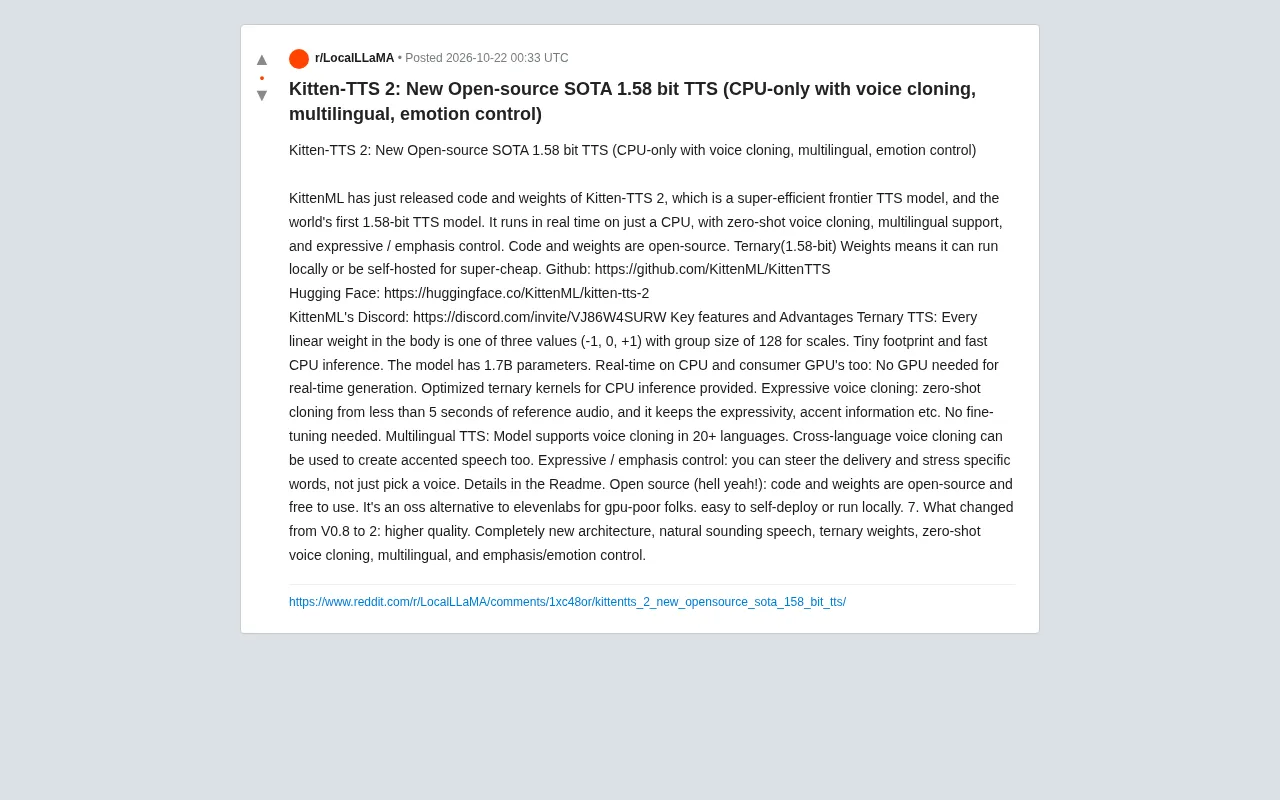
KittenML has open-sourced the code and weights for Kitten-TTS 2, billed as the world's first 1.58-bit TTS. Its core is ternary weights: each linear layer's weights take only -1, 0, +1, with a group size of 128 scaling factor, hence log2(3) ≈ 1.58 bits. The model has 1.7B parameters but, thanks to optimized ternary kernels, can do real-time inference on ordinary CPUs. Features include zero-shot voice cloning from under 5 seconds of reference audio, 20+ languages and cross-lingual cloning, and emotion/emphasis control. It's a complete new architecture versus V0.8, with upgraded quality and capabilities. Positioned as an open-source alternative for those with limited GPU resources, it suits low-cost self-hosting, though the audio quality ceiling involves trade-offs and commercial use requires attention to reference audio licensing.
KittenML has just open-sourced the code and weights for Kitten-TTS 2, a cutting-edge speech synthesis model billed as "the world's first 1.58-bit TTS." Its biggest draw: no GPU required—it generates speech in real time on CPU alone, while supporting zero-shot voice cloning, 20+ languages, and emotion and accent control. For developers lacking GPU resources who still want to self-host a TTS service, this is practically an "ElevenLabs alternative"-level option.
Ternary weights: what 1.58 bits actually means
The core selling point of Kitten-TTS 2 is Ternary TTS. Each linear layer's weights in the main model take only three values: -1, 0, and +1, paired with scaling factors using a group size of 128. This ternary quantization is exactly where "1.58 bits" comes from—because log2(3) ≈ 1.58.
The model has 1.7B parameters, but since weights are compressed to ternary values, actual storage and compute overhead is far lower than a full-precision model of the same parameter count. KittenML also provides optimized ternary kernels for CPU inference, which lets it hit real-time speeds on ordinary consumer CPUs. In other words, the hardware barrier to speech synthesis has been lowered to an unprecedented point.
Why CPU real-time matters
In the past, high-quality TTS almost always required a GPU by default, making self-hosting costly with a long deployment chain. By moving inference to CPU, Kitten-TTS 2 means you can run a speech service on an ordinary server or even a laptop, with extremely low marginal cost. For budget-constrained indie developers and small teams, this is a tangible productivity shift.
Ternary quantization with grouped scaling is key to understanding 1.58 bits. Traditional quantization maps weights to more discrete levels (e.g., 256 levels for 8-bit), whereas ternary quantization keeps only three values {-1, 0, +1}, so each weight theoretically needs only log2(3) ≈ 1.58 bits. But ternary weights have limited expressiveness, so scaling factors are needed: the model divides weights into fixed-size groups (here group size 128), each group sharing a floating-point scale factor, and actual computation multiplies ternary weights by that factor to restore magnitude. This "group quantization" preserves some dynamic range while compressing storage, a common trade-off for low-bit large models.
Ternary kernels refer to compute kernels specially optimized for ternary weights. Since weights take only three values, multiplication can be reduced to addition, negation, or zeroing—avoiding floating-point multiply-add operations and greatly reducing CPU compute overhead. This is the underlying reason Kitten-TTS 2 can do real-time inference on consumer CPUs.
Voice cloning and multilingual support: replicate a voice with 5 seconds of reference audio
Kitten-TTS 2 supports zero-shot voice cloning: with less than 5 seconds of reference audio, it can clone the target timbre while preserving the original voice's expressiveness, accent, and other characteristics—no fine-tuning required. This is relatively advanced for open-source TTS.
On the multilingual front, the model supports voice cloning in 20+ languages. Even more interesting is cross-lingual cloning—you can use a Chinese reference audio clip to synthesize English speech, producing an accented voice effect. For scenarios requiring multilingual content distribution, this flexibility saves the trouble of finding a separate voice for each language.
Emotion and emphasis control
Beyond choosing a timbre, Kitten-TTS 2 also lets you "direct" the tone: you can guide the overall expressive style and add emphasis to specific words. Specific usage is documented in the project's Readme. This kind of fine-grained control is typically a paid capability of commercial TTS, and an open-source model achieving it is valuable for podcasts, audiobooks, video dubbing, and similar scenarios.
Zero-shot voice cloning means the model can imitate a speaker's timbre from a short reference audio clip without any fine-tuning or training on that target speaker. The principle is usually to have the model extract speaker features (timbre, accent, prosody, etc.) from the reference audio as conditional input, then synthesize speech for new text accordingly. Compared with traditional approaches that require training a separate model per voice, zero-shot requires no extra training cost—at deployment you simply swap the reference audio to switch voices, which is why it suits multilingual content distribution.
From V0.8 to 2: a complete architecture rewrite
According to the release notes, going from V0.8 to 2 is not a minor patch but a completely new architecture. Changes include: significantly improved speech quality, more natural listening experience, introduction of ternary weights, addition of zero-shot voice cloning, multilingual support, and emotion/emphasis control. You could say V0.8 was more of an experiment, while version 2 is a complete product built for real deployment.
The model is released as open source, with both code and weights free to use, hosted on GitHub and Hugging Face, with community discussion on KittenML's Discord. The publisher explicitly positions it as "an open-source alternative for those lacking GPU resources," emphasizing ease of self-deployment and local operation.
TTS (Text-to-Speech) systems typically include a text frontend, acoustic model, and vocoder, responsible for converting text into natural speech. In recent years, mainstream approaches are mostly neural network-based; higher audio quality often demands more compute, which is why high-quality TTS has long depended on GPUs. Kitten-TTS 2's positioning is precisely in this context—using ternary quantization and CPU-optimized kernels to bring inference costs down to what ordinary hardware can handle.
Who it's for, and what to watch out for
Kitten-TTS 2 best suits three groups: developers without GPUs who want low-cost self-hosted TTS; content creators needing multilingual voice cloning; and voice application teams with emotion control requirements.
One caveat: while 1.58-bit quantization delivers extreme efficiency, there is still room for trade-off in audio quality ceiling compared with full-precision large models. For actual results, it's advisable to do a small-sample listening test with reference audio before deciding to integrate into production. In addition, voice cloning technology itself involves copyright and personality rights issues—be sure to confirm authorization for reference audio before commercial use.
Project links: GitHub (KittenML/KittenTTS), Hugging Face (KittenML/kitten-tts-2).
Related articles

Why Does Self-Play AI Always Get Crushed by Cheap Units? An RTS Developer's Account of the Dilemma
An independent developer trained an RTS commander AI with pure self-play, only to find it dominated historical versions but was crushed by human players using cheap tier-1 units. This article analyzes the causes of self-play strategy collapse, explores solutions such as exploiters, diversity rewards, and reward design, and introduces the open Bot Kit and AI league plan.
Which Multi-Agent Platform Wins? A Small Team's Battle Scars and Selection Considerations
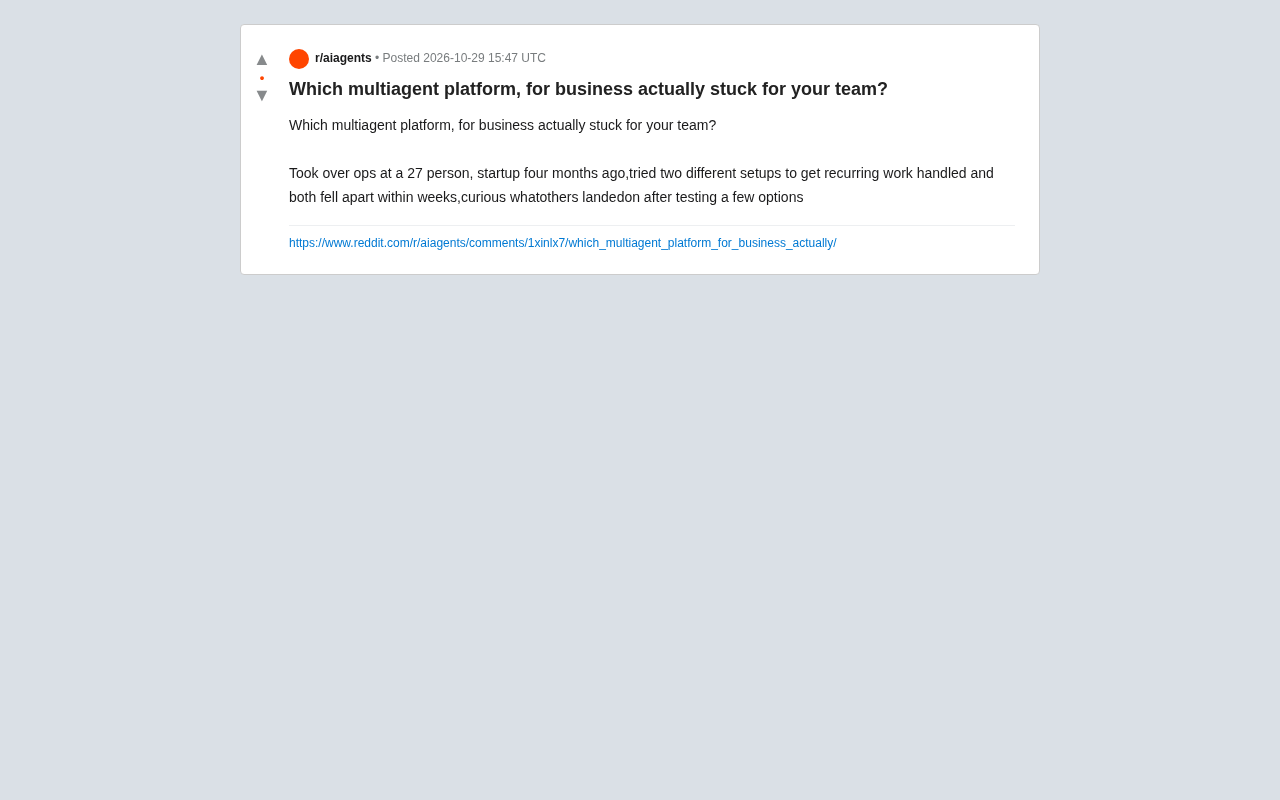
A 27-person startup's ops lead tried two multi-agent platforms in four months and both failed. This article analyzes why small-team deployments break down, and offers selection guidance on integration depth, observability, and progressive rollout.

Thrive Holdings Takes ADT Private in $7.6 Billion Deal
Thrive Holdings acquires ADT for $7.6 billion in an all-cash take-private deal expected to close in Q1 2027. Analysis of the deal structure, ADT's asset value, and impact on the smart home security industry.