Kodivo: Learn PHP Programming with Swipeable Cards and AI
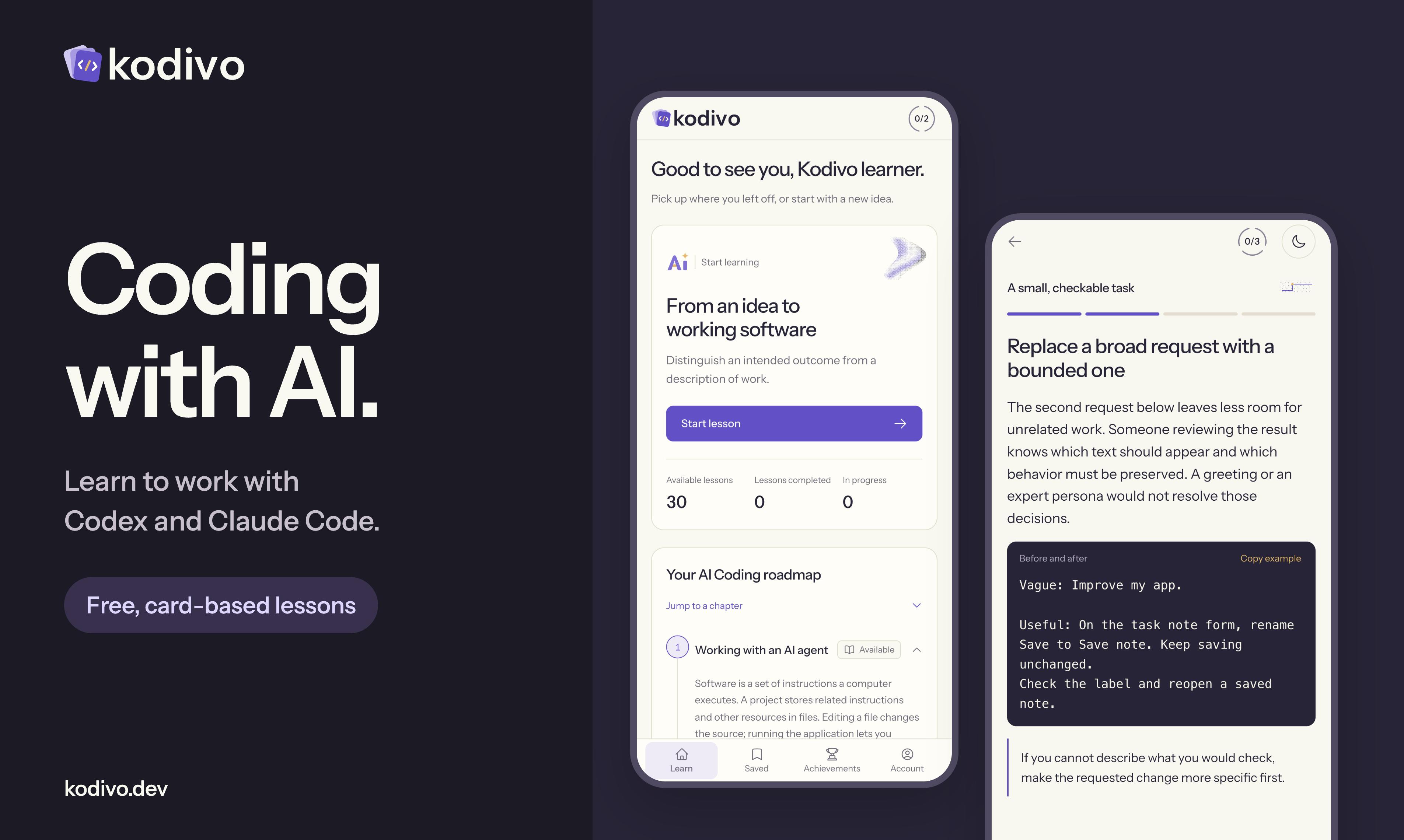
Kodivo teaches PHP and AI agents via swipeable cards and connects learning with coding toolchains through MCP.
Kodivo is a programming learning product on Product Hunt that organizes short lessons on PHP and AI coding agents into short-video-style swipeable cards, breaking knowledge into pieces to lower the mental barrier to entry. Each card is followed by exercises and explained answers, emphasizing active output over passive reading. Its differentiating design is support for connecting to Codex or Claude Code via MCP, making learning progress continuous with actual coding environments and reducing the switching cost between "learning" and "using." The product targets the entry-level and conceptual understanding stage; systematic in-depth training and project practice are not its strengths. As an early-stage product, its teaching content depth and exercise quality still need validation from more users.
When Programming Learning Meets "Swipeable Cards"
Kodivo, which debuted on Product Hunt, attempts to repackage the experience of learning to code using the interaction we're most familiar with from scrolling short videos and social feeds—swipeable cards. Its tagline is straightforward: "Learn coding with AI and PHP through swipeable cards."
Behind this lies a very practical insight: the entry barrier to programming often isn't the syntax itself, but the way learning materials are organized, which can be intimidating. Thick documentation and lengthy video tutorials easily exhaust learners' patience halfway through. Kodivo breaks knowledge points into individual cards, each carrying a short concept or a code snippet, switched by swiping—essentially using a fragmented rhythm to counter a steep learning curve.

Not Just Reading—Hands-On Testing
If it were merely turning tutorials into cards, there would be no essential difference from a flip-through e-book. Kodivo attaches exercises and explained answers after each card, which is worth noting. The most effective part of learning to code is never reading, but writing, making mistakes, reading explanations, and correcting. Embedding "test yourself" into the swiping flow means learners must actively produce output at the end of each small unit rather than passively swiping through.
The topics the product focuses on are also interesting: it doesn't just teach PHP syntax, but also how "coding agents" work. With AI coding assistants becoming increasingly widespread, understanding how AI agents generate and modify code is becoming a new foundational literacy. Kodivo covers both a traditional language (PHP) and AI collaboration mechanisms—a combination that isn't common among entry-level products.
MCP Connection: Linking Learning Progress with AI Tools
One of Kodivo's differentiating designs is support for connecting to Codex or Claude Code via MCP (Model Context Protocol), allowing users to continue working with their saved learning progress.
This means there's no longer a wall between the learning scenario and the actual coding scenario. After learning a card about a PHP function or AI agent behavior, you can continue practicing directly in your familiar AI coding environment, with progress staying连贯 (continuous). For developers already using tools like Claude Code, this衔接 (connection) lowers the switching cost between "learning" and "using," and gives learning records a real destination instead of leaving them stranded in an isolated app.
MCP (Model Context Protocol) is an open protocol proposed by Anthropic in late 2024, aimed at establishing a standardized way for AI models to connect with external data sources and tools. You can think of it as the "USB-C port" for AI applications: previously, every AI assistant needed custom integration code to connect to a tool or data source; with MCP, as long as the tool provider implements an MCP server, any AI client supporting the protocol can call it directly. In Kodivo's case, MCP serves as a bridge between the learning app and coding tools like Codex and Claude Code, allowing context data such as learning progress to be read and used by AI tools without relying on private APIs or manual export/import.
Where Are the Limits of Swipe Learning?
From its product positioning, Kodivo targets the entry-level and conceptual understanding stage, not systematic in-depth training. Swipeable cards excel at building intuition, quickly going through a knowledge map, and maintaining learning momentum during fragmented time. But真正 (真正) developing programming ability requires project-level practice, experience debugging complex problems, and the ability to read and understand others' code—these are hard for the card format to fully carry.
Additionally, the product currently focuses on PHP and AI agents, with relatively concentrated coverage. The community feedback scale of 75 upvotes and 1 comment also indicates it's still in an early stage; the depth of teaching content and the quality of exercise design will need more users actually using it before they can be judged.
A Learning Product Approach Worth Watching
Kodivo's value may not lie entirely in how well it teaches, but in the approach it demonstrates: packaging new knowledge for the AI era (how agents work) and traditional programming language learning in a lightweight, interactive way that connects with the toolchain.
For developers who want to understand how AI coding assistants operate, or who want to brush up on PHP fundamentals during fragmented time, it offers a low-friction entry point. And the MCP connection design hints at a more promising direction—learning tools no longer exist in isolation but are embedded in developers' existing workflows. If this approach works, it could offer significant inspiration for the shape of online learning products.
Background Notes
A coding agent is a type of AI system that can autonomously plan and execute multi-step coding tasks, distinct from code assistants that only do single completions. A typical workflow includes: reading and retrieving the codebase, breaking down tasks, generating patches, running tests, and iteratively correcting based on errors. Claude Code, Codex CLI, and Cursor's Agent mode all belong to this category. Understanding how agents work matters because the user's prompting style, review habits, and trust boundaries all directly affect output quality—knowing it reads files before modifying code means you understand why clear context is needed; knowing it relies on test feedback for self-correction means you understand that writing good tests is itself a skill for collaborating with AI.
PHP seems somewhat "counterintuitive" in an AI programming entry-level product, but there's a rationale. It is one of the most widely deployed languages in web backend development, with ecosystems like WordPress and Laravel having大量 (a large amount of) existing code and maintenance needs; at the same time, PHP has a low syntax barrier and can run without complex build tools, making it suitable as a vehicle for fragmented card-based teaching. For beginners, the feedback loop for validating a function or a piece of logic in PHP is extremely short, which highly matches the "small steps, quick tests" rhythm emphasized by swipeable cards.
Related articles
 Tech Frontiers
MuJoCo: An Analysis of DeepMind's Open-Source General-Purpose Physics Simulator
An in-depth analysis of Google DeepMind's open-source physics simulator MuJoCo: high-performance C++ kernel, MJCF modeling format, contact solving principles, MJX GPU acceleration, and robot reinforcement learning use cases.
 Tech Frontiers
Claude API Quick Start: The Official Quickstarts Project Collection
Anthropic's official claude-quickstarts project collection helps developers quickly build deployable apps with the Claude API. Nearly 20k stars, Python-based, great for beginners and prototyping.
 Tech Frontiers
AI Agents Connecting Directly to APIs: Which Calls Can Be Safely Allowed?
AI agents can call any API, but the real challenge is deciding which calls can be safely allowed. This article analyzes allowance decisions from three dimensions—intent matching, least privilege, and controllable impact—and argues that the control layer should sit outside the agent, combined with audit traceability to build a trustworthy API call governance mechanism.