Lakeflow Connect: A Unified Approach to Productivity and AI Data

Lakeflow Connect unifies productivity and AI data ingestion through a fully managed approach, cutting connector ops costs.
The article introduces Lakeflow Connect, a fully managed data ingestion solution for fragmented enterprise data across productivity tools and AI apps. Traditional per-source connectors carry high maintenance costs and poor timeliness; the fully managed model offloads deployment, scaling, and failure handling to the platform. Unified ingestion lets training, RAG, and analytics share one data foundation. The source covers only the series intro, so connector lists, performance metrics, and pricing remain undisclosed; enterprises should evaluate source coverage, sync timeliness, and lakehouse integration.
Enterprise data is typically scattered across productivity tools, AI applications, and various SaaS platforms. Unifying this data for analysis has long been a pain point for data engineering teams. Lakeflow Connect, a fully managed data ingestion solution, aims to address this challenge. Based on the second post in an official blog series, this article outlines its core approach and value.
Why Unifying Productivity and AI Data Matters
As AI applications proliferate, the variety of data sources enterprises generate has surged dramatically: documents in collaboration tools, conversation logs from AI assistants, and structured data from business systems—all fragmented from one another. Traditional ingestion approaches require building a separate connector for each data source, resulting in high maintenance costs and poor timeliness.
Lakeflow Connect is positioned to deliver fully managed data ingestion, unifying data scattered across productivity tools and AI platforms to reduce the operational burden of building pipelines in-house. The official series emphasizes its "fully managed" nature, meaning the platform handles connector deployment, scaling, and failure management.
A data connector is a key component in the data ingestion pipeline, responsible for establishing protocol adaptation, incremental detection, and field mapping between source systems and target storage. Traditional self-built connectors typically need to handle each source system's API authentication method, pagination mechanism, rate limits, and schema changes separately. Once a source system upgrades its interface, the connector often requires corresponding modifications—a major reason why data teams face persistently high maintenance costs. Fully managed connectors encapsulate these details on the platform side, exposing a unified configuration interface and synchronization semantics, transforming ingestion work from "writing code" into "configuring parameters."
Core Capabilities of Fully Managed Ingestion
Based on the series description, Lakeflow Connect's value is mainly reflected at two levels.
Reducing Connector Maintenance Costs
Data teams no longer need to write and maintain custom connectors for each SaaS or AI data source. The fully managed model delegates connector lifecycle management to the platform, allowing teams to focus on data modeling and consumption. This is especially critical for enterprises with many, rapidly changing data sources.
Supporting Data Supply for AI Scenarios
AI applications demand higher data freshness and coverage. By unifying ingestion of productivity tools and AI data, training, retrieval augmentation, and business analytics can share the same data foundation, avoiding consistency issues caused by duplicate collection.
Retrieval-Augmented Generation (RAG) is the most common data consumption pattern in current AI applications: before the model generates a response, relevant segments are retrieved from the enterprise knowledge base and injected as context into the prompt. RAG's effectiveness depends heavily on the coverage and freshness of underlying data—if documents are updated but not synchronized in time, retrieval will return stale content. This is why the article emphasizes unified data supply: if training, RAG, and business analytics each maintain their own collection pipelines, not only is investment duplicated, but the same entity may end up with inconsistent definitions across pipelines.
Practical Implications for Data Teams
It should be noted that the source material only includes the introductory post of the series and does not disclose specific connector lists, performance metrics, or pricing details. Therefore, this article does not speculate on specific capability boundaries.
From a trend perspective, fully managed data ingestion is becoming a standard feature of data platforms. When evaluating such solutions, enterprises should focus on three key areas: the coverage of supported source systems, guarantees around data synchronization timeliness, and integration with existing data lakehouses. Whether Lakeflow Connect can differentiate itself on these three dimensions will require more information from subsequent posts in the series.
A data lakehouse is an architecture that combines the flexibility of a data lake with the transactional and query capabilities of a data warehouse, typically using open table formats (such as Delta Lake or Apache Iceberg) as the storage layer. When evaluating data ingestion solutions, "integration with existing lakehouses" specifically involves target table format compatibility, support for incremental writes and upserts, and whether metadata can be synchronized to a unified catalog. If a connector can only perform full overwrite writes, downstream incremental computation and lineage tracking will be constrained—making this dimension often more decisive for real-world adoption than the number of connectors.
Summary
Lakeflow Connect targets the pain point of fragmented ingestion across productivity tools and AI data, reducing connector operational costs through a fully managed approach and providing unified data supply for AI scenarios. For enterprises with complex data sources, this type of solution is worth continued attention.
One-line Summary
Lakeflow Connect unifies productivity and AI data ingestion through a fully managed approach, reducing connector operational costs.
Paragraph Summary
The article introduces Lakeflow Connect, a fully managed data ingestion solution addressing the pain point of fragmented data across enterprise productivity tools and AI applications that is difficult to analyze uniformly. Traditional approaches require building a separate connector for each data source, resulting in high maintenance costs and poor timeliness; the fully managed model delegates connector deployment, scaling, and failure handling to the platform, freeing data teams to focus on data modeling and consumption. In AI scenarios, unified ingestion allows training, retrieval augmentation, and business analytics to share the same data foundation, avoiding consistency issues caused by duplicate collection. The article also notes that the source material covers only the series introduction and does not disclose connector lists, performance metrics, or pricing, and recommends that enterprises evaluate such solutions across three dimensions: source system coverage, synchronization timeliness, and lakehouse integration.
Related articles

Why Does Self-Play AI Always Get Crushed by Cheap Units? An RTS Developer's Account of the Dilemma
An independent developer trained an RTS commander AI with pure self-play, only to find it dominated historical versions but was crushed by human players using cheap tier-1 units. This article analyzes the causes of self-play strategy collapse, explores solutions such as exploiters, diversity rewards, and reward design, and introduces the open Bot Kit and AI league plan.
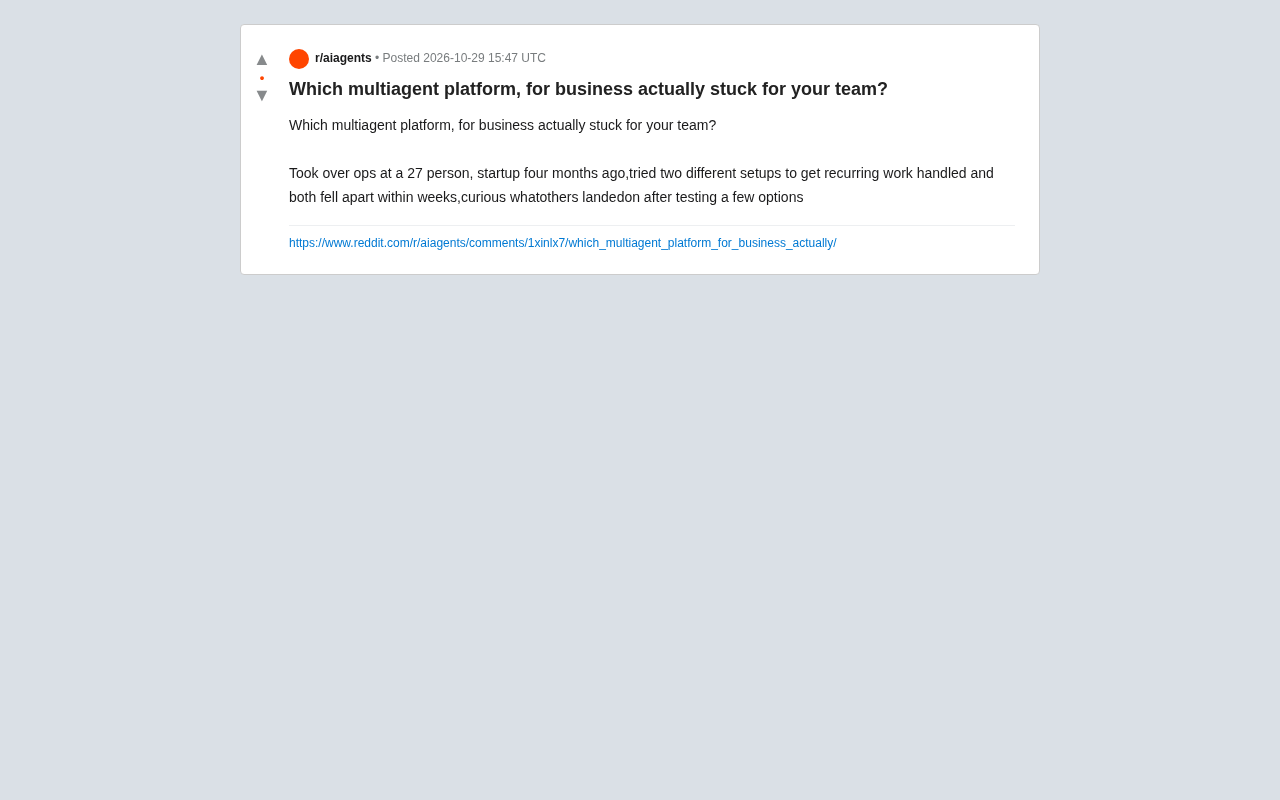
Which Multi-Agent Platform Wins? A Small Team's Battle Scars and Selection Considerations
A 27-person startup's ops lead tried two multi-agent platforms in four months and both failed. This article analyzes why small-team deployments break down, and offers selection guidance on integration depth, observability, and progressive rollout.

Thrive Holdings Takes ADT Private in $7.6 Billion Deal
Thrive Holdings acquires ADT for $7.6 billion in an all-cash take-private deal expected to close in Q1 2027. Analysis of the deal structure, ADT's asset value, and impact on the smart home security industry.