LangChain Adds SchemagateRetriever: On-Demand Table Retrieval Cuts Text-to-SQL Prompts by 92.9%

LangChain's SchemagateRetriever uses offline retrieval to trim schemas on demand, cutting prompts on large databases by 92.9%.
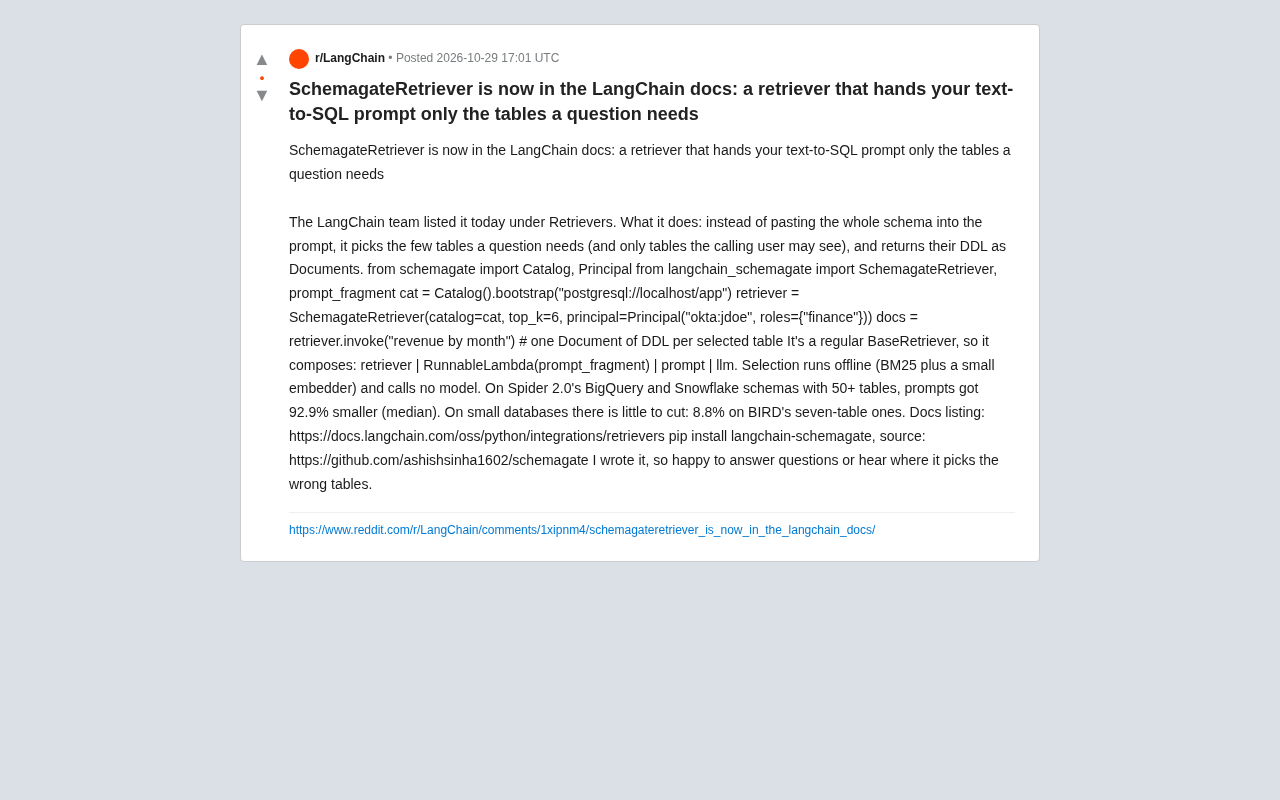
SchemagateRetriever is a retriever newly added to the LangChain documentation. Targeting the token waste and table-selection noise caused by stuffing the entire database schema into the prompt in text-to-SQL, it retrieves a small number of relevant tables based on a natural-language question and returns their DDL as Documents. Its selection process is entirely offline, based on BM25 plus a small embedder, with no model calls; permission filtering is completed at the retrieval stage via Principal and roles. It inherits from BaseRetriever and can be chained with prompts and LLMs. The author's tests show a 92.9% median prompt reduction on Spider 2.0's 50+ table schemas, but only 8.8% on BIRD's seven-table database. The core risk is retrieval recall failure, and the data has not yet been independently reproduced.
Text-to-SQL applications have long faced an awkward reality: the larger the database, the more bloated the prompt. Stuffing an entire database schema into the LLM context wastes tokens and tends to make the model "get lost" among dozens of tables. The SchemagateRetriever, newly added to the official LangChain documentation, attempts to solve this problem at the retrieval layer—handing the model only the tables the question actually needs.
What Problem It Solves: From "Full Dump" to "On-Demand Retrieval"
In traditional text-to-SQL pipelines, developers often concatenate the complete DDL into the prompt. Once the number of tables reaches 50 or more, prompt size quickly spirals out of control, and the probability of the model choosing the wrong table or writing an incorrect JOIN rises along with the noise.
SchemagateRetriever's approach is retrieval rather than brute-force stuffing: given a natural-language question, it selects a small number of relevant tables from the schema catalog and returns their DDL as Document objects. More importantly, it returns only the tables the calling user is permitted to see—permission filtering happens at the retrieval stage, rather than intercepting after the model generates SQL.
According to the author's note in the Reddit post, testing on Snowflake and BigQuery schemas containing 50+ tables (the Spider 2.0 benchmark) reduced median prompt size by 92.9%. The benefit is limited when there are few tables—only an 8.8% reduction on BIRD's seven-table database. This is intuitive: the value of retrieval grows as the candidate set grows.
BM25 is a classic sparse retrieval algorithm that scores query-document relevance based on term frequency (TF) and inverse document frequency (IDF), normalized by document length. It does not rely on vector representations, has low computational cost and strong interpretability, and performs robustly in scenarios with clear keyword matching (such as overlap between table names, column names, and entities in the question). SchemagateRetriever uses BM25 for initial screening of schema tables precisely because of its exact-matching capability for proper nouns (table names, field names), while a small embedder supplements semantic fuzzy matching. Combining the two avoids the overhead of calling a large model while covering synonymous expressions better than pure keyword retrieval.
Spider 2.0 is a widely used evaluation benchmark in the text-to-SQL field, characterized by its focus on real enterprise-grade databases with large schemas spanning multiple dialects (such as BigQuery and Snowflake), often with dozens or even hundreds of tables per database, and including complex multi-table JOINs and nested queries. Compared with the small academic datasets of the earlier Spider 1.0, Spider 2.0 is closer to production environments, so it is often used to measure the real-world benefit of schema retrieval and context-trimming approaches under "large candidate sets." The 92.9% prompt reduction cited in the article was measured on this benchmark's 50+ table schemas, which also explains why the benefit is not obvious in small-database scenarios.
Technical Implementation: Offline Selection, No Model Calls
SchemagateRetriever's selection process is entirely offline, relying on BM25 plus a small embedder, and makes no model calls whatsoever. This is friendly for both cost and latency: retrieval happens before prompt assembly, so it introduces no extra LLM round-trips.
It inherits from LangChain's BaseRetriever, so it can be plugged directly into existing chain compositions. The usage example provided by the author:
from schemagate import Catalog, Principal
from langchain_schemagate import SchemagateRetriever, prompt_fragment

cat = Catalog().bootstrap("postgresql://localhost/app")
retriever = SchemagateRetriever(
    catalog=cat,
    top_k=6,
    principal=Principal("okta:jdoe", roles={"finance"}),
)
docs = retriever.invoke("revenue by month")
The returned result is one Document per table, each containing that table's DDL. Being a standard BaseRetriever, it can be composed like this:
retriever | RunnableLambda(prompt_fragment) | prompt | llm
The Principal parameter carries the caller's identity and roles (the finance role in the example), while top_k=6 controls the upper limit of candidate tables. This design merges two dimensions—"who can see which tables" and "which tables the question needs"—into a single retrieval, with clear permission boundaries.
BaseRetriever is the abstract base class for retrievers in LangChain, defining standard invocation interfaces such as invoke and batch, and returning lists of Document objects. Inheriting from it means any component implementing that interface can seamlessly plug into LangChain's Runnable protocol, enabling composition with prompt templates, LLMs, and output parsers into chains via the pipe operator |. This is also why SchemagateRetriever can be directly chained with prompt_fragment, prompt, and llm—it abstracts "table selection" into a standard retrieval step rather than intrusively modifying the SQL generation pipeline.
Measured Data and Capability Boundaries
Judging from the figures published by the author, the benefit is strongly correlated with database size: on large schemas, prompt reduction approaches an order of magnitude in median terms, while on small schemas it is barely noticeable. This means it is better suited to enterprise-grade multi-table environments than to lightweight applications.
It is worth noting that both 92.9% and 8.8% are the author's own median measurements, obtained only on specific schemas from Spider 2.0 and BIRD, and no third-party independent reproduction has yet been seen. The author himself acknowledges in the post that he hopes the community will provide feedback on "where it selects the wrong tables"—retrieval recall failure is the core risk of this type of approach: once the correct table is not selected, no amount of downstream SQL generation power can compensate.
Differences from Existing Approaches
There are already several schema retrieval ideas in the LangChain ecosystem. SchemagateRetriever's distinguishing points are threefold: permission-aware retrieval (principal + roles), offline lightweight selection (BM25 + small embedder, no model calls), and composability via the standard Retriever interface. It does not attempt to replace the SQL generation step, but focuses on doing one thing: "context trimming."
Installation is via pip install langchain-schemagate, with source code hosted on GitHub (ashishsinha1602/schemagate), and LangChain documentation has listed it under the Retrievers category.
Use Cases and Getting-Started Advice
For analytical databases with dozens or more tables, this component is worth evaluating in a text-to-SQL pipeline. When getting started, it is recommended to verify two things: first, the balance between the top_k value and recall rate; second, whether permission filtering covers the actual security needs at row and column levels (the current example demonstrates role-level filtering).
If your database has only a few tables, the benefit is limited; if you are troubled by the prompt cost of oversized schemas, it is a low-cost retrieval-layer approach worth trying. The author has opened a discussion on Reddit, and feedback on cases of incorrect table retrieval would be especially valuable for the project's iteration.
One-line Summary
LangChain's SchemagateRetriever uses offline retrieval to trim schemas on demand, cutting prompts on large databases by 92.9%.
Paragraph Summary
SchemagateRetriever is a retriever newly added to the LangChain documentation. Targeting the token waste and table-selection noise caused by "stuffing the entire database schema into the prompt" in text-to-SQL, it instead retrieves a small number of relevant tables based on a natural-language question and returns their DDL as Documents. Its selection process is entirely offline, based on BM25 plus a small embedder, with no model calls; at the same time, permission filtering is completed at the retrieval stage via Principal and roles. It inherits from BaseRetriever and can be chained with prompts and LLMs. The author's own tests show a 92.9% median prompt-size reduction on Spider 2.0's 50+ table large schemas, while BIRD's seven-table database shows only an 8.8% reduction, indicating that the benefit scales with database size. The core risk is retrieval recall failure, and the data has not yet been independently reproduced by third parties.
Related articles
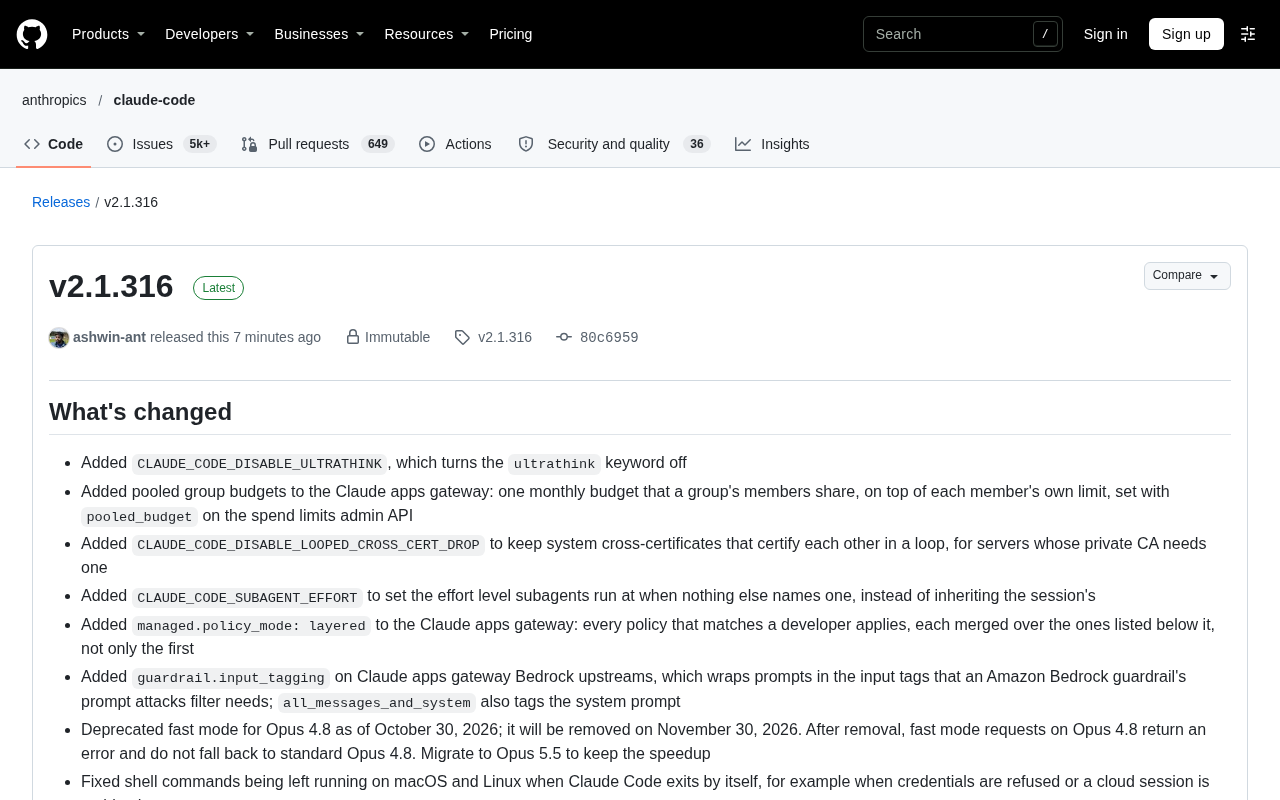
Claude Code v2.1.316 Update Analysis: Enterprise Gateway and Multiple Stability Fixes
Claude Code v2.1.316 released: new enterprise gateway pooled group budgets, layered policy mode, subagent effort control, dozens of Shell, network, and session recovery fixes, and Opus 4.8 fast mode deprecated.

17th-Century British Floods and Doomsday Panic: A New Perspective on Weather History
Based on a Hacker News discussion of '17th-Century British Floods and Foreboding,' this piece explores how extreme weather was given divine and political significance, and what weather history teaches us about contemporary climate communication.

Salesforce Acquires Rune for $375M: AI Logistics Tech Bolsters Defense Business
Salesforce reportedly acquires defense tech startup Rune for $375M. Rune's AI logistics tech will strengthen Salesforce's Missionforce defense platform, continuing its M&A spree.