LangChain for Beginners: Core Concepts and Three Major Application Scenarios Explained
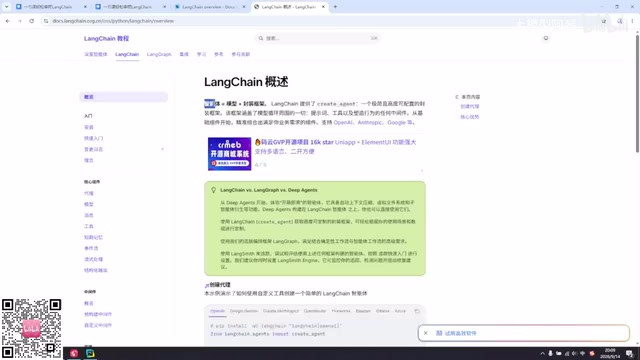
LangChain is a wrapper framework for driving large models; this article outlines its positioning, pain points it solves, and learning path.
Starting from the official equation "Agent = Model + Wrapper Framework," the article explains that LangChain doesn't produce models but, like Spring for web development, provides a toolchain and ecosystem for large models. It mainly solves three problems: getting post-training-cutoff information, connecting external data sources and internal systems (such as RAG), and managing context memory in multi-turn conversations. It also explains the name's origin from Lang and Chain and warns that the official Chinese docs are AI-translated with terminology errors and incomplete examples, recommending the English original. The learning path should center on the eight core components, running each with code—suitable for readers with Python fundamentals.
LangChain is often called the entry-level framework for large model application development. If you already know Python, it's usually the first tool worth picking up. The framework as a whole isn't very difficult, but it has many details. Based on the content of a hands-on tutorial series, this article helps you understand LangChain's positioning, core features, and typical use cases, and offers suggestions for a learning path.
What Is LangChain? Starting from the Agent Formula
The official documentation gives a clear equation: Agent = Model + Wrapper Framework. Here, "model" refers to large language models such as DeepSeekAd, Claude, Gemini, and GPT; "wrapper framework" corresponds to ecosystems like LangChain. In other words, LangChain itself doesn't produce models—it provides a toolchain that enables models to interact with the outside world, remember context, call tools, and ultimately form an Agent capable of solving real problems.
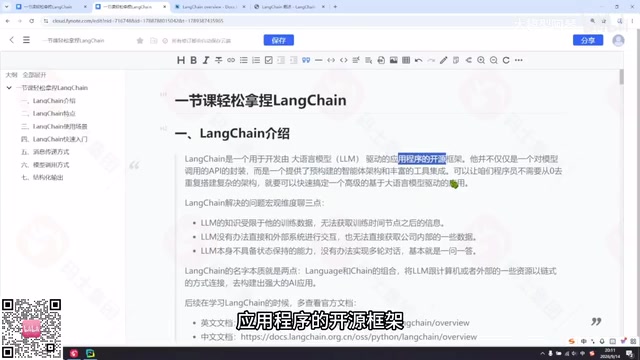
This is similar to Spring in the Java ecosystem: Spring helps you quickly drive web applications, while LangChain helps you quickly drive models. It wraps the model-calling APIs and integrates capabilities like tool calling, context management, and external data access, so you don't have to build complex architectures from scratch.
Three Core Problems LangChain Solves
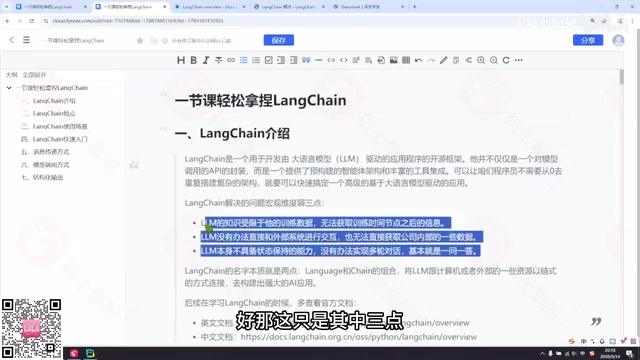
The model itself isn't omniscient. Its knowledge cuts off at the training time point—it doesn't know what happened afterward. More importantly, a pure model has no ability to proactively call tools or access the internet. LangChain exists precisely to fill these gaps. According to the tutorial's summary, it mainly solves three types of problems:
1. Getting Information After the Training Time Point
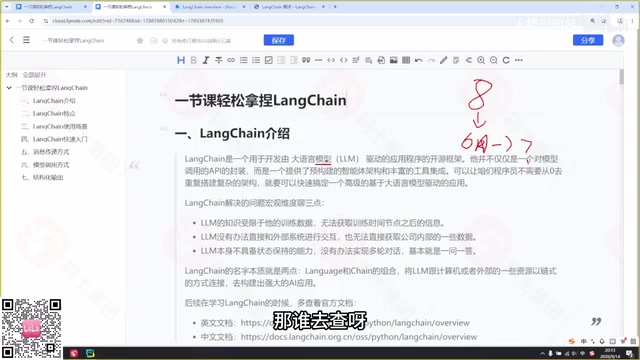
If you ask the model about something that happened after its training cutoff, it can't answer. The model knows it doesn't know, but it can't go look it up itself. LangChain can provide tools within its ecosystem to access the internet, letting the agent query the latest information on the model's behalf. It's important to distinguish: products like DeepSeek that you normally chat with directly are themselves agents with integrated internet access, not pure models; a pure model lacks this capability, and LangChain fills exactly this gap.
2. Connecting to External Data and Internal Systems
If you want the model to access your company's internal database, build a knowledge base (RAG scenarios), or trace information sources, a pure model likewise can't do it. LangChain provides components for connecting to external data sources, enabling the model to answer questions based on your private data rather than relying solely on its training memories.
RAG (Retrieval-Augmented Generation) is a technical architecture that combines external knowledge base retrieval with large model generation. Its basic workflow: first, private documents are split and vectorized into a vector database; when a user asks a question, the most relevant document chunks are retrieved first, then these chunks are spliced into the prompt as context and handed to the model to generate an answer. This way the model doesn't need to "memorize" private knowledge in its parameters, and answers can be traced back to the original documents. LangChain provides a complete set of components—document loaders, text splitters, vector stores, and retrievers—making RAG pipeline construction modular. Compared to fine-tuning, RAG only requires rebuilding the index to update knowledge, which is lower cost, making it the mainstream solution for enterprise knowledge base scenarios.
3. Managing Context in Multi-Turn Conversations
A pure model is one-question-one-answer: you ask, it answers; you ask again, and it answers based only on the current question without referencing what you said before. LangChain provides a context memory management mechanism that enables multi-turn conversations, allowing the model to "remember" prior text. Of course, you could implement this logic yourself, but LangChain makes it easier.
The tutorial also notes that these three are just the main directions—the actual capabilities go far beyond them.
Context memory at the implementation level is typically divided into short-term and long-term. Short-term memory stores the message history of the current session; common strategies include keeping everything, window-based truncation, token-based trimming, or summarizing and compressing history, to control prompt length and calling costs. Long-term memory persists key information to a database or vector store for cross-session retrieval. LangChain encapsulates these strategies through Memory-related abstractions and message history objects, allowing developers to swap different storage backends without changing business logic. Note that models themselves are stateless—so-called "remembering" is essentially re-splicing historical messages into the prompt on each call, so context window limits and costs are factors that must be weighed when designing conversation systems.
Origin of the Name and Learning Advice
LangChain is a combination of "Lang" (large language model) and "Chain" (chained). Its purpose is to connect models with the local computer or external resources in a chained fashion, ultimately building powerful agents.
During learning, the official documentation is the most reliable reference. The tutorial specifically reminds: the Chinese documentation is AI-translated and may contain terminology errors—for example, Agent was once mistranslated as "代理" (proxy), leading readers to mistakenly think a VPN was needed. In addition, the Chinese documentation's feature examples are incomplete, and some model examples (such as Gemini, Claude) have broken links. Therefore, it's recommended to study alongside the original English documentation and defer to English when uncertain about terminology.
Core Components: The Key to Understanding LangChain
The official documentation breaks LangChain into multiple core components; the tutorial mentions there are eight in total. Although the specific component list isn't fully expanded in the original content, it's clear that thoroughly understanding these eight core components essentially means grasping the main threads of LangChain. Subsequent learning should revolve around these components one by one in practice, running each small feature with code rather than just reading theory.
Chain is LangChain's most fundamental orchestration unit, referring to stringing multiple processing steps together in sequence or by condition into a reusable calling flow—for example, a chain of "prompt template → model → output parser." As the ecosystem has evolved, the official recommendation is to use LCEL (LangChain Expression Language) to compose components declaratively with pipe operators, which naturally supports streaming output, async, and parallelism. On top of Chain, Agent introduces dynamic decision-making: the model itself decides which tool to call and how many times based on user intent, rather than following a fixed path. Understanding the difference between Chain's static orchestration and Agent's dynamic scheduling is the key watershed for mastering LangChain's design philosophy.
Who Should Learn It? What's the Next Step?
LangChain suits learners who already have Python fundamentals and want to quickly get into large model application development. Its starter code is simple, the official documentation is solid, and starting with LangChain is a fairly universal path. After learning the basic concepts, you can further explore advanced features like tool calling and short-term context memory. Remember: read the official documentation more, run code hands-on more, and cross-reference the English original when encountering translation issues—this is the most effective way to avoid detours.
One-line Summary
LangChain is a wrapper framework for driving large models; this article outlines its positioning, the pain points it solves, and a learning path.
Paragraph Summary
Starting from the official equation "Agent = Model + Wrapper Framework," the article explains that LangChain itself doesn't produce models but, like Spring for web development, provides a toolchain and ecosystem support for large models. It mainly solves three problems: getting information after the model's training cutoff, connecting external data sources and internal systems (such as RAG scenarios), and managing context memory in multi-turn conversations. The article also explains that the name combines Lang and Chain, and warns that the official Chinese documentation is AI-translated with terminology mistranslations and incomplete examples, recommending study against the English original. For the learning path, focus on the eight core components in the official documentation and run through each with code—suitable for readers with Python fundamentals who want to quickly get into large model application development.
Related articles

Microsoft WebIQ: Verifiable Real-Time Web Grounding for AI Agents
Microsoft WebIQ gives AI Agents real-time, citable web grounding across web, news, images, videos, and Places—164ms P95 latency, 50% fewer tokens, Scopes source control, and MCP integration.

Augmentable Gaussian Splatting: Building Photorealistic Simulation Environments for Robot Training
Team combines Gaussian Splatting with meshes to build photorealistic robot simulation environments, integrating MuJoCo Warp physics and Franka Panda for augmentable, relightable real-site simulation.

Gemini 4 Carbon Released: The Leap from Gemini 3 to Gemini 4 in Under a Year
Google releases Gemini 4 Carbon, less than a year after Gemini 3. In the official demo, Carbon reverse-engineered the Theme Park binary, added a new DeepMind-themed ride, and ported it to the web in one shot.